

It takes quite a bit to make the overall gist of Homer’s legendary works uninteresting, but director Uberto Pasolini has somehow found a way to do so with the leaden paced and passionless anti-epic The Return. A scaled back reimagining of elements contained within The Odyssey, The Return wants to reduce mythology and history to its barest essence, but it can’t quite figure out how it wants to achieve that and how to do so without boring the audience to tears. There are good performances to be found within The Return, and the idea isn’t a terrible one on paper, but in terms of execution, the scope and drive of Pasolini’s film is severely lacking and incapable of generating even the most modest of intellectual or emotional investment from viewers.
After fighting the war in Troy for ten years and being lost at sea for just as long, warrior king Odysseus (Ralph Fiennes) washes up on the shores of his homeland, naked and halfway to death. His disappearance and lack of news as to his whereabouts have created a power vacuum on the island of Ithaca, turning his wife, Penelope (Juliette Binoche), and son, Telemachus (Charlie Plummer), into prisoners. Various scoundrels, con artists, and killers have arrived or arisen to try and claim the queen as their bride to take control of the throne, but Penelope won’t budge. Unrecognizable due to the ravages of war and time, Odysseus returns unnoticed to a vastly different Ithaca than the one he left behind, and proving himself to be the former king will take a lot of skill, cunning, and violent action.
It also takes a lot of credibility straining waiting around, which is the biggest problem with The Return. The script from Pasolini, the late Edward Bond (Walkabout, the English dialogue for Blow-Up), and John Collee (Monkey Man, Master and Commander: The Far Side of the World) wants to depict Odysseus’ struggles and trials as basically and realistically as possible. It’s always a gamble to strip famous stories back to their bones and then rebuild the flesh and muscle from scratch, but Pasolini (Nowhere Special, Still Life) never erects anything dynamic atop the structure, leading to a film that feels more ridiculous than any bombastic version of The Odyssey ever could. The fact that Pasolini’s film is lacking in visual grandeur and bloodlust isn’t the issue. The fact that there’s nothing to fill a major void in this reconfigured narrative is.
The tone being set is adequate for the type of unconventional revenge thriller that Pasolini is going for with The Return. Pasolini isn’t big on action, and even the gory denouement is restrained, but the solemnity is on point. There’s an eerie brutality, sense of deprivation, and pervasive hunger, both literal and in terms of the lust for power amongst the island’s male population. The vibes would land a lot better if Pasolini knew how to properly implement Rachel Portman’s score, with some scenes coming across as unsubtly heavy handed and others that should be rousing playing to ill advised, peculiar silence.
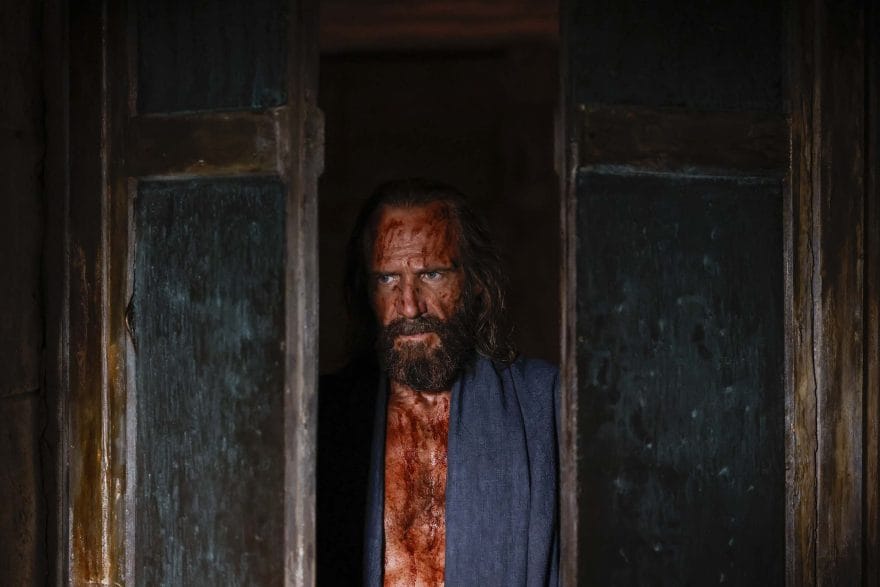
And the whole thing would work better if The Return didn’t always feel like it was wasting every minute allotted to it, conflating an almost full two hour running with a genuine sense of depth. This is a narrative based entirely on stalling for time. Instead of creating an intricate plot where multiple suitors are fleshed out and Odysseus has to contend with a variety of personalities, most of the villains, save for Marwan Kenzari’s suitably slimy Antinous, have no layers or genuine sense of malice beyond being run of the mill jerks. Binoche is saddled with the grieving, but strong willed wife character, which she plays wonderfully, but is the kind of thing that doesn’t allow the actress to stretch very much. Plummer is stuck playing a frustrated, whiny brat who seems written for a younger actor. And Fiennes – boasting an impressive physique once he takes his rags off – brings all the gravitas he can muster up in a losing effort. The four leads of The Return are doing all they can in a losing effort, but none of the blame can fall at their feet.
It starts and ends with the script and direction of this thing. The Return frames Odysseus’ return to power in something akin to his Trojan Horse plan: sneak in unannounced, gather intel, feign weakness, and wait to strike. To a degree that makes sense, since no one other than Odysseus’ former housekeeper (Angela Molina) recognized him immediately, and because the optics of him being the sole survivor of the Trojan War will make him wildly disliked among the people. But without any additional depth to the situation and players, Pasolini’s film ludicrously forces Odysseus to wait a laughable amount of time before taking action. The entire plodding time, all the viewer can think about is how there has to be better ways of implementing his plan than simply observing the whole bunch of nothing special that’s going on. The power plays in The Return have no impact because the viewer hasn’t been given much reason to care about the players involved. Even the film’s most exciting sequences take an eternity to play out, draining them of any sense of amusement or impression. The Return is as passive as supposedly epic filmmaking gets. The film, like its hero in the events leading up to this point, is hopelessly lost at sea without any sense of direction other than to float along on a lack of currents.
Homer understood that the point of an epic is to balance scope and force, which is why it remains one of the greatest novels ever created, centuries after it was written. Many who try to attempt such an adaptation will luxuriate in the very primal nature of the emotions in play or the historical implications and modern subtext that abounds. There’s very little emotion in The Return, precisely zero subtext, and Pasolini is certainly luxuriating, but only on the script’s sense of unearned importance. For a film that takes inspiration from one of the bedrocks of literature, The Return has curiously little spark of its own. There’s a good idea for an approach here, but the execution is sorely lacking.
The Return opens in select Canadian cities on Friday, December 6, 2024.
