

Durga Chew-Bose’s adaptation of Françoise Sagan’s novel Bonjour Tristesse scales back its source text to the bone and finds great specificity in silence. Whether showing the longing, jealousy, rage, sadness, or glee at the heart of her characters, writer-director Chew-Bose uses subtlety to tell the story of people aching to be seen and valued by everyone around them. Bonjour Tristesse presents itself in ways that feel both classically influenced and modernly formatted, which sometimes leads to a disconnect between the flowery, prosaic dialogue and the content of the story, but most of the time it weaves an entrancing spell over the viewer, bringing them gently into a story driven by spite and passive aggressive revenge and ushering them out as softly as they went in.
18 year old Cécile (Lily McInerny) is summer vacationing with her father, Raymond (Claes Bang), and dad’s new girlfriend, Elsa (Naïlia Harzoune), on the French seaside. Cécile spends most of her days in a bathing suit, swimming, sunning, supping, and hooking up with her summer fling, Cyril (Aliocha Schneider). The family’s quiet, sun soaked bliss is shaken up a bit by the impending arrival of Anne (Chloë Sevigny), a successful American fashion designer who was best friends with Cécile’s late mother and has always harboured deep feelings for Raymond. While cordial and somewhat captivated by Anne, Cécile thinks that her presence isn’t fair to Elsa, who starts to become a third wheel in her own relationship. In fairness to Anne, she was unaware that Elsa would be there, but once Cécile suspects there are ulterior motives for this visit, the younger woman concocts a cruel bit of subterfuge.
Bonjour Tristesse was most famously adapted for the screen by Otto Preminger in 1958, but Chew-Bose follows her own path away from both that film and the source material. While Chew-Bose clings onto dialogue that sometimes feels inorganic in all the wrong ways for something set in more contemporary times, for the most part Bonjour Tristesse gets the marriage of setting, characters, and performances spot on. Chew-Bose values the viewer’s ability to put two and two together and figure out what’s actually being said between the lines, not simply what’s being fed to them as exposition or through banter. Bonjour Tristesse is complex, but relaxed and assured in its approach, gently coaxing reactions out of characters and their audience instead of making hard dramatic pushes.
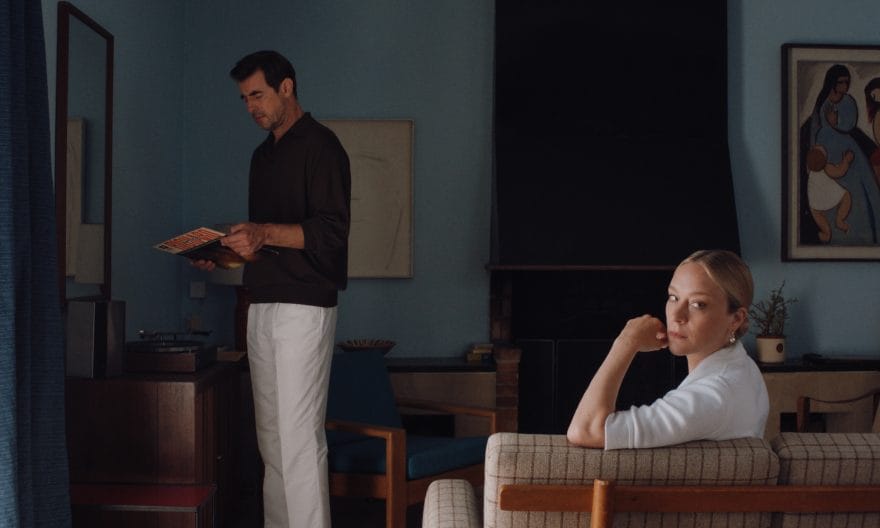
The women of Bonjour Tristesse are particularly adept at conveying more with glances and actions than words. Each of the actresses are able to conjure up complicated feelings within the viewer. Harzoune is likeable, but one can see a darker side to her easy going character. McInerny’s actions are made immediately understandable by the performer’s decision to play the character properly like a young adult still trying to figure out the world and navigating difficult emotional terrain. Sevigny also manages to find balance between her character’s outward confidence and success with a deeper inner sadness that makes her profoundly empathetic.
Whether through instinct as actors or the direction of Chew-Bose, the film is able to showcase implied behaviours and feelings through simple gestures that speak volumes to the characters, be it the eating of an apple, the tightening of a hair bun, the unravelling of headphone wires, or putting on a necklace. The subtle actions of Bonjour Tristesse speak volumes, and when the story finally does shift into an examination of cruelty – both conscious and unconscious – Chew-Bose does so without judgment and carries on in a thoughtful, touching manner.
Visually, Bonjour Tristesse looks the part of an opulent, secluded vacation: sunny skies, stunning architecture, sparkling waters, picturesque cliffs. But there’s also a pronounced haziness to cinematographer Maximilian Pittner’s images that match the cloudy emotional tone. While I’m not sure it works for the entire movie, it does amplify certain sequences nicely. Throughout, the film captures the dizzying warmth and sticky discomfort the “season of love” can bring.
Chew-Bose has put a lot of thought into the thematic weight of Sagan’s source and it shows, leaving a lasting impact on the viewer. What constitutes a fling and what is lasting love, and which can be more valuable and emotionally stabilizing? Actions have consequences in Bonjour Tristesse, and through this sense of cause and effect, Chew-Bose keeps the viewer on their toes, making them question just how much they knew about these characters from the start. Everyone in Bonjour Tristesse is meant to be perceived in specific ways, only for the film to challenge those notions. It’s an impressive directorial debut for Chew-Bose, making her someone worth keeping an eye on going forward.
Bonjour Tristesse opens in select Canadian cities on Friday, May 3, 2025.
