

Canadian writer-director Jason Buxton’s Sharp Corner is a rarity these days: a wholly original film that occupies its own space in terms of tone and content. A moody character piece with flashes of coal black comedy and unnerving thriller elements, Sharp Corner (based on a short story by Russell Wangersky) defies easy categorization, but invites plenty of rich interpretation. Not only does Buxton want the viewer to engage with some dark material and themes, but the filmmaker also refuses to put words directly into the audience’s mouth. It’s a big leap of faith on the part of Buxton, but for those willing to parse the small details, Sharp Corner is as rewarding as it is chilling.
Josh McCall (Ben Foster), his therapist wife, Rachel (Cobie Smulders), and their young son, Max (William Kosovic), have just moved into a new home on a quiet suburban street. Things seem good for them on the surface. Rachel is getting back into the swing of her practice after maternity leave. Max is a bright boy starting school. And while Josh is low key annoyed that he got passed over for a promotion at work, he remains loving and attentive as both a father and husband. But the family’s solid foundation is rocked on the first night in their new home, when a violent car crash unfolds on their front lawn. Josh immediately identifies the problem as a sharp turn in the road just to the side of the property line. Rachel and Max are shaken by the incident, but Josh develops an unhealthy obsession with keeping an eye on the turn. After more crashes happen, Rachel wants to leave, but Josh doubles down on his desire to stay, hoping that he can somehow – with only a minimal amount of training – be the first responder to an accident in an area where professional help could be slow to arrive. He begins to watch impatiently out the living room window, waiting for his moment to shine.
With Sharp Corner, Buxton (delivering his first feature since 2012’s Blackbird) wrestles with the sometimes odd and unhealthy ways that humans become fascinated and repulsed by death; some willing to run towards the danger while leaving others – even those tangentially or barely involved – with lasting scars. At first, it appears as if Buxton wants to examine an unusual awakening within Josh, who initially dips his toe into the dark side of human behaviour by looking into the lives of people who’ve passed away in front of his house. But instead of examining why Josh develops such a fascination on a granular level, Buxton’s detailed direction and script lead in a different and more sinister direction.
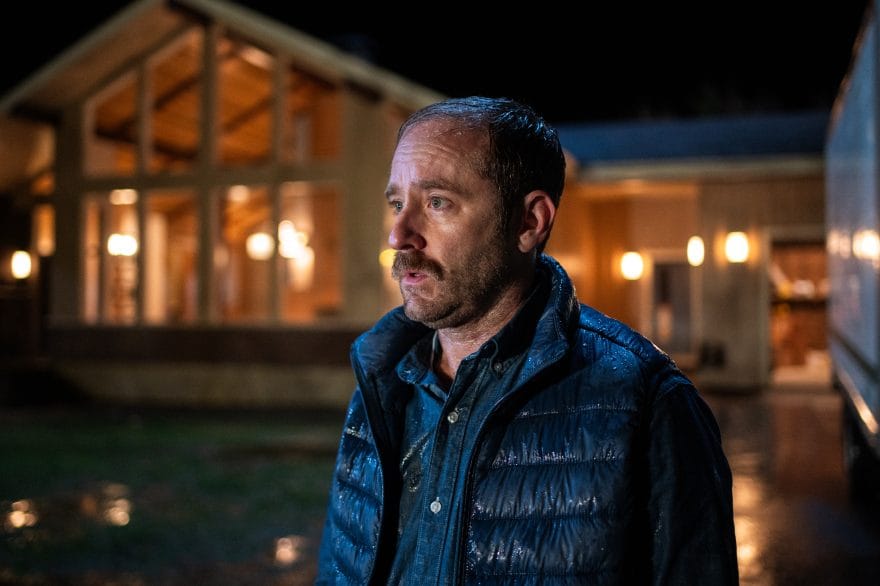
What starts out as an examination of a family under stress and a fixation upon death and trauma becomes one of the most darkly thought provoking looks at a mid-life crisis in recent memory. Buxton gives Foster all of the details, but the actor brings the character to uncomfortable light through pitch perfect posturing and an unwavering dedication to portraying Josh as perpetually meek, sometimes allowing for some moments of cringe comedy (especially during the film’s cheeky conclusion). As Josh starts to develop an undeserved hero complex, he grows openly deceitful and contemptuous towards his wife and son, retaining his unassuming appearance and mousy, quiet voice, but adopting a more menacing sense of self-worth and self-importance, almost as if he thinks he’s somehow above his family. It’s clear that Josh isn’t the brains or the heart of this family unit, but he certainly thinks he is, and this quest to somehow become “heroic” will give his humdrum life meaning and fill a void that he doesn’t openly discuss with his wife. Foster delivers a commanding performance that’s just as rare as the film built around his character: the story of a person who isn’t all that special trying desperately to feel relevant. He never shares his true feelings, but he clearly harbours a belief that his life has been a waste, despite having a great family, stable job, and plenty of privileges that suggest otherwise.
Buxton and Foster slowly build Josh’s sociopathic toxicity disguised as altruism like the details are coming from an IV bag, but the supporting performances of Smulders and Kosovic offer balanced, necessary counterpoints to the main character’s mounting madness. Smulders, in her best performance yet, plays an intelligent wife and mother who wastes little time realizing her husband is on a dangerous path and makes healthy choices for the sake or her child. It’s hard to play a character that’s a therapist in a movie with so many psychological implications, as many writers and filmmakers use them as shorthand to convey complex emotions and plot points rather than showing them to the viewer, but Buxton and Smulders make Rachel into a full bodied human being. It’s not a therapist plunked into the middle of a psychological thriller, but really like watching a therapist realizing they’re in a bad situation of their own and never giving into storytelling cliches. And a tremendous amount of praise should go to young Kosovic, who plays a part that would be difficult for a performer of any age and delivers revelatory work. It’s one of the best turns from a young actor in this or any other year.
It’s up to the viewer whether or not they choose to view the character arc at the centre of Sharp Corner as chilling or tragic, and falling into either category depends entirely on willingness to think about the purposeful gaps in Buxton’s storytelling. If a viewer chooses to dismiss this film as another “men will do literally anything to go to therapy” meme come to life, they’ll get very little out of Sharp Corner. If you dismiss Josh as a fully formed creep from the start, you’ll likely miss the point. As it grows in darkness and malevolence, observant viewer’s opinions on the character likely won’t change, but their perception of the situation at hand will constantly become redefined. Buxton doesn’t want to push a viewer’s face into Josh’s muddy, skid-mark covered lawn, but he asks the viewer to open up to asking questions the character can’t ask of himself. Even on a visual level, with slow pushes, pans, and a chilly demeanour, Sharp Corner is built upon the smallest of details that build to an emotionally large film. The character of Josh McCall is steeped in misery, but in spite of the bleak subject matter, the film built around him is not; provided that one is willing to look beyond the obvious.
Sharp Corner opens in Canadian theatres on Friday, May 9, 2025.
