
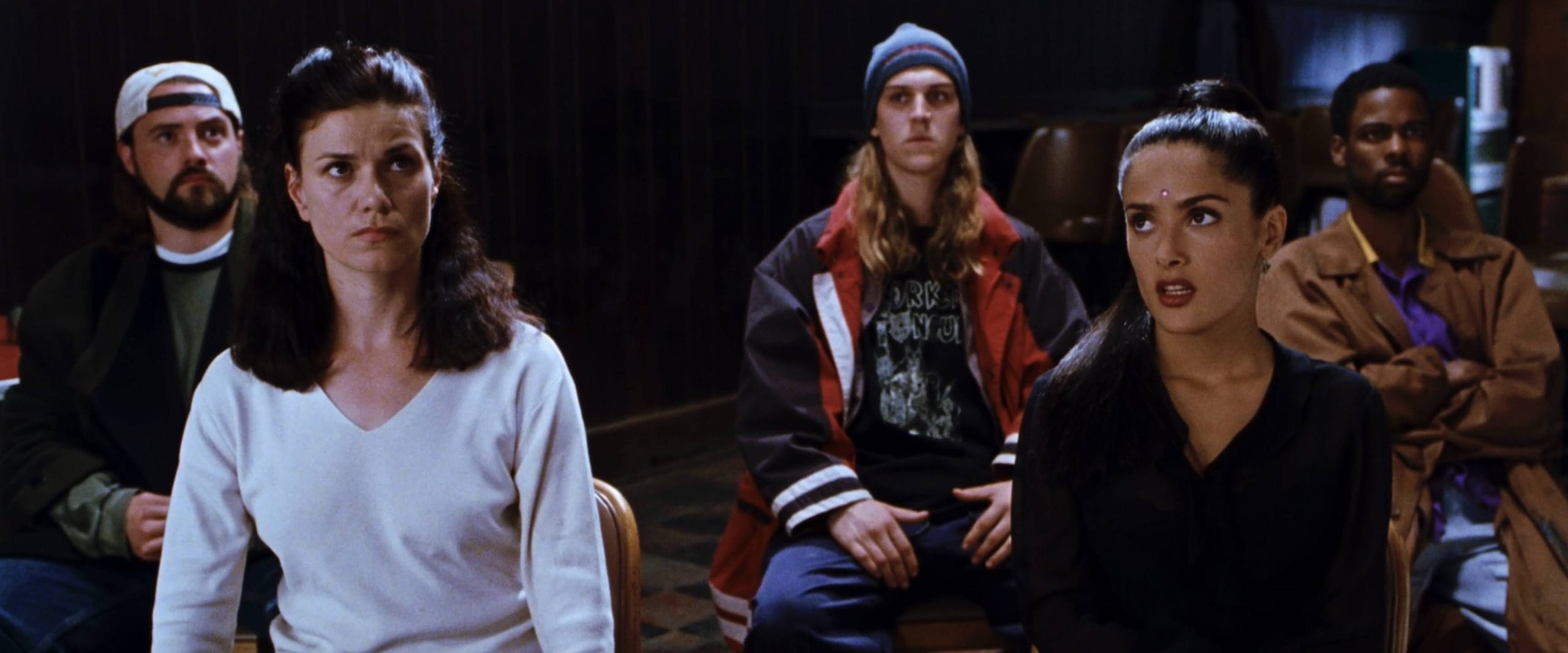
Kevin Smith has never made a movie that wasn’t personal. Okay, maybe Cop Out wasn’t a personal passion project in any way (more of a well intentioned misfire meant to scratch a certain filmmaking itch), but he still had reasons for making it. His best known efforts – whether loved, divisive, or widely disregarded – are always the work of someone who has a deep emotional connection to their material. They always come from the heart. And of all the films in his decades long career (one that keeps going after a surviving a major health scare and subsequent lifestyle change), 1999’s Dogma remains the very best. Next to his landmark, indie darling featured debut Clerks from 1994, Dogma is the film Smith’s legion of fans, admirers, and viewers will likely point to as a career defining work. If you want to know exactly who Kevin Smith is and the type of movies he makes, Dogma is a great place to start, and in some cases end. Not because Dogma was the last good movie he made, but because it’s the perfect distillation of what it must be like to living inside the proud New Jersey native’s head.
Dogma – which has been remastered in 4K under the supervision of cinematographer Robert D. Yeoman (who has shot most of Wes Anderson’s films) and is seeing a wide theatrical re-release this weekend – blends Smith’s high and low brow sensibilities perfectly. It’s a smart, incisive conversation between a filmmaker and their audience about religious faith and man’s inhumanity to man told with sojourns to strip clubs, giant poop monsters, weed references, bloody killing sprees, and a sailor’s ability to curse up a storm. It was – to that point, and still might be today – his biggest and most expansive production, boasting some impressive set pieces, a wide array of visual effects trickery, and an all star cast that no one could afford today if they tried to get the same people. In fact, Smith and company could barely afford all the talent back then.
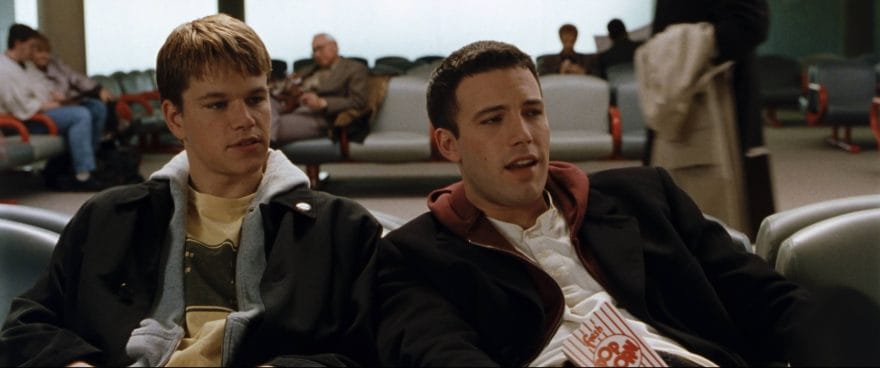
The plot revolves around the comedically violent exploits of Loki and Bartleby, played by Smith regulars (and by this point bonafide, Oscar winning megastars) Matt Damon and Ben Affleck, two people who always bring out the best in each other on screen. Loki and Bartleby are troublemaking, shit disturbing, fallen angels, cast out of heaven by a pissed off God for dereliction of their duties, exiled to Wisconsin for all of eternity as punishment. Bartleby receives word via a mysterious letter that a Catholic church in New Jersey is about to celebrate its centennial with a unique twist. By way of a papal decree, anyone who passes through the arches of this church will be forgiven of all their sins, no questions asked. It’s an arcane, obscure practice known as Plenary Indulgence. The plan is to cut off their wings (which they keep hidden), thus making them human and able to be forgiven of their sins. They walk into the church, they walk out of the church, they die, they get back into heaven where they think they belong.
But that’s a problem for all of humanity. If Loki and Bartleby succeed, they expose a massive loophole between God and the Catholic church; one that will prove the big person upstairs’ fallibility, undoing all of existence in the process. On top of that, God has somehow gone missing. (It makes sense in the context of the film.) The voice of God (played by Alan Rickman, in one of his most memorable roles) comes to Earth to charge The Last Scion with a holy quest and stop these angels from reaching New Jersey. Only problem is that this famed, mythical crusader is Bethany (Linda Fiorentino, whose talent for understated snark is put to perfect use here), a jaded worker at an Illinois women’s health clinic whose faith in God is hanging on by a thread. Needing a ton of convincing that any of this is real and that she’s the right person for the job, she’s aided in her quest by an inept pair of prophets – Jay and Silent Bob (Jason Mewes and Smith) – and the forgotten thirteenth black apostle, Rufus (Chris Rock).
Those who remember the film’s release in 1999 also are likely to recall the controversy that surrounded it. Holy rollers – not just the Catholic ones – were up in arms about the film’s comedic and sometimes rather violent tone as being blasphemous and defamatory. (In hindsight, Dogma proves to hint at some action and horror related elements that Smith would return to in the likes of Tusk and Red State.) The studio that was originally tasked with putting the film out – the Bob and Harvey Weinstein run Miramax – was a subsidiary of Disney at the time, and the Mouse House had no intention of courting such bad press amongst the faithful. A shell company was quickly created – with Lionsgate helping with the theatrical release and Sony taking home video duties – to bring Dogma to the masses and Smith’s devoted, steadily growing audience.
This re-release is notable because the rights to the film belonged to Harvey Weinstein outright, effectively holding the film hostage and keeping it out of circulation on DVD, Blu-Ray, and streaming platforms. Next to Ron Howard’s Cocoon, Dogma was probably the most noteworthy mainstream/hit film to go out of print for an extended period of time. With the help of another independent producer and due to Weinstein’s never ending legal troubles, Smith was able to get the rights back recently and give the film a proper make-over. Naturally, like most aspects of his career, Smith has spoken about these trials extensively, and he’s probably better equipped to break down what happened than anybody else.
While not all of Dogma has aged well (particularly some of the dialogue, which at times gets wince inducing with its shock value, and its admittedly overstuffed plot), the film rightfully remains one of the most talked about movies from a landmark year in cinematic history. The controversy that initially erupted when the film finally made it to theatres in November of 1999 (following a premiere at the Cannes Film Festival earlier in the spring and screening at TIFF in September), died down in much the same way that hubbub surrounding the likes of The Exorcist and The Last Temptation of Christ subsided once the frothing, myopic detractors actually saw and heard about what the movie entailed. And much like Friedkin and Scorsese’s more artful critical darlings, Dogma is a pure and attuned work of what we like to call “faith based cinema” today, and a much more balanced, earnest, and philosophical version of such films than Christian audiences are subjected to these days. Friedkin once said that a film like The Exorcist couldn’t be made by someone who didn’t believe in what they were depicting, and Scorsese is, like Smith described himself, a Catholic. Dogma is the work of someone wrestling with their faith through their art; posing questions that some might find hard to broach in an institution that often asks for blind loyalty.
Although Smith produced Dogma before the landmark 2002 investigation that brought to light widespread sexual abuse within the Catholic church and none of that is mentioned here as a result, the filmmaker isn’t afraid to drag the seedier side of religious faith into the light. The nature of blind forgiveness and the Catholic belief in wiping away sins with ease drives the plot and forces the viewer to think about the implications of such tenets. The role of marginalized people in organized religions (people of colour, women, the downtrodden, the dying) are examined in heartfelt, empathetic detail that gives Smith’s story a pronounced sense of investment. The line between good and evil is often blurred because of atrocities carried out in the name of God and the deity’s reluctance to step in and intervene. Smith also notes that there’s not much different these days between a megachurch (run by the late George Carlin’s huckster Cardinal Glick, who’s the definition of style over substance) and a Disney-styled mega-corporation that creates false idols. And in his depiction of God, Smith presents the creator as a woman, but carefully and wisely describes the deity as nonbinary, which is one of the first times I ever remember seeing such a treatment on screen.
With the exceptions of a couple of blips along the way, Dogma plays like a contemporary film, not a nearly thirty year old production. Although Smith approaches Dogma from the Catholic perspective that he knows best, this examination of religious zealotry and people (or in this case, rogue angels) doubling down on their worst impulses and opinions plays perfectly in today’s divided and widening cultural climate. On screen, Smith is playing a prophet of sorts, but as a filmmaker he calls attention to issues of faith that will never go away, asking viewers to keep believing while acknowledging holes and prejudices in the church’s core beliefs and history. In spite of all of its irreverent humour, one could easily describe Smith’s work as low-key Pollyanna-ish, but maybe that’s what the world needs sometimes in order to question the nature of the world around them. With Dogma, Smith puts in the work to make something inherently unknowable and questionable into a down to Earth modern parable about the nature of being a good person in the face of overwhelming apathy and malice.
Dogma comes back to theatres starting Thursday, June 5, 2025.
