

Danny Boyle and Alex Garland’s long awaited 28 Years Later is an unexpected surprise, in both good and bad ways. But whether or not it connects with those who waited with baited breath for another instalment in their outbreak based breakout horror franchise remains to be seen. A dreary, dire, dour affair, 28 Years Later moves at a much slower pace than its predecessors, 28 Days Later and 28 Weeks Later, preferring long passages discussing what it’s like to come of age in an apocalyptic war zone and how humanity and empathy has been bred out of the people stuck in England amid the spread of the “rage virus.” At times heady and surreal instead of straightforward and dynamic, 28 Years Later wants to challenge its audience to some extent, but those more artful and philosophical touches often run counter to a story about family togetherness and bonds that’s admittedly hokey and overblown. It’s a movie that’s more interesting than it is great, but also not something that will easily evaporate from memory.
The UK has become a locked down quarantine zone. No one can get in or out of the country, as the rest of the world has successfully beaten back the virus and left the island region for dead. After opening with a bravura sequence where an entire family is attacked and slaughtered – kids and all – 28 Years Later joins up with an established enclave of survivors living on an island off the coast of Scotland, which is connected to the mainland via a causeway that can only be accessed during low tide. Father Jamie (Aaron Taylor-Johnson) has been grooming his twelve year old son Spike (Alfie Williams) to be a hunter-gatherer for their people, about to take the young man on his first trip to the mainland against the strenuous protestations of his gravely ill mother, Isla (Jodie Comer). While things don’t go perfectly to plan on their mission, Spike learns about the existence of a mysterious doctor on the mainland. Spike thinks this doctor could help Isla’s condition, but Jamie forbids him from taking her. Spike doesn’t listen and makes a break for the mainland again with mother in tow to try and save her life.
Director Boyle and writer Garland (returning to their roles after passing off 28 Weeks Later to other creatives) have put a lot of thought into the logistics of how the world has changed since the onset of the virus. Resources have been further depleted, nature has reclaimed large swaths of the formerly populated landscape, and the infected themselves have evolved and adapted in various ways (including obese, slowly creeping worm eaters and ultra-strong, super-fast alphas). But Garland and Boyle are more compelled to tell a story about how humanity has lost all sense of compassion. Teaching a child to kill is now a rite of passage worthy of grand celebration. Schools are run with military styled protocols. Every band of surviving humans has begun to feel like a cult. Survivors have stopped caring entirely that the infected they take such pride in slaughtering were once humans themselves.
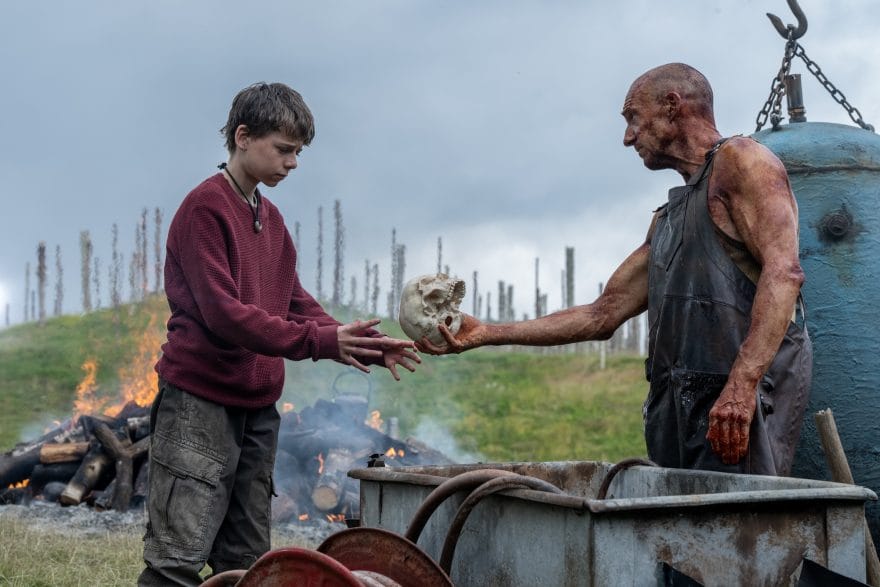
Boyle and Garland take things to a bleaker level thanks to the isolated nature and demeanour of the material, making for a stylistically dazzling, but slow burning film. Once again working with frequent cinematographer Anthony Dod Mantle and shooting largely handheld, Boyle goes for broke with the imagery here. Towering piles of bones, wide expanses of stars in the sky, and the vapour trails of built up gasses in a building add a surreal element to 28 Years Later that bursts into full on fever dream mode once Ralph Fiennes’ mysterious doctor finally shows up just around the three-quarter mark. The world has become unreal, and through a variety of gory theatrics and visual effects ingenuity, Boyle has found a way to make the downfall of humanity both artful and chaotic. Strangely, the film reverts back to the kind of frenetic editing style of the first franchise entry, and it doesn’t tonally work all that well with the reserved vibe Garland’s material calls for here.
28 Years Later is a classic Boyle freakout on a visual level, but it’s very much an Alex Garland movie in terms of storytelling. By focusing on the exploits of someone who’s still just a kid, Garland weaves a messed up, modern day fairy tale quest where a naive hero has to interact with a wide variety of dangers and eccentric personalities along their way. Thematically, Garland’s proclivity for documenting humanity’s worst impulses remains intact, but 28 Weeks Later also feels more spiritually close to the likes of Boyle’s morally complex crowd pleasers like Slumdog Millionaire and Millions, which were also built around young people trying to navigate tough situations. Something here isn’t gelling all that well, and the story of a young man trying to save his mother’s life is handled at some turns with maudlin platitudes about growing up and maturing. 28 Years Later can be very corny, sometimes to eye-rolling degrees in its later stages, and the severity of the situation at hand leads to a tonal disconnect throughout.
Despite being the fourth billed performer in the cast (just behind an actor who only pops up for the film’s absolutely bonkers, ill fitting coda, which builds a bridge to the next sequel, currently due for release in January), 28 Years Later is Williams’ film outright. It’s up to Williams to propel the action and act as the audience surrogate in this nasty world, and the young actor delivers a tremendous performance. It’s Williams’ efforts that make the difference between 28 Years Later being a well intentioned misfire and something good. Comer goes a bit over the top as Spike’s unwell mum, but in a few scenes where the character has some clarity, the actress shines. Johnson skews a bit one note as the problematic father figure who’s set in their ways and seemingly doesn’t want his wife to get the help she desperately needs. And while it takes awhile for him to show up, Fiennes gives a playful and surprisingly warm turn as the slightly mad, but deeply kind doctor our heroes are searching for.
The balance of bleakness and sentimentality throughout 28 Years Later is always off kilter, but the best moments of the film reach their intended emotional levels. Horror fans who like buckets of gore will have a handful of moments to satisfy their bloodlust (and Boyle isn’t above a good, old fashioned jump scare every now and again), but this will likely appeal more to genre buffs who prefer their movies to have a more thoughtful bent and outlook. 28 Years Later isn’t the film a lot of people who’ve been waiting for decades will be expecting, and I’m not convinced it’s the one everyone in that camp wants. Refreshingly, Boyle and Garland are carving their own path instead of playing it safe, and they’ve been allotted a great amount of resources to pull it off. The results aren’t perfect, but they’re something to behold just the same.
28 Years Later opens in theatres everywhere on Friday, June 20, 2025.
