

Amid renewed American interest for the Japanese icon and before the international critical and commercial success of Oscar winning period piece Godzilla Minus One, there was 2016’s game changing and franchise revitalizing Shin Godzilla, returning to theatres this week in a 4K remaster. Released two years after director Gareth Edwards’ exceptional, American produced re-boot and a whopping twelve years after famed studio Toho’s previous effort (the fun and campy Final Wars), Shin Godzilla paved the way for more serious, but still spectacular fare featuring the supreme, city destroying creature. If it slipped by you the first time around (as it has been out of print in North American on DVD and Blu-Ray for awhile now and the theatrical release in the same region was limited), this is the perfect time to catch up with such a wholly unique monster mash.
Shin Godzilla starts off in a fashion similar to other films starring the “god lizard.” The earth trembles, steam rises from the ocean, and eventually a radioactive creature emerges that begins laying waste to surrounding cities and towns, carving a path of destruction that leads straight to Tokyo. The creature is evolving at a rapid rate, starting out as a malformed, bug-eyed, awkward looking beast that spews blood from its gills, then becoming an unstoppable beast, and finally an even more destructive force capable of producing deadly radioactive beams from its mouth. This is all standard Gojira territory and a classic kaiju storyline, but writer/chief director Hideaki Anno (Shin Kamen Rider, Evangelion 3.0 + 1.01 Thrice Upon a Time) and VFX director Shinji Higuchi (Shin Ultraman, Bullet Train Explosion) have found a way to balance satirical substance with disaster movie melodrama.
While the haunting memories of the 2011 Fukushima nuclear disaster are just as present in Anno’s film as they were in Edwards, the focus of Shin Godzilla is placed on the unbending nature of governmental bureaucracy, which makes it hard for anyone to respond to the monster’s threat in a timely manner. Shin Godzilla features hundreds of speaking roles (most of which are only on screen to move things along for a single scene, never to be heard from again) and moves along at a snappy pace for a film that speaks to the slowed down nature of ineffective and inefficient government.
Pulling inspiration from the staccato, walk-and-talk nature of Aaron Sorkin’s writing (with The Social Network brought up as a specific point of comparison by Anno in interviews, and boasting healthy hints of The West Wing), Shin Godzilla is the fastest anyone has ever seen people moving slowly; terrified of stepping on the toes of other departments and even more afraid of making the wrong decisions without consultations. Who should be in charge of the response? What are the rules of engagement? Should operations be handed over to foreign interests better equipped to deal with the threat? Should the beast be destroyed or sedated and kept for research? No one can agree on how to respond or even what’s the top priority here.
Bureaucracy can be a great thing, capable of fostering equality and establishing a system of rigorous checks and balances. But when it comes to anything revolving around crisis mitigation and disaster relief, those systems slow to a crawl. Anno focuses on a trio of characters doing their best to speed up the process: the head of the response task force (Hiroki Hasegawa), an advisor to the Prime Minister (Yutaka Takenouchi), and a special American envoy (Satomi Ishihara) who has to convince her superiors to not step in and use destructive nuclear force. They have to keep going long after it seems like hope is lost and all others have given up, and the actors provide a much needed human face to a variety of different governmental systems and departments. It’s less a race against time thriller, and more like the Godzilla equivalent of a procedural, which is a fascinating take on familiar material, amounting to the most thoughtful entry in the franchise since Ishir? Honda’s 1954 original.
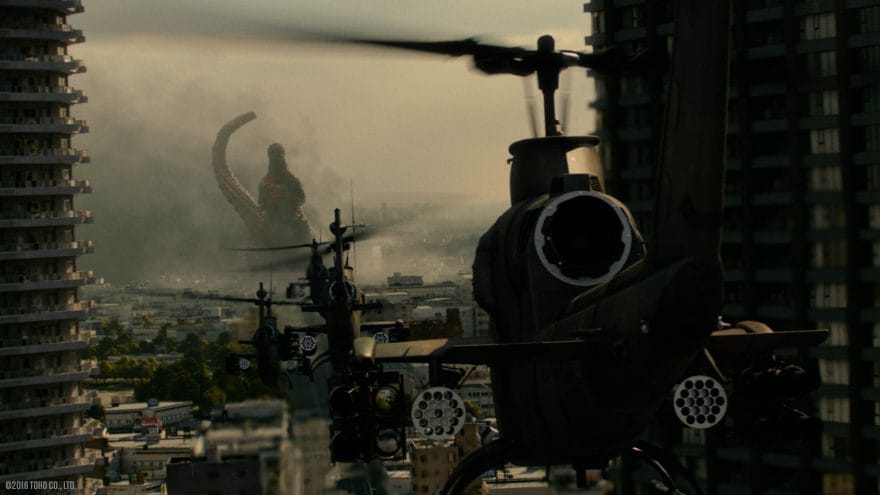
But that’s not to say that the epic action and destruction isn’t enviable. Higuchi’s breathtaking depictions of the monster and its path across the country is filled with top notch effects that can appear frighteningly realistic. Godzilla has never looked more unsettling (especially when it first emerges from the ocean). Fans who appreciate seeing buildings toppling, bridges crumbling, helicopters crashing, and rivers swelling will get plenty of eye candy to offset the fact that a large majority of Shin Godzilla takes place in boardrooms, legislatures, and offices. Once the classic Godzilla theme hits, savvy viewers will know that business is about to pick up in a big way. The pace and the pulse quicken and time is of the essence. Shin Godzilla is a special film worthy of seeing on the big screen, one where the moral choices being faced are just as scary as the well known villain causing chaos anew.
Shin Godzilla re-releases in theatres on Thursday, August 14, 2025.
