

The Perfect Neighbor is director Geeta Gandbhir’s documenting of American morality and friendliness in tragic free-fall. Taken almost exclusively from primary resources The Perfect Neighbor is a shudder inducing piece of documentary filmmaking that explores trauma, mental illness, racism, and (most pointedly) the shortcomings and fallacies of “stand your ground” laws in select states. Although it fully unfolds over the course of a couple of years in Ocala, Florida, The Perfect Neighbor has the immediacy and punch of something that feels like it’s unfolding in real time, and the tragic weight of something that the viewer knows is impossible to stop in hindsight.
Back in the early 2020s, sixty year old, self-described “perfect neighbour” Susan Lorincz lived in a rental home on a tight-knit, once easygoing residential street, filled with families with numerous children who traditionally played in a grassy, empty lot next to her house. Lorincz couldn’t stand these kids “screaming their fool heads off” and generally playing around so close to the house. Lorincz, who in no way owned any part of the field, would put up trespass notices, scream at any kids and parents who came too close, and would frequently call the Marion Country Police Department to suggest that her life and wellbeing were being threatened by a bunch of eleven year olds playing football or walking their dogs. Lorincz’s temper and fear worsened over time, eventually leading to her purchasing of a gun that she would wave around to scare the kids. In the summer of 2023, 35 year old black mother of four Ajike “AJ” Owens would cross the street to confront her kids’ frequent neighbourhood bully over her actions. The incident came to a tragic, easily avoidable conclusion when Lorincz – who insists she feared for her life – shot and killed an unarmed Owens through a locked metal door, without even knowing who could be on the other side.
Gandbhir builds The Perfect Neighbor around first person recordings, including two years’ worth of dashcam and bodycam footage made public by the Marion County Police. The footage provided by the officers who had to constantly interact with local residents proves revelatory. The frustration of parents and community members with their ornery neighbour is palpable, and so too is the exhaustion the police feel with constantly having to come around multiple times in some weeks to assuage Lorincz’s fears and tell the kids to keep it down; all without Susan ever having much in the way of concrete proof that anything remotely bad is happening. She’s just perpetually annoyed and on edge.
It’s clear that Lorincz is suffering from a form of mental illness (something that she explains to an officer during a particularly bizarre incident involving her pick-up truck and none of the neighbourhood youths), but no one is seemingly around to help her navigate these traumatic feelings. On one hand, there’s someone with obvious issues going down a dark path in an environment that isn’t healthy for them. On the other, there are parents who want to protect their children and preserve a peaceful, loving sense of community in the neighbourhood. These warring sides never mix, and the odds of someone getting hurt or arrested continue to escalate to a point of no return. When the tragically inevitable finally happens, the community, local officials, and members of the police department familiar with the situation, want to arrest and charge Lorincz with manslaughter, but “stand your ground” laws in certain states, including Florida, say that armed citizens are allowed to open fire on potential intruders as long as a presumption of fear or bodily harm is present. No one could stop the discomfort from escalating, but the machinations of the local government could do nothing but make things worse.
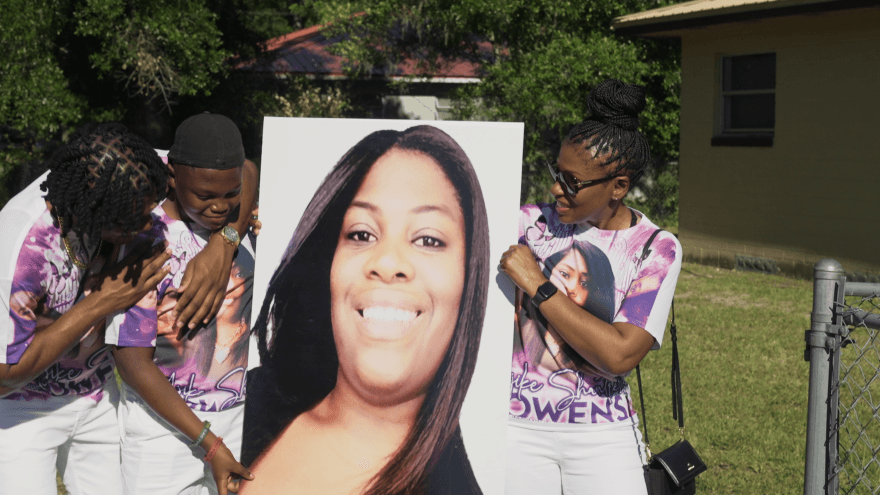
While the Ocala neighbourhood is a melting pot of residents from different backgrounds, it’s clear that much of Lorincz’s posturing is driven by racial prejudice and hatred, not only fear. Part of me feels a tinge of empathy for the deeply flawed Lorincz throughout The Perfect Neighbor, because it’s clear that this woman is unwell. (The film never fully delves into an explanation of her traumas, but any cursory research into the ensuing trial offers some light into what she would use as a defence.) But even with a “presumption of fear” and the right to bear arms, it’s never excusable to shoot someone sight unseen through a locked door. One shudders to think what would’ve happened if the person on the other side was a child or a police officer and not an average, everyday adult. If those were the cases, maybe things would’ve moved swifter and more forcefully, as cynical as it is to say that. Instead, provenly ineffective legislation would make justice harder to achieve.
Really, there is no justice. Owens’ family and children have lost something they can never get back, and going to prison will almost assuredly make Lorincz’s already fragile mental state worse. The Perfect Neighbor lays bare the American need to resort to extreme shortcuts in difficult situations rather that relying on social safety nets, meaningful dialogue, and reasonable lawmaking. Gandbhir examines everyone involved in the situation in the moment, and often at the worst points in their lives, not by being a filmmaker on the scene, but by observing the raw emotion captured through the eyes of the police cameras, inside the courtroom, and even during a lengthy, fascinating, and harrowing interrogation room interview with Larincz that’s unlike anything else in most similarly oriented documentaries.
The Perfect Neighbor doesn’t try to explain why people do what they do or how they can react inappropriately under pressure and stress. But it does an exemplary job of underlining America’s broken humanity and protective nature, and shows it in the most unvarnished and potent way possible. It’s the kind of film where one thinks that it could never be replicated in the same way. Depressingly, a similar kind of story could be taking place somewhere at this exact moment thanks to “stand your ground” laws, but the specifics of this case are what gives The Perfect Neighbor undeniable power.
The Perfect Neighbor is streaming on Netflix starting Friday, October 17, 2025. It also screens at Hot Docs Ted Rogers Cinema the same day at 6:00 pm.
