
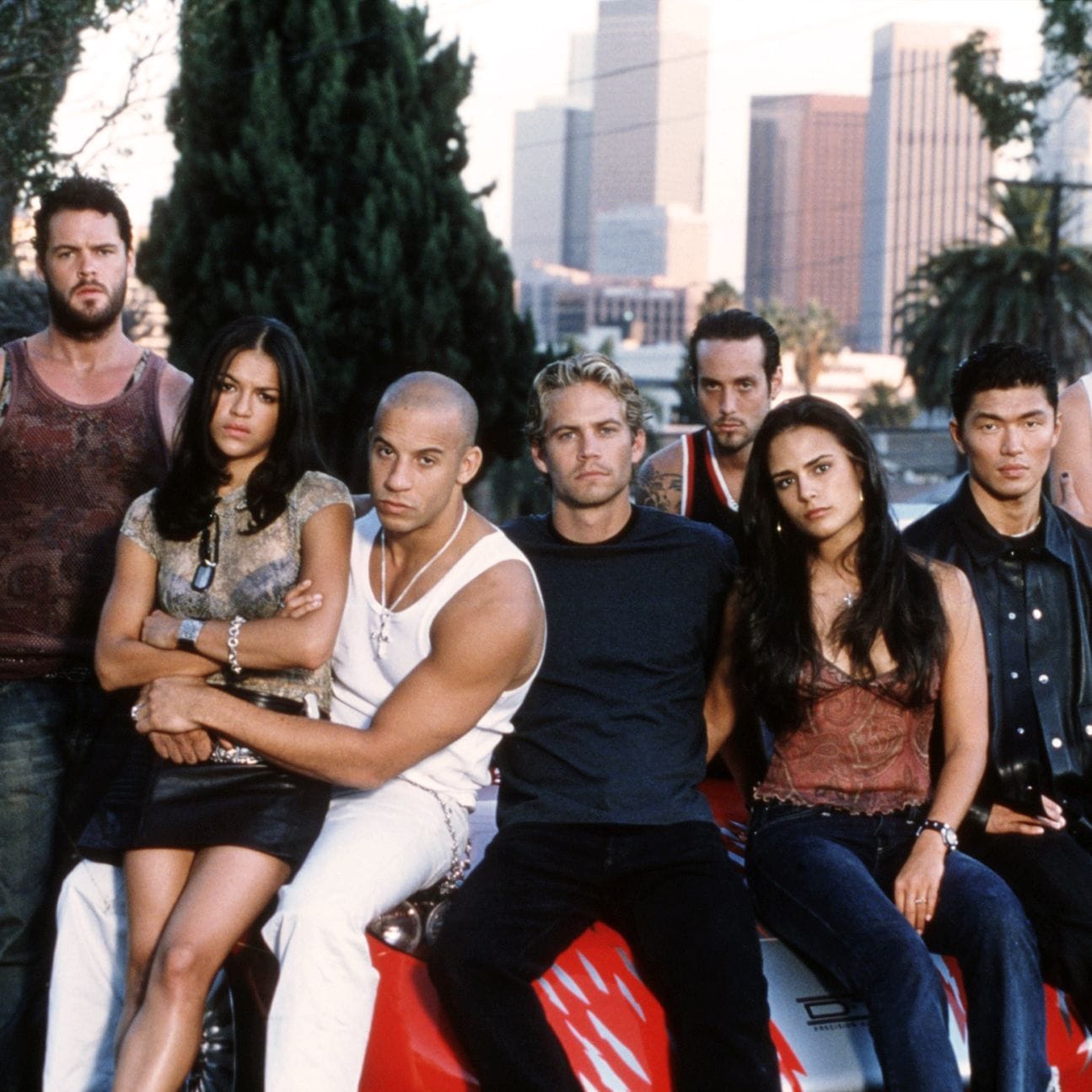
Like many great stories involving people in and around the film industry, this one begins with a trip to the movies. Although this time it doesn’t begin with a wide eyed kid getting exposed to a radical new art form or a favourite character at a young age, but rather with a teenage employee of a movie theatre. That’s where journalist, editor, and author Barry Hertz was first exposed to the Fast & Furious franchise (or THE Fast and THE Furious, or just Fast, if you’re into the whole brevity thing).
Released in the summer of 2001, director Rob Cohen’s The Fast and The Furious was a sleeper hit for distributor Universal Pictures, and one that made stars out of its leads, Vin Diesel and Paul Walker. Tapping into a subculture made up of hip-hop, swagger, asphalt, and fast cars, and built on stacks of stolen DVD players and cached cans of nitrous oxide, The Fast and the Furious was bigger than most anyone could’ve expected, spawning a ten movie franchise full of ludicrous action and even more ludicrously named sequels (many featuring rapper Ludacris) that (maybe) still continues to this day.
Not to get too inside baseball or anything, but anyone who knows Hertz (myself included, as I’ve worked with him on pieces and projects in the past) can attest to his love for the adventures of Vin Diesel’s marble chiseled and mouthed Dominic Turetto and his extended FAMILY of like minded crooks that have become something akin to superheroes and spies. No one that I know gets as excited for another entry into the Fast saga than Hertz, which makes him the perfect person to literally write the book on the subject.
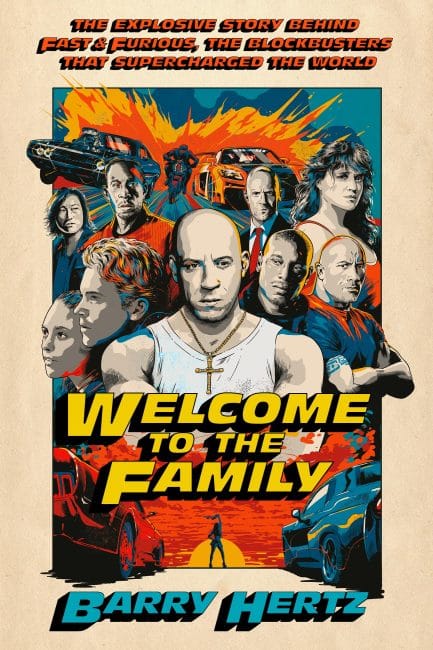
That book, Welcome to the Family: The Explosive Story Behind Fast & Furious, The Blockbusters That Supercharged the World (releasing this week, on Tuesday, November 25th), is an unauthorized, but exhaustively researched look into the global success of the series, as well as all the behind the scenes drama and struggles it takes to get such gargantuan event movies off the ground.
But our story of how Hertz fell in love with the Fast life actually involves two very different trips to the theatre, and the first one wasn’t where the love began.
“I remember watching that [first] film, cumulatively, in bits and pieces, maybe twenty or thirty times,” Hertz said during a recent Zoom chat about the book, recalling his time spent working as an usher and box office cashier at the SilverCity Elgin Mills (now operated by Imagine Cinemas) during the summer of 2001. “We had a parking lot where people would come out and start doing donuts after the shows, and at the time I thought that was a lot of fun. And it was surprising because no one at the time had thought about what a success that film was going to be. It was in one of our smaller theatres. But at the same time, it was something that kinda came and went, and I didn’t think about it too much until they decided to do another, and then another, and then another, and then another.”
Fast forward a decade to the summer of 2011, and that’s when Hertz, several years out of university and then working as a copy editor for the National Post, fell in love with the Fast franchise, with the landmark fifth instalment of the series, Fast Five, even if he hadn’t even intended to see that specific movie when he went to the theatre.

“I certainly didn’t see that film for press reasons. I actually remember that it came out around the same time as the new X-Men movie – Matthew Vaughn’s First Class, where they rebooted it – and I remember going to see that instead. That movie was the reason for me going to the AMC at Yonge and Dundas, back when it was still an AMC. And I finished that, and thought it was pretty good, and I had time to kill, and don’t tell AMC, but I theatre hopped.” Hertz chuckles., hoping that the statue of limitations is up on such crimes. “And I went to see Five, not really expecting all that much from it, and that ended up being the movie that blew me away that day. That was the movie I came to see. That was the spectacle I had wanted. And after watching that, it made me want to reexamine everything that had come before, which I had seen, but that was because I tended to see everything, anyway. The franchise was never a destination thing for me to that point. Then I glommed onto it and realized that something really crazy was happening here.”
If one were to poll the average moviegoer about their most memorable moments from the Fast franchise, responses would likely start with and be dominated by sequences from director Justin Lin’s Fast Five, the filmmaker’s third entry into the franchise and one that’s generally seen as a high water mark in terms of quality and insanity. Prior to that, however, the series looked somewhat directionless. The first and second movies, the latter directed by John Singleton, had vastly different tones and styles. Diesel declined participation in a second film, leaving director John Singleton to team Walker up with rising talent Tyrese for a more cartoonish sequel. The third film, Tokyo Drift, Justin Lin’s first entry into the franchise, felt only tangentially related to the series at first, with only a brief cameo from Diesel at the end bringing everything together. (Spoiler: Tokyo Drift would prove huge to the overall Fast mythology and lore, even if no one noticed at the time.) And the fourth film brought the core gang back together (including female co-stars Jordana Brewster and Michelle Rodriguez), but despite Lin’s participation, something was still missing for many.
Hertz had many of these same feelings at the time and expresses many similar sentiments within the pages of his book, but through the process of revisiting the earlier entries in the series, the writer forged a greater respect and appreciation for the bedrock that was laid out early on, somewhat in terms of storytelling, but mostly in terms of the technique and craft these films had been built upon.
“First of all, I visit those [older entries] as an audience member with no background, and then I revisited those after talking with a lot of the people who made those movies, and you see what they were trying to do, what they succeeded in doing, and what they couldn’t anticipate the challenges of, and you get a renewed appreciation for their purpose and what makes it up on the screen,” Hertz says about how the earlier films inform where the franchise would ultimately head.
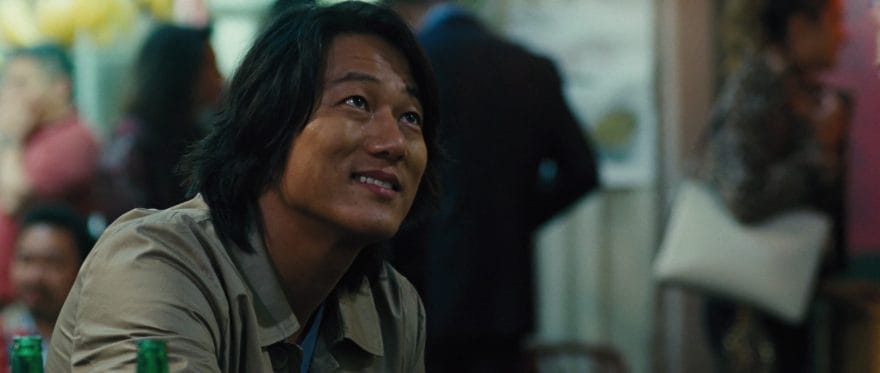
“For instance, Tokyo Drift – which I remember liking but not initially loving on an initial watch – has become, I think, my third favourite of the franchise. You definitely get to trace the genesis of the set pieces, even though each of these films is kinda working in its own sense of reality, in terms of action and aesthetics. Once Justin Lin joined the franchise on part three, it became clear that this was a series that valued practical, in-camera stunts. If there was a car, it was getting destroyed for real, and whatever visual effects were happening were mostly in the background to clean things up. The destruction was real.”
“And then you rewatch the first one and see what Rob Cohen is doing, and it’s very grounded, but the way he treats the races is very hyper-realistic. It’s like the cars are going at warp speed, and you can see the speed lines behind them. It’s treating things in a surreal fashion. Then you go to two, which is one of my lesser favourites for a number of reasons, but you can still see what John Singleton was trying to do by treating this as kind of a cross between a spaghetti western and an anime thing, where it’s total cartoonish exaggeration.”
“It’s a franchise unlike anything else, which is what I came to appreciate. There’s a log-line of fast cars and people are doing crazy stuff with them, but nothing else is ever the same from film to film. There’s not a single character that appears in every film, except for a can of NOS, and the aesthetics change, even within the films that Justin Lin did. Everything evolves and gets bigger and crazier. It really made me wonder what it takes to make a franchise like this; not just how to get it off the ground, but to keep it in this state of perpetual motion for so long. It’s a little crazy to think about.”
Although the franchise was both justly and unjustly compared to a clone of the Kathryn Bigelow’s similarly minded 1991 action masterpiece Point Break (where Keanu Reeves’ undercover cop gets in deep with surfing and skydiving crooks, led by Patrick Swayze), Hertz’s book gives the Fast films a lot more credit for their ingenuity. At one point in the book, Hertz gets a choice quote from editor Fred Raskin, who worked on the third, fourth, and fifth franchise films before going to work with Quentin Tarantino from Django Unchained onward.
Raskin nicely points out that Fast and the Furious is “a blank canvas blockbuster. There is no intellectual property that needs to be obeyed, no source material that must be adhered to for fear of fans crying foul.” Although this has become a massive series with a lot riding on it, there’s far more leeway to creating one of these movies as opposed to a Marvel or DC movie.
“As long as there are certain things happening in these films – not necessarily racing, because they drop that, but definitely a kind of chase element and this bromantic and family energy – these films could be anything you want it to be,” Hertz says about the series’ creativity. “That blank canvas perspective is really illuminating once you get to thinking about it. I learned while I was reporting on this – and this is true for a lot of big budget stuff – which is both scary and illuminating to extrapolate from the process, is that the filmmakers almost have to work backwards.”
“What we think of as a script doesn’t just arrive on one of these movies and you don’t really build up from that. They’ve thought about a lot of this through the reverse engineering of set pieces. ‘Wouldn’t it be cool if we took down a plane? We don’t have to have everything in place now. We’ll figure out the details about how we do that and who the bad guy is later.’ They just know there’s opposing forces, and they’re going to take down that plane, and they work backwards from that.”
“You learn that, and it’s really interesting, but also kinda distressing. It’s a real ‘how the sausage is made’ part of the experience, and it made me reconsider a lot of things in my own reviews. Often when I would pan a script in one of my reviews, I would just say that it sucked. But now even though it sucks and someone has to [take credit] for it sucking, I think about how it has probably gone through so many different hands and voices that it’s almost impossible to pinpoint who did said sucking, especially on movies of this magnitude. So that’s one of the big things I took away from this.”
And those set pieces that make up the high spots of a Fast film are almost never in the script. Sure, there will be a stop in the dialogue and exposition for a bit for an action sequence to happen, but quite often a script for one of these movies lets the imagination of the creative team run wild.
“A scene will come along in the script and it would just say something like, ‘A fight scene happens here, and it’s going to be the most awesome fight scene you’ve ever seen!’ And that’s how a lot of it is,” Hertz explains about the series’ writing process. “It’s left to the imagination of the fight choreographers, the stunt people, the director, the visual effects artists, and the performers to paint all of that in. It’s remarkable, really, but that’s how these things are built. Those scenes are the most labour intensive versus just shooting five people in a room or sitting around a table. Those scenes have to be worked on ahead of time, simultaneously with the rest of the film, and into post-production.”
And it takes a village of thousands of craftspeople to pull something like these films together. Although Universal politely declined to participate in Hertz’s research, he sought out as many people involved with the making of the Fast series as possible, which included an assortment of stunt-people, visual effects artists, and other assorted creatives to paint a picture of the enormous task of making such grand action spectacles. It’s not an easy task considering that there are so many people tied to the Fast franchise behind the scenes that tracking a lot of them down when they aren’t banded together under the umbrella of the same project could prove tricky.
“It was difficult, but at the same time it’s one of the most fun parts of the research and reporting, even though eventually I would have to take all of that information, collate, and then write it, which is in itself a lot of work,” Hertz says when asked about seeking out such a wide variety of interview subjects. “You get really hungry for as much information as you can get, and you just keep piling it on and figure out what you’re going to do with it later. You have to sift through all that and try to find a narrative.”
“But that was the way to do it. You needed to talk to the people who were on the ground, and you needed those different perspectives. And that helped me find my own perspective. Going in, I had an idea of what I though people on the second unit of a film did, but I never really got the intensity of it and the critical nature of it on these big action movies until I began looking into it more. And with the Fast movies, it’s not just the second unit. There’s often a third and fourth unit, splintering off and going at the exact same time in locations all around the world. And it also gives you a great eye into the editing process on one of these productions, because someone has to watch all of this stuff as it’s coming in from all these units. Editing starts right away on one of these things, taking in all of this raw footage from all the units around the world and trying to make sense of it. It was an incredible Filmmaking 101 crash course, in a lot of ways.”
That extends to learning about the sleek, supercharged cars that help power the franchise, ferrying its heroes back and forth across a variety of heists, chases, and dangerous situations. Hertz knew little about automobiles going into the writing process, but he was in good company there. Justin Lin knew almost nothing about cars before joining the franchise either, and both of them got by with a little help from their friends.
“I knew I was in for a steep learning curve,” Hertz replies when asked what he learned in the research process for the book. “I am not a car person. I like looking at nice cars, but I never really wondered what it would be like to drive that, and I definitely couldn’t tell you anything about them. I had to start reading a lot about cars and the automotive scene at the time each of these films was made. I had to know why a Skyline was special, and what was under the hood of a Dodge Charger, and not just commenting on how cool they look. I had a good friend who knew a guy who was very much an automotive expert, and he knew things that I’m willing to bet a lot of people who worked on these movies didn’t even know about these cars. He was the car guru I would turn to if I needed to describe how an engine fired up or double check the different models of cars. I learned a lot about cars, but can I drive a stick or drift now? No. Absolutely not. And nor would I really want to, but I definitely have a bigger appreciation for them as someone who drives a RAV-4.”
It’s perhaps unavoidable when forming any kind of narrative, both fictional and non, to have a hero or sympathetic figure emerge from the pages. On a franchise where behind the scenes squabbles between big muscles and bigger egos were part of the daily struggle, someone always got caught in the middle and had to be a voice of reason. Perhaps because he directed half of the entries in the series (almost six before exiting Fast X early in production), Lin’s role in shaping what the Fast and Furious franchise would become is one of Hertz’s most fascinating, heartfelt, and eye-opening threads, making the filmmaker’s contributions seem heroic. Even though Lin was one of the parties who declined to participate in the writing of Hertz’s book, the director’s tenacity and participation in the films proved to be a major pillar of of the overall story.
“I always had such admiration for Justin Lin as a filmmaker. I saw what he did with Better Luck Tomorrow, Tokyo Drift and again with Five, and I think if you were to canvas most Fast fans, I think the vast majority of them would say Five is their favourite. In interviews he always seemed like he had a good head on his shoulders, and when talking with people who worked with him on these movies, it really feels like he was able to accomplish the impossible against impossible odds. He’s a crazy workaholic who never really stops. He always fought for his vision and made sure his collaborators got their proper due and recognition. He was the hero of the franchise.”
“I spoke with a lot of people who worked with him, but there were still a lot of people who didn’t want to speak with me, and that included Justin Lin, sadly. I knew going in that I was pretty sure that Vin wasn’t going to talk to me and The Rock wasn’t going to talk to me, but I was a little hopeful Justin would. I had interviewed him before [for The Globe and Mail] for Star Trek: Beyond, and that turned out really well. And I was able to get in touch with every member of his inner circle, some of whom did talk to me, and had them pass along messages. I wrote personalized messages. But he was very adamant that he was done with these movies, and he politely said that this was a point of his life that he didn’t want to revisit. And honestly, when you read the book and think about what he went through on these movies, I can’t blame him. Hopefully, maybe he reads the book and hears some positive things about it, and maybe then he can share his story on his own terms and in his own time. One of the things I wanted to get across, and it certainly wasn’t the original or only intent with the book, was that I hoped he gets his due credit within the industry, and that people realize how much of him is put into those films. So much of the success of the films is owed to him.”
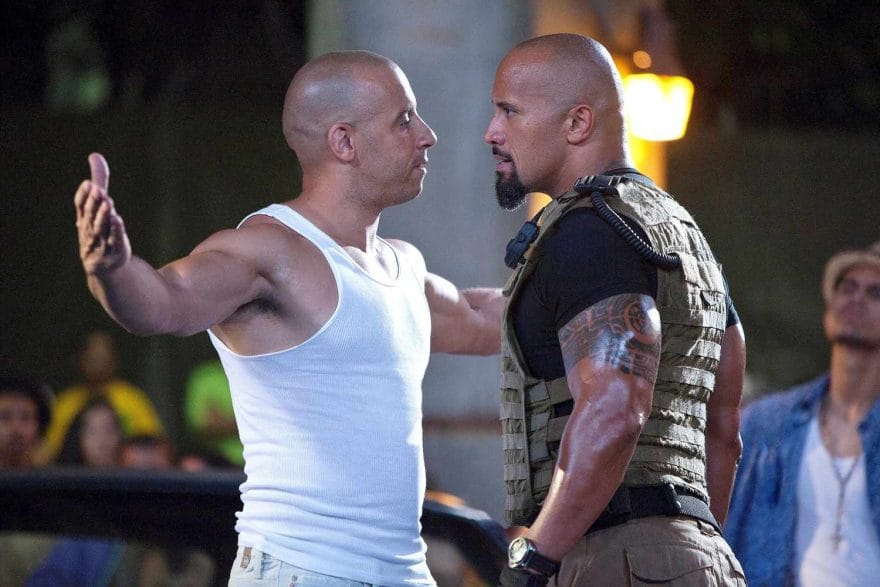
Justin Lin’s vision combined with the ego and demands of leading star and head producer Vin Diesel have helped to shape the perception of the Fast series, for better and worse. Both possess a specific, admirable, but often combative and demanding knack for willing what they want into existence out of virtually nothing; something that places them alongside the likes of Howard Hughes, Tom Cruise, and James Cameron. If you told Lin or Diesel something couldn’t be done, they would go out of their way to invent a method to make it happen, no matter the cost. But was it Vin’s egotistical drive as an on screen figurehead or Lin’s workaholic tendencies as a filmmaker that helped push the series to its boundaries?
“I think comes from equal parts,” Hertz says when asked this question. “Vin has a sizeable ego, and I don’t think anyone will contest that, including Vin himself. But he is extremely liked by people, and like Tom Cruise, he is a relentless force of self-determination. He wills things into existence through tenacity, drive, and brute force. When he came back for Tokyo Drift and was able to negotiate producing powers for the franchise moving forward, that was a smart move when it comes to making the series bigger and more ambitious.”
“And Justin Lin was very much on board in terms of that ambition and epic scope. In a lot of ways, they complemented each other well. They’re both workhorses who are hands-on, particular, and want the absolute best. And they both suffer in that same respect because of micromanaging tendencies. It’s all in service of making things as good as they can be. Sometimes that manifests itself as delusions of grandeur perhaps on Vin’s part, and a bit of tunnel vision on Lin’s part, but they both care deeply about the work. But once you head down this path, you can only go so big for so long before you hit an exhaustion point.”
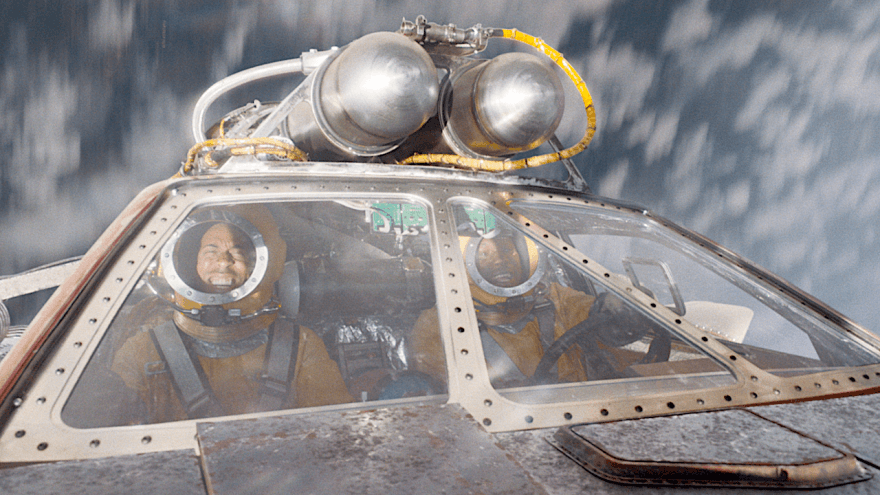
But the sizeable fan base of the series hasn’t minded too much about what happens behind the scenes of a Fast movie. Up until recently, audiences seemed like they couldn’t get enough of these characters and their increasingly chaotic and implausible world. The cast became something that employed just as many big name actors (Helen Mirren! Kurt Russell! Brie Larson! Charlize Theron! Jason Statham!) as a major Marvel crossover event picture, but on a more regular and recurring basis. The laws of physics are blatantly disregarded, and the toll such action takes on the human body is frequently ignored. At one point in F9, series stalwarts Ludacris and Tyrese go to space in a beat up rust bucket to help disrupt a satellite, something fans had long joked about happening, but probably never thought would be a reality. The series always tried to give fans the most bang for their buck (backed by Universal’s willingness to pump the GDP of a medium sized nation into the films), but at a certain point it felt like fans were getting more than they bargained for or wanted.
Hertz reflected upon the franchise as it sees itself in a state of flux, with the second part of the series’ grand finale now stuck in a state of stasis, following the critical lambasting and box office underperformance of Fast X. To a certain extent, Hertz admits that listening to the fans who only demand greater excesses and big character returns has put a burden on the series.
But that bit where Roman and Tej go to space? For Hertz, that’s actually an endearing high point.
“I think 8 and X kinda suffer under the weight of everything, but one of the things I really came to appreciate was that moment in 9 when they go to space. I think at the time, we all viewed that one under a weird set of circumstances. It was still before we were fully coming out of COVID, and going to the movies wasn’t the same just yet. It was a weird time. And at the time, I wasn’t too sure about it. But then listening to the writers and those who were involved in the creative process and hearing what they were trying to do with it, it becomes clear that this is a nice kind of metatextual moment. Yes, it is speaking to fans and saying, ‘Hey, you wanted space? Here’s space!’ But it’s also marvelling in its own way about how far this series and these characters have come. Roman and Tej have this exchange while they’re up there where they marvel that they were just two guys from the ghetto up there in space, and who would’ve thought they would be able to do this. This is the franchise commenting on its own street level origins. I talked to a lot of people who said they consulted NASA and tried to keep things as realistic as possible, but the reason they’re up there is patently ridiculous, although the way they got up there, maybe not so much. But I’m really not against it. I’m cautiously for it.”
“But I do feel like letting the audiences dictate the direction of these movies has crept in a little bit, and so much so that when you let every section of the audience have their voice, it becomes too much and those same people start to revolt against it. Why are we doing so much? Why is there so much stuff here? Why are there so many characters and actors? And then you start thinking about going back to what made this so special in the first place, and I think that’s where we’re at now. That’s the danger of going on this long. The Bond films are a good point of comparison. They go on, but at certain points they reset. You can get a new actor in there, new filmmakers, new writers. There are always elements that they will have to satisfy, but they reset enough to offset the rough years between instalments that might feel played out. With the Fast movies, the trajectory has been so sharply upward, that eventually it feels like the staircase to nowhere. When you get to that point, you either have to find a way down or you’re going to fall.”
Barry Hertz is the Film Editor and Deputy Arts Editor at The Globe and Mail. His book, Welcome to the Family: The Explosive Story Behind Fast & Furious, the Blockbusters That Supercharged the World is available from Grand Central Publishing in hardcover, audiobook, and eBook format on Tuesday, November 25. Hertz will be conducting an Author Talk about the book with CBC host Elamin Abdelmahmoud at Hot Docs Ted Rogers Cinema on November 25 at 7:00pm. He will also be introducing and signing/selling books at a special screening of the original The Fast and the Furious at Hot Docs Ted Rogers Cinema on Friday, November 28 at 9:00pm.
