

The Australian post-apocalyptic zombie movie riff We Bury the Dead exists in a strange, but interesting space. It’s not pulse pounding or gory in ways that genre buffs would find fun or amusing, but it is thoughtful, measured, and sorrowful enough to entice viewers who want something more from a chiller. It’s not a consistently assured film, especially down the stretch, but We Bury the Dead has a lot of good ideas, notions, performances, and smart writing to keep things engaging. It’s on the high side of what someone might expect from the first major new release of a calendar year.
Daisy Ridley stars as Ava, an American physical therapist travelling to the Australian island of Tasmania to find her missing husband, Mitch (Matt Whelan), in the wake of a major catastrophe. The American military mistakenly detonated an experimental weapon of mass destruction off the coast of the island, killing over half a million people instantly. Ava has joined the Australian government’s clean up and rebuilding team as part of the body retrieval and identification program. Mostly tasked with checking for IDs and hauling bodies out of their resting places, Ava’s team also has to contend with a small number of victims who’ve suddenly arisen from the dead, most of which seem harmless and confused at first, but grow increasingly erratic and angered the longer they’ve been reanimated. She’s eager to get to the resort town of Woodbridge in the south (where her husband’s work retreat was staying), but is repeatedly told that due to fires in the centre of the island, it’s impossible to reach. With the help of the gruff, hard man she’s been paired up with on the job (Brenton Thwaites), Ava slips past her bosses and makes her way towards the coast, hopeful that if Mitch has become one of the resurrected that she can find him help.
Early on, writer-director Zak Hilditch (best known for These Final Hours, another film with the end of the world on its mind) is able to create a convincing scale for an unusual disaster of unknown origin. Buildings are still standing, water is still running, and nothing is radioactive, but humans have died seemingly as a result of a shockwave of some sort. It’s an eerie world, amplified nicely by the film’s score from mononymous composer Clark. There’s a military presence all around, but the duties depicted in We Bury the Dead are being carried out by citizens largely driven by civic duty, many of whom can’t take the rigours of the job. The earlier scenes in We Bury the Dead are unique and humane, with Hilditch’s core notion that not all corpses will suddenly come back to life adding a degree of suspense and unpredictability that keeps viewers and the characters on their toes. Hilditch also cleverly finds ways of transitioning from the present moment to flashbacks from Ava’s life via smooth, well matched edits that feel effortless.
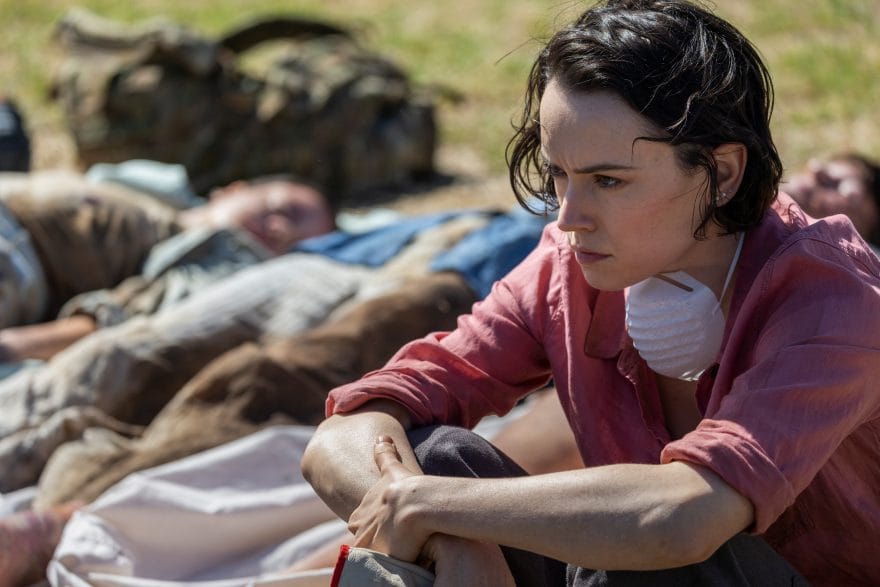
It’s not long before Hilditch switches gears and We Bury the Dead becomes a quest movie, with the protagonists hitting the road on a pilfered motorbike. Ridley and Thwaites have great chemistry together, knowing when to highlight their characters’ similarities and differences to make the biggest impact. A tonally fascinating Mark Coles Smith shows up for a turn as a military man with unusual motives who intercepts the leads along the way. It becomes clearer that We Bury the Dead isn’t going to be a thrill a minute horror extravaganza, or even a treatise on society’s ills or man’s inhumanity to man, but rather a granular look at our need for closure in the wake of tragedies, both personal and global. Everyone in the film is searching for that same emotional release, and Hilditch wants to examine what these people will get when they achieve that goal. Will it change anything or does life just keep going on in this new normal without variation?
So, yeah, not a typical movie about the walking dead, and overall that’s a net positive when it comes to delivering a final product that’s satisfying on the whole. Things do slow down a bit once the story hits the road and Ava makes her way towards her husband, but Hilditch cares more about giving his themes and ideas weight rather than constantly trying to goose the audience with relentless jump scares and set pieces. But this desire to carefully spell out the film’s subtext in great detail threatens to derail We Bury the Dead in the final act, where Hilditch struggles and flounders when it comes to settling upon an ending that puts a fine point on everything.
It’s one of those movies where viewers will be able to recognize a perfect moment to end things on, but instead the film carries on for another fifteen minutes without adding much more than what was already made obvious. That’s disappointing, but even the unnecessarily extended conclusion is well done and acted, so any complaints that can be made about the film’s sudden disregard for pacing is a minor one. After all, it’s set in a place where time has been frozen in place. There’s not much else to do besides sitting around and contemplating where things go from here.
We Bury the Dead opens in North American theatres on Friday, January 2, 2026. It opens in Australia and New Zealand on February 5.
