

The vital and incendiary documentary Yintah is the best look at the fight to maintain indigenous land rights and native sovereignty since Alanis Obomsawin’s landmark films Incident at Restigouche and Kanehsatake: 270 Years of Resistance. An eye opening, tragic, and infuriating look at the lengths multi-national corporations and the Canadian government have gone to in an effort to build one of the world’ longest and most controversial oil pipelines, Yintah is a work of embedded, but deeply personal journalism told by the indigenous leaders on the frontlines of a moral and legal battle that has dragged on for over a decade now.
Yintah (meaning “land”) examines the ongoing struggle of the Wet’suwet’en people in British Columbia, who have been fighting the establishment of said pipeline, a major project that could compromise the ecology of their land, the safety of their residents, and their overall way of life. The establishment of this pipeline would require it to go through a great deal of indigenous lands, and the five clans of the Wet’suwet’en haven’t given their permission or consent for any work to take place. What sets the Wet’suwet’en apart from other tribes is that they have never ceded their land to Canada, making what these corporations are doing illegal by the strictest letter of the law. But with the cash these companies inject into the government of Canada and an almost unlimited amount of funds and resources in reserve, they’re allowed to constantly muscle their way onto Wet’suwet’en land, with the help of the RCMP and local police forces to back them up.
Directors Jennifer Wickham (a communications manager for one of the Wet’suwet’en checkpoints) and Brenda Michell and director of photography and co-director Michael Toledano largely zone in on the period of time spanning from 2015-2021, but the issues of the Wet’suwet’en and their battles in court and on tribal lands reaches further than that in both directions. While many viewers might be familiar with the plight of the Wet’suwet’en through the support they had via nationwide protests several years ago, the story somewhat faded into the background once again. Yintah will surely place those concerns front and centre once again.
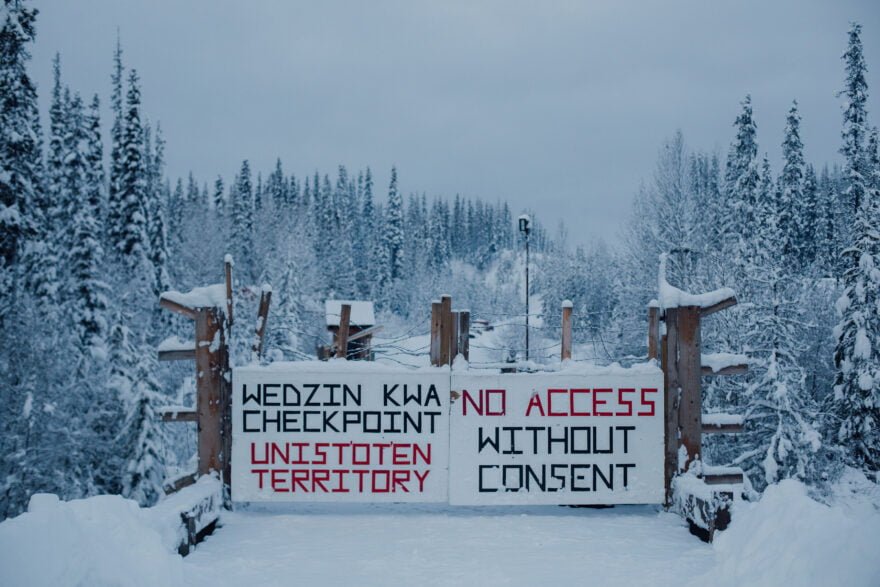
Although the filmmakers put together a comprehensive overview of the issues and concerns at hand, Yintah looks at the situation more specifically through the eyes of two women at the forefront of the movement. Sleydo’ Molly Wickham and Howilhkat Freda Huson are organizers, spokespeople, and respected leaders who are often at the front of the line and directly behind the blockades that sit at the entry to their lands. In calm, firm voices, they tell trespassers to turn around, while resolutely declaring the Wet’suwet’en peoples dominion over the land. Wickham and Huson are perfect subjects, not just because of their strength and wealth of knowledge, but also their personal openness.
A lot of the strength in Yintah can be found simply in the fine art of observation. By spending an intimate amount of time inside tense council meetings, out in the streets during the dead of winter, and within their homes and alongside their families, Yintah intelligently and without ambiguity shows that the “crumbs” the Wet’suwet’en people would gain by giving into big business and the government would pale in comparison to all that would be lost and never regained with the passage of time. Wickham, Huson, the Wet’suwet’en clans, and all of their supporters aren’t remaining vigilant strictly for their land, but for an entire culture.
A lot has been said about truth and reconciliation in Canada since Justin Trudeau’s Liberal government came into power, but there’s a clear disconnect between what is being said and what is being done. The healing of marginalized and traumatized peoples can’t happen if others keep taking from them. The system is also rigged in favour of those who have the most money and influence. If nothing can stop these cash rich industries from barging their way into protected lands that aren’t owned by them, why then do these companies and the governments backing the bristle when they are met with peaceful, equal pushback? It creates a sick cycle of retreats, advances, injunctions, and court battles designed to break and exhaust the resistance. And people like Huson and Wickham refuse to cave, constantly finding strength to carry on, even when all hope seems lost.
On a larger level that goes beyond indigenous studies, Yintah (which picked up the award for Best Canadian Film at Hot Docs this past spring) is truly a film for our times. In its depiction of the ways capitalism tends to destroy culture and heritage, the film delivers cautionary messages that should be heeded by all cultures around the world. These stories are playing out around the world, where those without powerful connections are being forced out of their homes without good reason and devoid of consultation or proper reparations. The Wet’suwet’en leaders have proven that the biggest asset in a fight against such abuses of power lies in fostering community and protecting that sense of togetherness at all costs.
Yintah opens in Toronto at TIFF Lightbox on Friday, July 12, 2024, with a post-screening virtual Q&A with Jennifer Wickham following the 6:30pm performance on Friday the 12th. The film is currently touring Canada, making stops in many major cities and towns. For a list of future screenings, please consult the film’s website.
All photographs © Amber Bracken
