

Clair Titley’s documentary The Contestant will leave viewers stunned, even if they think they know the whole story behind it. A snapshot of a time when reality television was in its infancy and no one paid much attention to the ethics of extremity for the sake of entertainment, The Contestant will generate a lot of empathy for a person who was put through hell just to make thirty million people laugh. An insightful look at trauma and the ways people can gain catharsis and a sense of false accomplishment by watching someone having a worse day than they are, The Contestant is the type of work that lingers in the memory long after it ends; whether you want it to or not.
At the tail end of the twentieth century, right before the reality television explosion, there was Denpa Shonen, a Japanese competition show that cornered the cultural zeitgeist in the country. The brain child of television producer Toshio Tsuchiya, Denpa Shonen was initially conceived as a sort of extreme precursor to The Amazing Race, a show where young people would push themselves to their limits across a series of globetrotting challenges of increasingly dangerous difficulty. Flush with a sense of accomplishment and power (paraphrasing his words, not mine), Tsuchiya created a new segment for the show: A Year in Prizes.
Enter Tomoaki Hamatsu, an aspiring comedian nicknamed Nasubi, meaning eggplant, as a nod to his long face. Eager to become a star, Nasubi witnessed how others who participated in Denpa Shonen contests became overnight celebrities and decided to try out for Tsuchiya’s latest offshoot. Through almost sheer luck (or misfortune) of the draw, Nasubi became the contestant for A Year in Prizes, but he was never aware what he signed up for when the show began immediately, nor did he ever sign a contract.
Nasubi was blindfolded and whisked away to an unadorned, windowless room with nothing more than an overflowing magazine rack, a telephone, a radio, and a stack of blank postcards. Nasubi was stripped naked and told that he had to survive solely on winnings from contests in magazines and on the radio. If he wanted food (beyond a pittance of crackers provided by the crew to literally keep him alive) or clothes, he had to win them. Nasubi was told that he would be set free (even though the door was never locked) once he amassed over one million yen in total prizes won. For over a year, Nasubi struggled to complete the challenge, all without knowing that his “comedic” “unhinged” exploits were fodder for an audience of thirty million Japanese television viewers every week.
A Year in Prizes might’ve been cutting edge television at the time, but by today’s standards and morals it sounds and looks a lot more like a psy-ops experiment designed to break the spirit of a detainee in a military facility. Titley sits down with both Nasubi and Tsuchiya – alongside cultural critics, technical advisors, and family members – to talk about the experience of making A Year in Prizes, and the results are both infuriating and emotionally devastating. Nasubi, who stayed because it’s in his nature to finish the things he starts, speaks frankly about how the show’s sillier tone in no way captured the loneliness, psychological torment, and physical pain he felt as the show dragged on. As the weeks turned into months, Nasbui began looking more and more like a haggard, modern day Robinson Crusoe, sending messages to the outside world and praying for lifelines. The Contestant lays bare traumas unfolding both in the moment and still affecting Nasubi to this day.
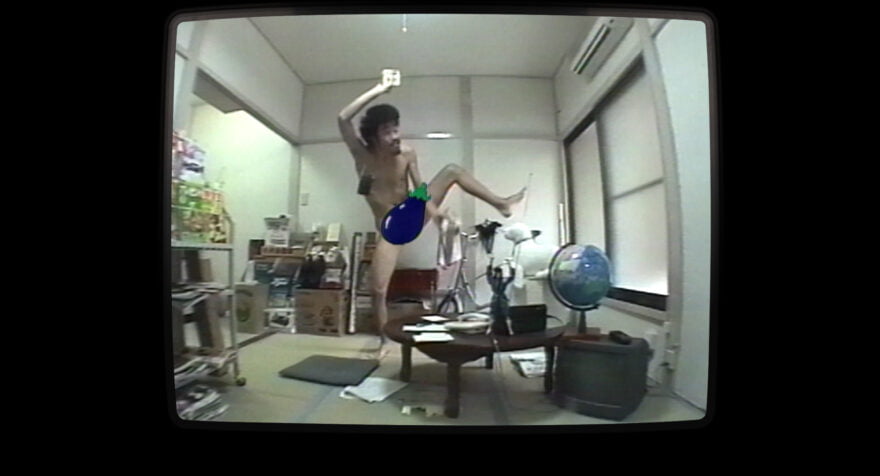
And that madness spurred on by isolation was what the almost maniacal and virtually unrepentant Tsuchiya wanted to capture. Released around the same time as The Truman Show, it’s hard not to see parallels between that film’s single minded, god-like director (played by Ed Harris) and Tsuchiya, who Nasubi said he once looked up to as a deity. Whether Nasubi experienced crushing hardship (a ramen delivery meant for a different apartment), extreme embarrassment (always being nude, being forced to eat dog food), or soul stirring elation (actually winning something useful, expensive, or comforting), the director got what he was looking for: unfiltered, raw emotion. Tsuchiya speaks philosophically and dubiously about his methods, and very proudly of what he was able to accomplish with A Year in Prizes, coming across like an auteur filmmaker that would make some of the most brutal tyrants reconsider their tactics.
Although it’s a film about a television show, Titley frames The Contestant as an examination into the relationship between the star, the filmmaker, and the audience. The star works to entertain the audience, but they have no clue in advance what they are going to witness and how they will come across. The filmmaker tells the audience what to think about the star by assembling a final product that will fit their vision. Then it’s up to the audience to decide what they think about the star. Are they laughing at him? Are they sharing in his pain? Do they find this inspirational or inhumane?
Titley lets Nasubi explore the years of PTSD he suffered before (as a victim of childhood bullying over his appearance), during, and after the show, while she lets Tsuchiya speak his unfiltered opinions about his work and why it proved successful. Tsuchiya thinks he gave the world a story about someone surviving against unending hardship. Nasubi sees the whole thing as an experience that drained his will to live and gave him none of the lasting celebrity he was seeking in return. The closer Nasubi gets to his goal, the crueler the show becomes, and the more viewers of The Contestant will question how the show was such an enormous multimedia phenomenon custom made for the early days of the internet and streaming video. The Contestant also gives viewers insight into Nasubi’s efforts to turn his trauma into something genuinely positive, with some unlikely help from Tsuchiya, something that is far more inspirational and aspirational than A Year in Prizes could’ve ever hoped to have been.
The Contestant could benefit from talking to people who tuned into the show regularly back in the day and asking what they think about it now, but as an examination of how people are willing to alter their minds and bodies for the sake of mass entertainment, Titley’s film is a powerful cautionary tale and expose of an entire industry. Titley (who first heard about Nasubi’s story the same way I initially did, via a wonderful episode of This American Life) has made The Contestant into a perfectly contextualized addendum and take down of a show that thrived on manipulating someone who has been forced into oversharing their life. Things that once seemed trivial to passing observers at the time are now exposed as contemptuous, dangerous practices; some of which still endure in some form or another in the reality television industry.
The Contestant is now available to watch and stream in Canada on Hollywood Suite and Hulu in the United States.
