

Although it ends up taking on far more baggage then necessary for something that’s mining already familiar territory, animated adventure The Wild Robot is a consistently heartwarming, visually stunning, and instantly likeable parable for the wonders and difficulties of parenthood. Based on the book by Peter Brown, The Wild Robot balances a cheerful disposition with just enough darkness to not turn off or offend younger sensibilities, making for a pleasing whole that remains entertaining even when much of its story has wrapped up and the film shifts into tonally very different territory during its latter stages.
Following a typhoon, a high tech helper robot finds itself washed up on the shores of an island in the middle of nowhere. The Rozzum 7134 unit (voiced wonderfully Lupita N’yongo) is duty bound to complete all its tasks to the letter, but the robot is confused by the lack of a human customer to assist in the middle of the island’s dense forestation. Initially greeted with a frosty and sometimes outright hostile reception from the local wildlife, the robot sets about trying to understand and communicate with the animals. That also doesn’t go as well as hoped, but a tragic accident gives the robot a unique sense of purpose when a recently hatched gosling imprints itself on Roz. The robot now finds itself in the unique position of being a parent to a living creature that needs to be able to gather its own food, swim, and fly away from the island before the winter chill sets in. With some help from the locals, Roz learns that being a parent requires more than good planning and logic. It also requires a lot of fast thinking and improvisation, two things that aren’t a part of its programming.
Screenwriter and director Chris Saunders (How to Train Your Dragon) isn’t mining completely new territory with The Wild Robot, which treads heavily upon ground that the likes of The Iron Giant, Big Hero 6, and Wall-E all did before, and admittedly better. The concept of a robot learning how to care for the people and world around it isn’t especially inspired, and neither is anything The Wild Robot has to say about the difficulties of parenthood. But in both respects, Saunders’ film doesn’t need to reinvent the wheel because there’s a truthfulness and honesty that always shines through. To watch the chipper, energetic, but otherwise emotionless Roz slowly turn into a worn out, stressed, and empathetic caregiver is measured and careful. Saunders satisfyingly creates a story where a piece of artificial intelligence learns how to love and accept change. In short, it’s a nice, resonant story that’s told well.
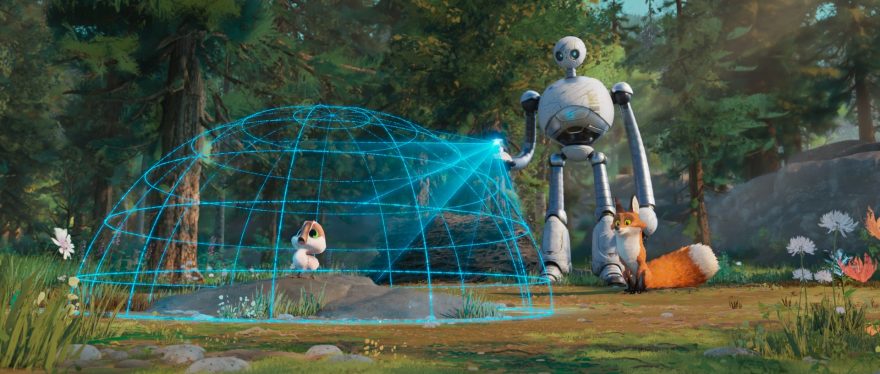
The Wild Robot is also a visual and sonic stroke of genius. The character design is eye catching, and the scenery is laid using the same kind of painterly techniques that Dreamworks has been dabbling in previously with the likes of The Bad Guys and Puss in Boots: The Last Wish. The sound design and voice casting is impeccable, and the soaring musical score is elegant in its bombast. Saunders also doesn’t shy away from depicting some harsh truths about the ways animals survive (or, yes, die) in the wild. A few of the set pieces – including a pulse pounding early bit where Roz is chased by a bear – might give younger viewers the creeps, but like some of the best animated filmmakers in the world, Saunders understands that kids can take a lot as long as they’re reassured that things will turn out okay in the end.
Watching Roz trying and failing to train their young ward, Brightbill (Kit Connor, cleverly leaning into the ways the little goose thinks it’s part robot), holds a lot of entertainment value and family fun. Getting advice along the way from a sketchy, but loving fox (a warm-hearted Pedro Pascal), a harried possum mother (Catherine O’Hara), a wisened older goose (Bill Nighy), and a surprisingly helpful falcon (Ving Rhames), Roz’s journey nicely illustrates how it can take an entire village to raise a child and help keep a parent from cracking entirely under the pressure. The Wild Robot is at its absolute best when it shows how there’s a link between parenting and fostering a sense of community, and it builds up a lot of warmth and good will along the way.
But there’s also a major problem with The Wild Robot when it come to its script. The main thrust of the story wraps up rather nicely with about forty minutes left in the movie, when suddenly Saunders decides the film needs a villain and shifts the narrative’s direction into a less satisfying parable for the dangers of fully automated living and climate change. Once the company that made Roz sends a “morally neutral” superintelligence (voiced by Stephanie Hsu, doing a perfectly amusing impersonation of some marketing executives I’ve met over the years) to retrieve their product and strip mine Roz for all they’ve learned, The Wild Robot feels like a completely different movie. It’s like watching a movie whose sequel has already been tacked onto the original. Saunders film remains thoughtful, smart, and exciting, but also lesser than the great stuff that came before it.
The back half of The Wild Robot remains spectacular and heartfelt in all the right ways, but it also comes at the cost of the greater whole. The entire final act could be excised without harming what makes the film so special. It’s never a bad movie, but had one part been divorced from the other or there was more emphasis put in the right place, this would be an all time classic. Instead, it’s a very good movie that still will be highly re-watchable for kids and parents alike. And there’s absolutely nothing wrong with that.
The Wild Robot opens in theatres everywhere on Friday, September 27, 2024. It screened as part of the 2024 Toronto International Film Festival.
