
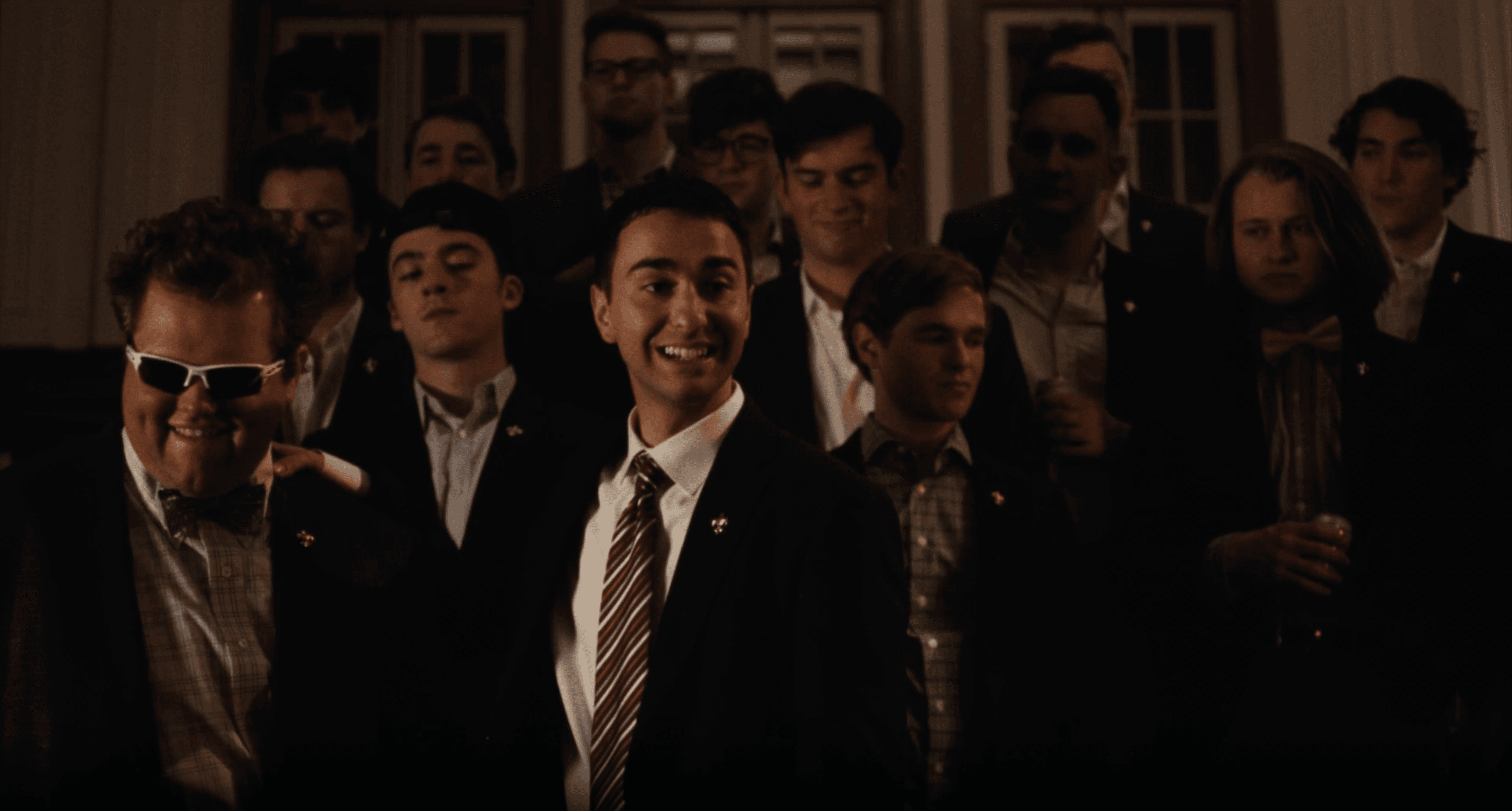
The Line, first time featured director and co-writer Ethan Berger’s look into the dark corners of frat boy culture, is simultaneously gritty and predictable. It’s unflinching, yet wholly expected, with almost none of its grand revelations about toxic masculinity landing with much of a surprise. It’s not a badly made, acted, or written film, but rather overly familiar and lacking in substance that hasn’t been explored previously in film and literature. The Line is pretty good for what it is, and the outstandingly committed cast helps, but for all of its positives and sense of lived in realness, Berger’s impact is fleeting.
At the start, set in 2014, Tom Backster (Alex Wolff) is gearing up for another year at university and moving back into the Kappa Nu Alpha frat house with his fellow brothers and future pledges. His boorish, boisterous, American flag pattern loving roommate, Mitch (Bo Mitchell), comes from the kind of well connected family that Tom would like to get to know better and cozy up to, so much so that he’s willing to overlook this dude’s obviously long list of faults and off-putting behaviours. KNA is known for breeding winners, including several U.S. presidents and dozens of Fortune 500 company CEOs. Current KNA president, Todd Stevens (Lewis Pullman), is grooming Tom to take the reigns of the frat after he graduates next year, an enticing proposition that will force the young man to keep his head down, sell his soul, and overlook a lot of dangerous, negligent behaviour, particularly with regard to raucous group outings and dangerous hazing rituals.
With The Line, Berger nicely captures the visual dichotomy of “Greek” life, which presents itself to the world as clean-cut, usually white, affluent young men bonding and giving back to the community, but in the shadows is a degrading, drug and booze slathered, shambling, inequitable, debauched mess where the party doesn’t stop and no one considers the consequences of their actions. The Line doesn’t show much interest in examining the fraught relationship male frats have with women on college campuses (although there’s plenty of locker room talk about scoring chicks), and instead decides to zone in on the nature of hazing and the price that’s paid for brotherhood.
There is a feminist character on hand to offer some outsider perspective – played nicely by Halle Bailey – but she’s always treated as more of a love interest and guiding light for Wolff’s unlikeable, but conflicted protagonist, and not taken very seriously as a philosophical and equitable counterpoint. Instead that role falls to actor Austin Abrams, who shines brightly as Gettys, a confident and unfazed pledge who’s beloved by Todd, but rubs Mitch in all the wrong ways. Although he’s frequently on the periphery of Tom’s drama and mostly has to contend with Mitch’s increasingly unhinged confrontations, Gettys provides Berger with the dramatic counterpoint The Line needs to remain special. Gettys isn’t a perfect person by any stretch, but his growing dislike for hazing and frat culture is smartly realized.
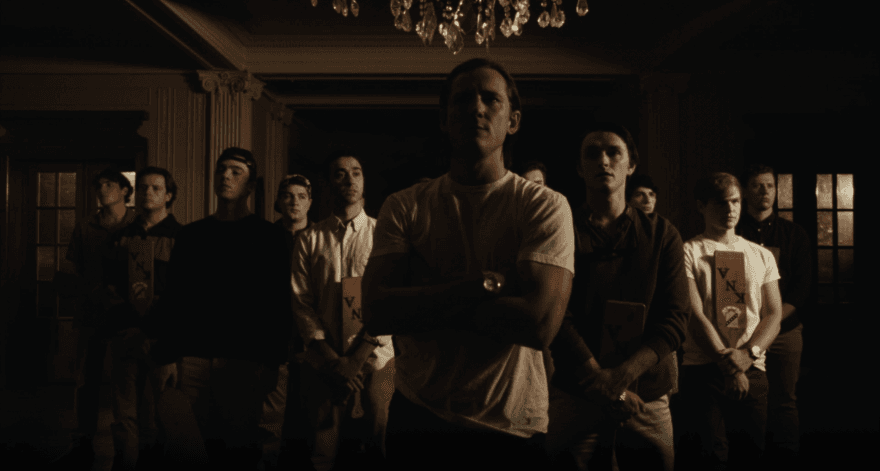
But there’s a different between smart and original, and Berger’s “frats can be awful” messaging arrives without much ingenuity. There’s partying and in-fighting amongst a bunch of petulant, entitled brats who rightfully or wrongfully know they’ll inherit the world after they graduate, and who act like infants whenever they don’t get their way. There’s no lies to be found in Berger’s approach, but also very little in the way of ingenuity. Pledges are subjected to physical, psychological, and emotional tortures to prove they can be part of the pack. Bad decisions will be made. Homophobic, ableist, and racist slurs will be hurled as jokes and insults. People will take things too far. There will be consequences for some who aren’t as well connected, and others with deep familial pockets will find ways to duck accountability time and time again.
It’s not that the characters in The Line are uninteresting, but rather that they are predictable people built from familiar frat movie archetypes. This is where Berger’s eye for casting (which includes brief cameo roles for old pros like John Malkovich, Cheri Oteri, Scoot McNairy, and Denise Richards) comes in to elevate The Line into a compulsively watchable film. Wolff brings a layered perspective to Tom, a low-key insecure young man who keeps code switching to keep up appearances, and whose darker skin tone makes him into a moving target for boorish jokes. Pullman excels at playing a “squeaky clean,” but complicit leader who expects greatness from everyone around him. And Mitchell delivers a star making performance as the unhinged and disrespected brother who comes across like the dark side of John Belushi’s Bluto from Animal House; a performance that is all raw nerve and delivered with full, uncomfortable investment.
If thematically The Line isn’t much more than a slow head nod of acknowledgement that frats are problematic, the rest of Berger’s package is something worth admiring and heeding. Its head is in the right place, and the elements of a good film are there, even if one can’t shake the familiarity of the material. It’s memorable, but only in comparison to other memorable works that share common DNA (The Chocolate War, Goat, School Ties, Burning Sands, Todd Phillips’ banned HBO documentary Frat House). It treats the subject seriously, and it moves with a great deal of accomplishment and force. Sometimes that’s all a movie needs.
The Line is now available on VOD.
