
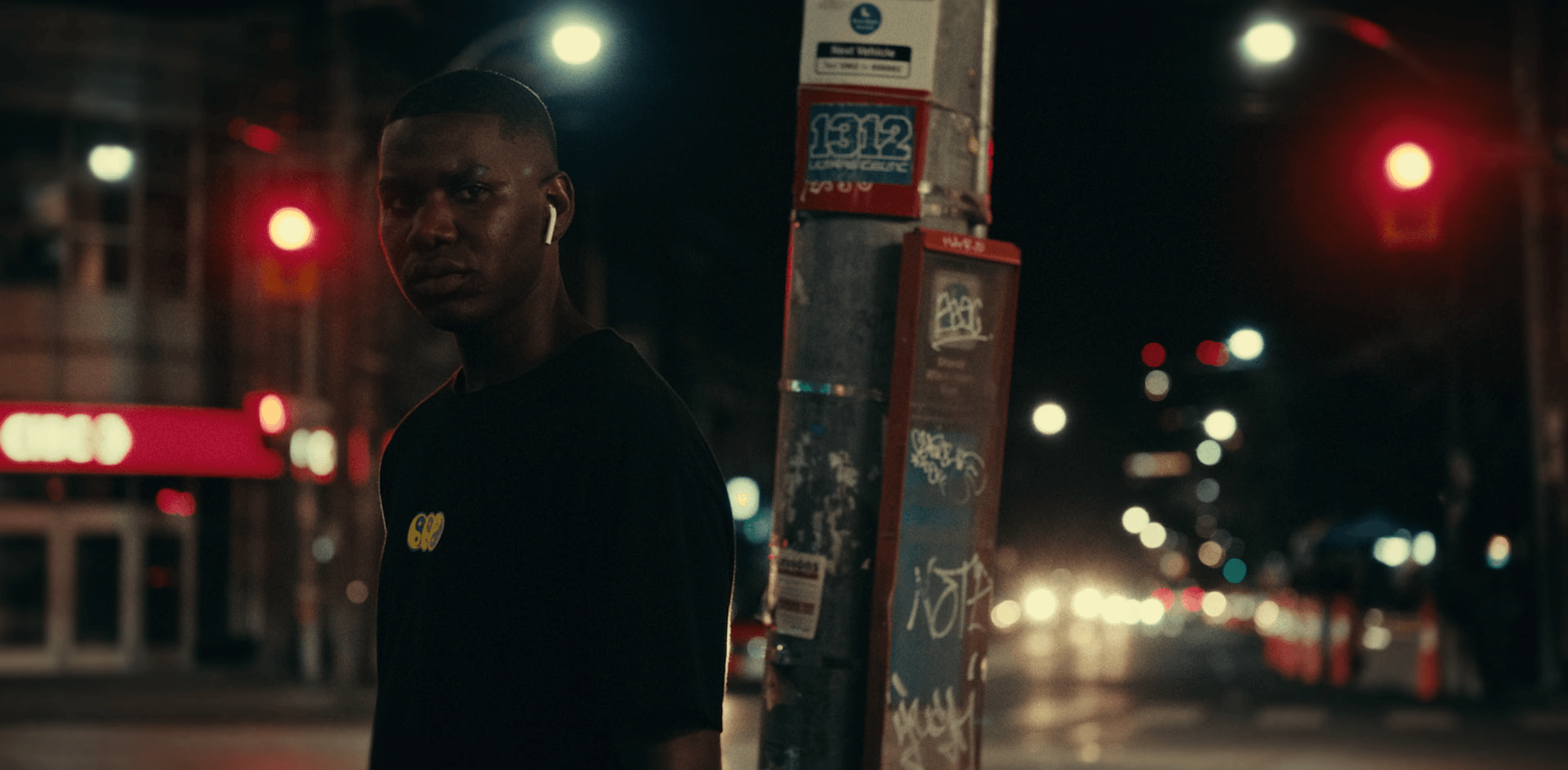
Filmmaker Reza Dahya’s first standalone feature Boxcutter is a creative drama steeped in artistic freedom and struggle. As its protagonists bounce around across a variety of different Toronto locations on a tight timeline in search of a missing McGuffin, Boxcutter contemplates what it truly means to be a successful, fulfilled, artist in a crowded landscape and cultural scene. Dahya and frequent collaborating screenwriter Chris Cromie have no easy answers about what constitutes success, failure, or at the very least, artistic satisfaction, but Boxcutter is a pointed plea for creative types to stop being their own worst enemies, get out of their own heads, and put themselves out into the world regardless of the reception they receive back. It’s main character is going to hell and back emotionally, but the final results are assuredly inspirational without being cheap or cloying.
Aspiring rapper Rome (Ashton James) is a perfectionist who would rather have his tracks come out to the world fully formed instead of trying to fine tune them in awkward situations. His struggling manager, Sid (Viphusan Vani), who is crashing on Rome’s couch, begs his friend and client to take some pay-to-play showcase gigs to build up his brand. But for Rome, it’s straight to the top or nothing at all. When Rome gets word that a high profile producer (Rich Kidd) is going to be having a low-key party in the city from a co-worker with a hook-up (Clairmont II Humphrey), he begs and bribes for an invite in a bid to get his music in front of some connected ears. Rome rushes home to get his laptop, only to walk in on a pair of burglars ransacking the place. With his back-up drive also stolen, Rome has no access to his eight completed songs. With the help of friend and muralist Jemaya (Zoe Lewis), Rome frantically speeds around the city to get his tracks back from his four producers before the party starts at 8pm.
The stakes in Boxcutter aren’t strictly life or death, but for a hungry, aspiring artists like Rome these concerns can become all consuming. There will likely be other opportunities, but times are increasingly desperate and he needs to hit now. Despite the fact that Rome steers clear of using social media or putting his tracks on streaming sites, he’s keenly aware that he lives in an economy where every artist is one chance encounter away from making it big, especially in a musically minded city like Toronto where success stories become things of local legend. The urgency in Boxcutter is real, but what sets Dahya’s clockwork-like quasi-thriller apart from other similarly pitched films is the decision to play this journey like a character study told in fine detail.
With a pronounced amount of nervous energy and artistic assuredness, James portrays Rome as a creative type who’s instantly identifiable. Rome can’t get out of his own head long enough to stop second guessing his choices, which extends to the fact that he somehow hasn’t performed any of his songs live and in front of a crowd yet. His insecurity is obvious to everyone around him, yet Rome refuses to settle for second best, hoping to skip the hard part of grinding it out in shitty gigs at second rate clubs in the suburbs and just getting to the part where he’s put on for his talent alone. He has a chip on his shoulder and refuses to fake it till he makes it, but he’s also crippled by the terror of potential failure. He annoys pretty much everyone around him with his fussiness, save for the eternally patient and sympathetic Jen, but even her encouragement can only cushion his ego so much.

The city itself also doesn’t prove too kind to artists who are afraid to put the extra work in. Boxcutter unfolds in a city where the artistic class is being pushed out in favour of the white collar worker who can afford million dollar renoviction aided condos. Just being in Toronto causes the characters in Dahya’s film stress outside of their professional goals. There’s no distinct centre for arts and culture in the city anymore, which forces Rome on a grand quest across the amalgamated megacity and all its varied neighbourhoods via a transit system that makes getting around in a timely manner impossible, and a place where cab rides and ride shares are cost prohibitive for those who are struggling. Privilege is seen all around Rome, but he’s not privy to even a small slice of the things that could make his life easier.
It’s easy to understand why Rome is so determined and foolish at the same time, especially during a wrenching scene where he witnesses the equally proud, but more realistic Jen running into artistic troubles of her own. Artists run on a human drive to get their message out, but almost all of them (with few exceptionally rare exceptions) also have a need for social or critical validation. If someone doesn’t get their vision, they wonder why that is and stress over the reasons it’s not landing. If they get brushed off and treated like they’re work is unimportant, they’ll tend to double down on their own worst impulses. If there’s any slight fear that something can be taken negatively, they’ll sit on it endlessly until they feel like they’ve crafted their own holy grail. It’s a lot of “I should” and “I would” and not a lot of “I have.” Dahya never shies away from looking at these struggles and contradictions in a realistic light, but the director also shows great love and empathy towards these characters, who look down upon themselves more than they look down upon the gatekeepers.
With hyper-specific references and sequences set in character rich Kensington Market, the eternally dusty Portlands, slowly gentrifying Regent Park, ethnically diverse Eglinton West, and the sensory overload that is the downtown core, Boxcutter is an unabashedly Toronto-centric movie (one that premiered last fall at the Atlantic International Film Festival and screened at SXSW this spring). But beyond a pronounced sense of setting and place, Boxcutter is most brilliantly about more universal themes and fears. Success, or at the very least happiness, means taking a bigger, less defined chance with one’s art, and Boxcutter is about finding the courage to take such leaps on one’s own terms and through hard learned lessons. It’s a film that makes the specifics deeply resonant with a wider audience that can see themselves in these characters, even if their struggles aren’t the exact same. The emotional truth in Boxcutter is off the charts.
Boxcutter opens at Scotiabank Theatre in Toronto and Cineplex Morningside Cinemas in Scarborough on Friday, June 13, 2025.
