
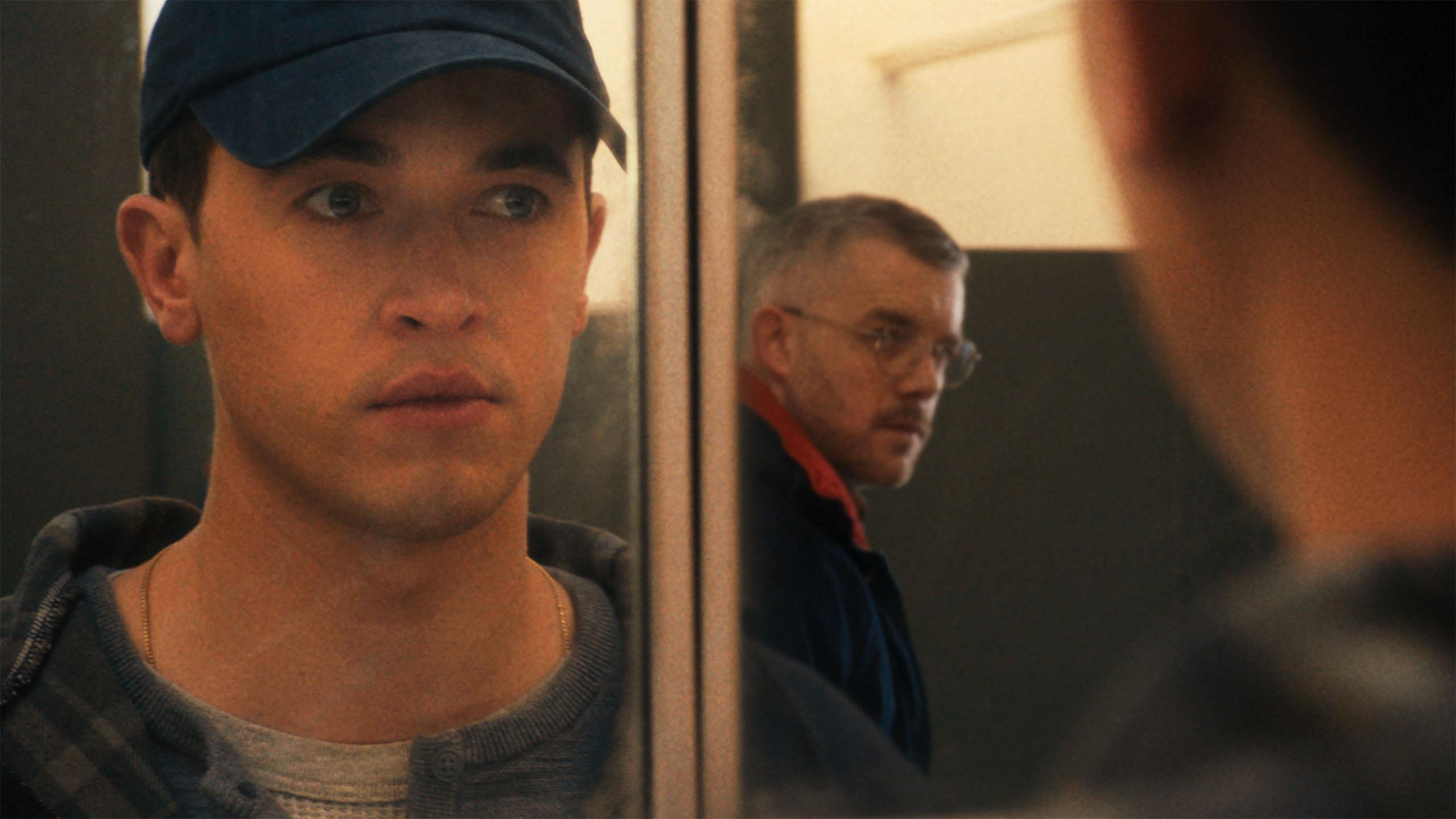
Carmen Emmi’s first feature Plainclothes is a refreshing, original blend of intrigue, romance, and psychological drama. Built around a unique period concept and a fascinating main character, Plainclothes might appear to some like a kinder, gentler version of something like William Friedkin’s divisive thriller Cruising. But in terms of execution, style, and writing, Plainclothes is something altogether more delicate and morally complicated than any flashy thriller aiming for shock value could ever achieve. Emmi gets under the viewer’s skin, burrows straight through the body, and leaves a mark with his exceptional examination of a closeted man coming apart at the seams.
Lucas (Tom Blyth) is a Syracuse, New York cop in the late 1990s. He’s part of an undercover task force that hangs out around the local shopping mall food court, hoping to lure unsuspecting gay men into compromising sexual situations in a public washroom. Lucas spots a target, lures them into the bathroom, and his partner (Christian Cooke) makes the arrest, hoping to book them on indecent exposure charges. It’s a lucrative hustle for the local police. Most of the men entrapped in this scenario are closeted and have families, meaning they’re unlikely to show up in court to fight the charges, opting to pay a fine instead of having their reputation destroyed in a public forum. From the opening of Plainclothes, it’s clear that the job is taking a toll on Lucas, himself a closeted gay man with a somewhat bigoted family – especially his boorish, leeching Uncle Paul (Gabe Fazio) – and a recently ended heterosexual relationship. Lucas has become fixated upon one of his marks, in particular: a kindly, attractive older man named Andrew (Russell Tovey), with whom he begins a secret affair.
Emmi employs a time shifting structure (revolving around a pivotal New Year’s Eve family get-together) that works well for the story and even better for the overall style of Plainclothes. The reduced framing and aspect ratio used by Emmi adds not only a sense of period realism, but also a pervasive sense of claustrophobia. The frame grows even smaller when Emmi and cinematographer Ethan Palmer employ flourishes of low grade digital camerawork that hit like bursts of memories forgotten suddenly coming back to life. Some moments are hazy, others crystal clear, but the visual decisions made by Emmi and his team always make it clear what the viewer is witnessing firsthand, and what sequences are coming directly from the point of view of the characters. It’s slick, and helps keep Plainclothes consistently on edge, even in its more relaxed and romantic moments.

The chemistry between Blyth and Tovey is natural and unforced. Their hook-ups often speak to something deeper inside the characters; leading frequently to deep, meaningful conversations. But in addition to revolving around marginalized people living in constant fear and a “rogue” cop going against his “sworn duty,” the core relationship is what gives Plainclothes most of its dramatic tension. It becomes clear that while Andrew has affection for Lucas, he can’t love Lucas the way he wants to be loved, sending the officer further into a downward spiral in his professional and personal life. There’s the danger of getting caught, and the fear that love could be slipping away.
Blyth’s performance is revelatory, and Emmi gives the rising star plenty to work with. Lucas is on edge throughout Plainclothes, and Blyth expertly shows how the character wants to seek out comfort and love rather than focusing on his unfulfilling sham of a life that causes him to constantly question his identity. Blyth displays great anguish in Lucas’ yearning for connection, but never resorts to overacting. It’s all in the character’s body language and cadence. The character is further complicated because in addition to searching for connection with another human being who can understand what he’s going through, Lucas is looking for two other things that a relationship can never provide for him: a cure for his crippling anxiety and absolution for all the guilt he feels. It’s a fully fleshed out tragic character expertly portrayed by an actor who continues to fascinate with his choices.
The dramatic reveals in Plainclothes are striking; potent without ever feeling manipulative, which is great for a story that relies on characters distorting the truth as a survival mechanism. The film serves as a depressing reminder of the underhanded policing within the gay community not that long ago, but more poignantly about the psychological torment people faced when the walls of the closet closed in on them tighter and tighter. There are waves of tension throughout Plainclothes, and only few moments of release or relief, but those quieter and more tender moments are what gives these men a reason to carry on in life. It’s depressing and built upon trauma, but also a thoughtful look at accepting one’s identity in the face of overwhelming oppression.
Plainclothes opens at TIFF Lightbox in Toronto, VIFF Centre in Vancouver, Sudbury Indie Cinema, Cineplex Forum in Montreal, Roxy Theatre in Victoria, and Roxy Theatre in Saskatoon on Friday, September 26, 2025. It opens at Metro Cinema in Edmonton on October 1. Writer-director Carmen Emmi and stars Tom Blyth and Russell Tovey will participate in a live, virtual Q&A following the 2:00pm screening of the film on Saturday, September 27 at TIFF Lightbox.
