

There’s a lot one can learn from failure. Plenty of films – both fictional and factual – have taken a look at how people rebound, relearn, or refocus after falling flat on their faces. But filmmaker Charlie Shackleton’s playful, metatextual documentary Zodiac Killer Project isn’t entirely about the value that can be found in failure. Instead, it’s about something a lot stickier and hard to put into words. Zodiac Killer Project looks at what happens when someone realizes they’re on the wrong path and decides to course correct.
An erudite visual essayist, Shackleton (Fear Itself, Beyond Clueless) decided several years ago that he wanted to make a film about a specific investigation into the identity of the infamous and unexposed Zodiac Killer, a serial murderer whose reign of death, terror, and cryptic clues became the stuff of legend in the San Francisco Bay area in the late 1960s. Many filmmakers – again, documentarians and dramatists – had parsed the topic of the Zodiac in the past, but Shackleton found himself particularly taken by one specific investigation into the killer’s identity.
Although less widely lauded and cited than Robert Graysmith’s 1986 book Zodiac (which is heralded in many true crime circles as the gold standard on the subject), former police officer Lyndon E. Lafferty’s The Zodiac Killer Cover-Up (a.k.a. The Silenced Badge) intrigued Shackleton more, igniting his creative instincts. Although he had never ventured into the realm of true crime filmmaking before, Shackleton pursued the rights to Lafferty’s book (one that focuses specifically on the author’s belief that he crossed paths with the killer on several occasions, and it wasn’t a suspect that the police ever looked at seriously), and began preproduction in earnest. Shackleton scouted and filmed locations in and around Vallejo, California, and began envisioning what the film’s dramatic reenactments of key events would look like. Eventually, Lafferty’s estate declined to sell the filming rights for the book to Shackleton, and upon closer consideration, the Zodiac Killer Project was abandoned.
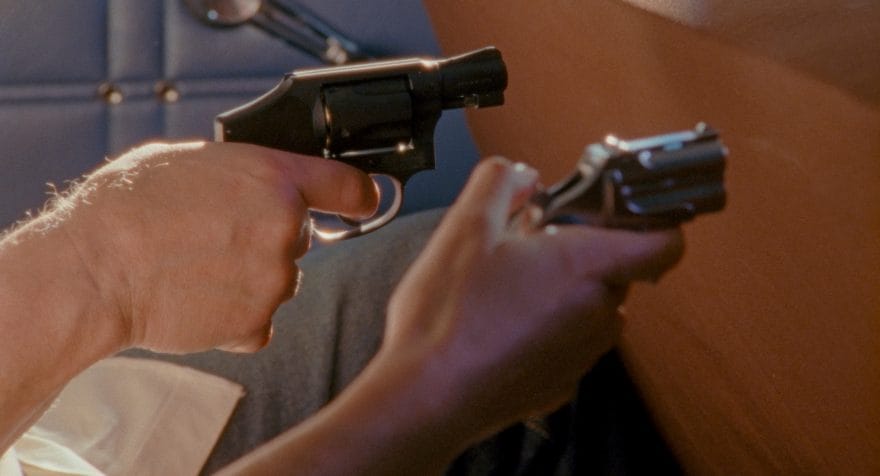
Instead of letting his ideas go to waste, Shackleton formed another visual essay around his research, interstitial footage, and half-formed concepts to examine the allure and over-saturation of true crime narratives. Zodiac Killer Project is stuck somewhere between an earnest presentation of bits and pieces of an actual documentary, and a discussion about the type of film Shackleton almost made. It’s not that Zodiac Killer Project is devoid of interesting and insightful tidbits about one of America’s most notorious crime sprees, but rather that Shackleton is offering a look into his creative process. The actual nuts and bolts of Shackleton’s research (some of which can’t be discussed here because not everything he learned in the early days of his inquiries has been vetted by lawyers) is secondary to the main question the director raises: Does the world need another film about the Zodiac Killer?
Shackleton narrates over his unused footage from a recording booth and discusses the challenges of working within a specific genre of documentary that has played itself out. While the subject matter at the heart of Shackleton’s scrapped project was challenging and interesting to parse, it’s clear that the production was leaning towards the kinds of tired visual and storytelling cliches that have become de rigueur in true crime movies. At times, it’s hard to tell if Shackleton is being critical of the genre, guiding the audience through a breakdown of true crime filmmaking, or simply getting a weight off his chest. This makes Zodiac Killer Project a sometimes meandering experiment that can feel a bit like a stream of consciousness podcast, but within some of the dryer passages, Shackleton is able to show an understanding for why the cliches he has developed and aversion to work so well in a true crime context.
Although Shackleton never before made such a straightforward documentary as the one he was planning to make about the Zodiac, the director halfway jokes that he could’ve learned the ins and outs of making a successful one almost through osmosis. Although Shackleton speaks warmly and lovingly about some true crime projects (including some examples that are inherently problematic), it’s clear that the more successful of these films are the ones that stick closest to a template. They’ll have those faux gritty opening title sequences that look like they’re from the deranged perspective of a killer, someone will say that a person or a place has “a dark side,” often over bucolic or banal footage, and there will be no shortage of “evocative B-roll;” those shots of burning case files, cigarettes in ashtrays, flash bulbs popping, eerie hallways, tape recorders turning on, etc. Shackleton looks at the nature of story structure for these kinds of projects, both illustrating how one deciphers several different threads and theories about the case at once, and noting which situations and developments lend themselves well to melodrama and tension building. Shackleton also express his unease at the genre’s need to cross several ethical lines in order to present a coherent argument in favour of singular or selected theories, especially in the case of unsolved or disputed crimes.
Zodiac Killer Project is more commentary than essay, which means tangents and lulls are sometimes unavoidable. It’s conversational in tone, and evident that a lot of this material is still in the front of Shackleton’s mind, and while he still shows a love for true crime narratives, he wants to confront their shortcomings and overall carbon copy familiarity. While there are some fascinating insights about investigatory minutiae throughout Zodiac Killer Project, this isn’t a film that’s likely to please those looking for the kinds of straightforward true crime documentaries Shackleton chooses to examine and parse. It’s not 100% successful as a film on its own, but then again, neither was the project Shackleton set out to make in the first place. Zodiac Killer Project is confounding, but also unique in its willingness to admit defeat.
Zodiac Killer Project screens at Hot Docs Ted Rogers Cinema in Toronto on Friday, November 21, 2025 at 6:00 pm, Sunday the 23rd at 4:00pm, and Saturday the 29th at 4:00pm. It opens at Metro Cinema in Edmonton on Tuesday, November 25 and at Dave Barber Cinematheque in Winnipeg on Friday, December 5.
