
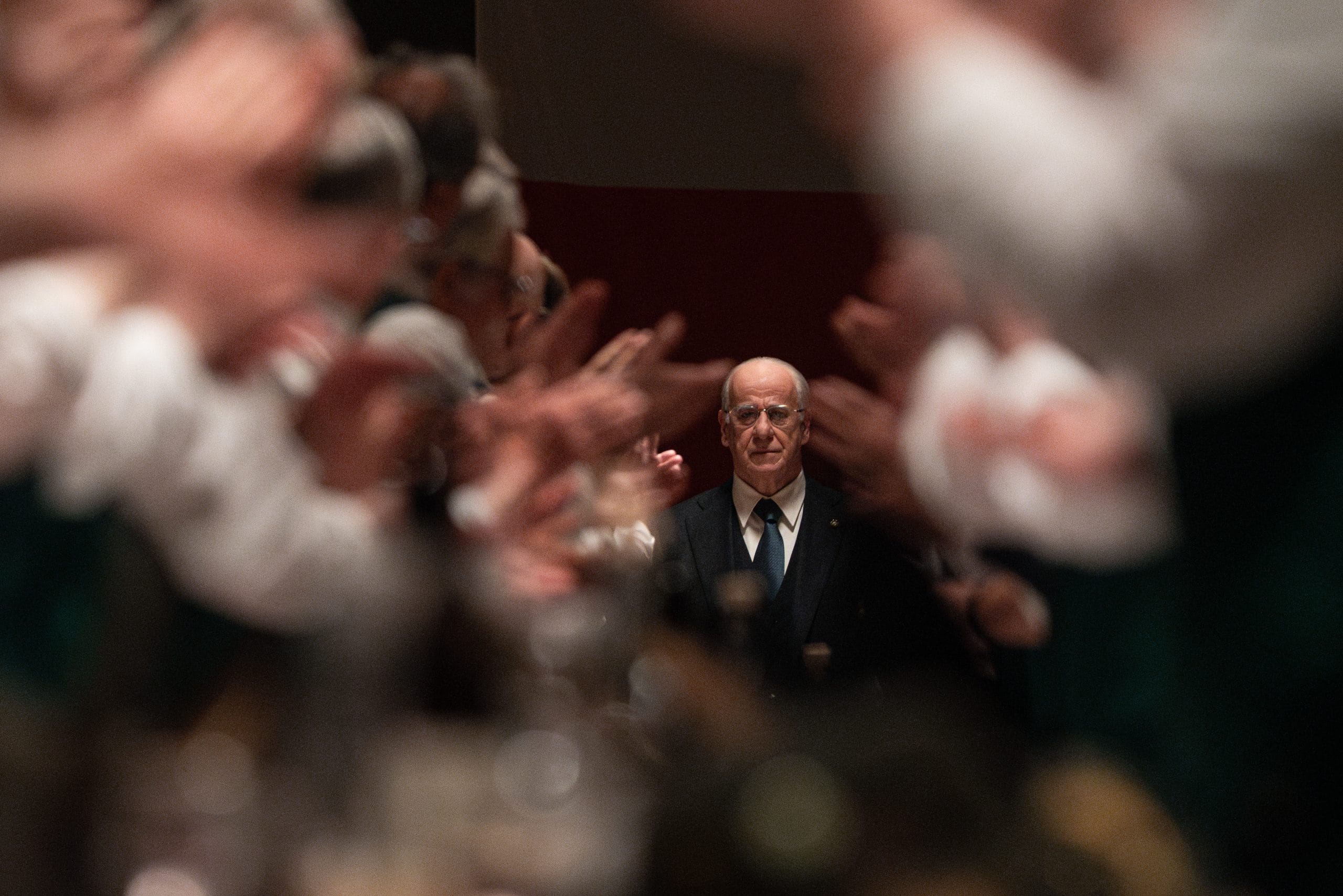
La Grazia, the latest film from stylish Italian auteur Paolo Sorrentino, is one of the director’s best and most reflective works to date, maybe because it’s a bit more low key than some of his more aggrandizing efforts. While some hold works like The Great Beauty, Youth, The Young Pope, and Loro in high esteem, I was never one of those people. Prior to La Grazia, Sorrentino was a filmmaker I’ve often said was one of my least favourite, or if I was being charitable towards how much I actively disliked most of his movies, the most overrated. He hadn’t made a film in years that I enjoyed or found worthwhile, dating all the way back to Il Divo in 2008. But just as I was about to write Sorrentino off as a one-trick filmmaker who’s only capable of recycling the same through-line of creepy men reflecting on their lives, Sorrentino offers up what might be his absolute best variation on the theme yet.
Frequent Sorrentino collaborator Toni Servillo stars as both an aging man and a politician, two things Sorrentino has centred movies around several times before, so he’s nothing if not going back to the well here. Servillo portrays Mariano De Santis, a lame duck president entering the last several months of his term in office. There’s not much left to do and not enough time or support to try something new. He’s decidedly melancholic, stuck in a cycle of boredom and stagnancy, still grieving the loss of his wife. His daughter and closest advisor, Dorotea (Anna Ferzetti), tries to keep dad motivated, but it’s tough going. In addition to steering the government towards an eventual successor – most likely his longtime friend and Justice Minister Ugo Romani (Massimo Venturiello) – there are only two pressing issues left for Mariano to tackle. One is deciding whether or not to sign a bill allowing access to euthanasia and assisted suicide, a sticky political and religious issue in a country where the Pope holds a lot of sway. The other involves a pair of pardons for convicted murderers whose crimes are more complicated than the courts would have the public believe. But amid his existential rut, Mariano would rather vegetate in his office listening to Italian rap music on his headphones, content to drag his heels and potentially leave any hard decisions to his successor.
La Grazia is another Sorrentino film that follows an aging, once virile male figurehead trying to stave off irrelevance and obsolescence in a modern world that has little space for him. That’s nothing new, but La Grazia is decidedly less horny and leering than a lot of Sorrentino’s other takes on this subject. Like every other Sorrentino film, La Grazia is also an exercise in style and form, but not at the expense of the narrative this time out. Most of the story here plays out in the same halls of power, devoid of life and vibrancy except for what Sorrentino is able to bring to the settings. Visual subtlety has never been Sorrentino’s strong suit, but a lot of his showy flourishes here have a more poetic and elegant bent instead of being in-your-face provocations and proddings. It’s still a Sorrentino film, but a kinder, gentler one that’s able to be a bit more granular in its look at life on the backside of middle age.
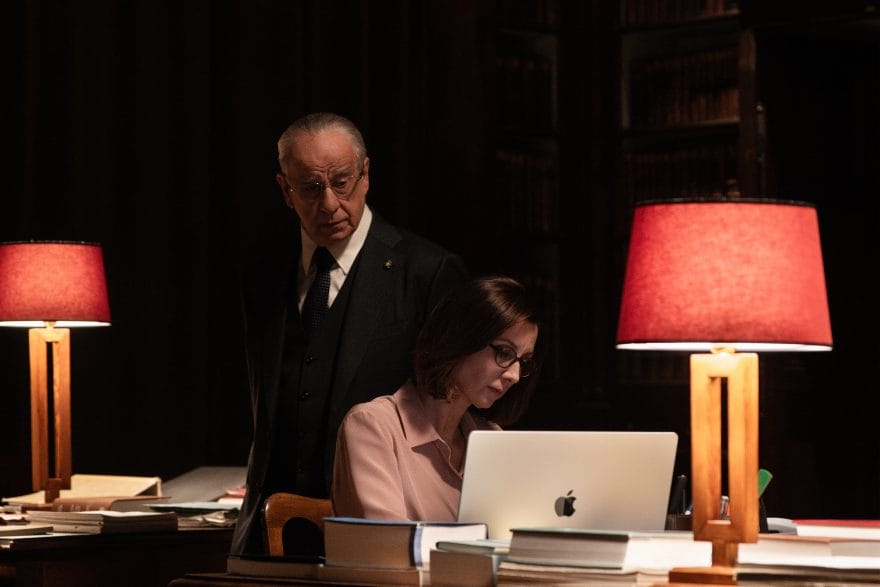
In all their years of working together, Sorrentino has never given Servillo such a wonderful platform for his talents. President De Santis’ arc is one steeped in death and legacy, both internally and externally. Both of the issues presented to him revolve around the end of life. He consistently pines to be reunited with his late wife, even after a mutual friend of their’s (Milvia Marigliano) lets it slip that she had an affair, despite his fidelity. He’s described even by his closest friends as an immovable object that can’t be swayed, but Servillo depicts Mariano’s awakening as something slow building and nuanced, not the kind of explosive revulsion of convention that Sorrentino normally traffics in. There’s a gentility and warmth to Mariano that’s expertly depicted by a never better Servillo. The actor expertly parses the core question of Sorrentino’s material: at what point does life become too much to handle and when do we give up?
The pacing of La Grazia is slower than one might expect from the usually hyper-charged Sorrentino, and in some of the film’s admittedly duller moments, that choice feels like an over-calculation. A lot of the same narrative buttons are pressed repeatedly here, but again, that’s part for the course in a Sorrentino film. Only this time, that choice revolves around a character incapable of making firm decisions for a variety of psychological reasons. Instead of feeling like another attempt to change a few notes from an established piece of music, La Grazia feels like a final draft made from one of the writer-director’s lesser works. There’s reasoning. There’s moral, ethical, and legal complexity to the topics at hand, and all of them are handled with care, respect, and empathy, three things often sorely lacking from Sorrentino’s films. The father-daughter dynamic between Servillo and Ferzetti is the best on-screen relationship Sorrentino has ever come up with, and both characters compliment each other more than they clash. Even when disagreements arise, the responses are as believable as they are measured.
Maybe Sorrentino has gone soft as of late. Or maybe he has just figured out how to better modulate his impulses and fetishes and turn them into stories that have just as much substance as they do style. La Grazia isn’t the kind of elegant film that Sorrentino has become most renowned for, but I prefer this kind of contemplative and playful approach from him a lot more than I do his more blustery or saccharine efforts. There’s true gravitas to be found here, and while it might not give viewers what they’ve comes to expect thematically or stylistically, La Grazia still has a familiar enough story that they can fall back upon.
La Grazia opens in select Canadian cinemas on Friday, December 12, 2025.
