
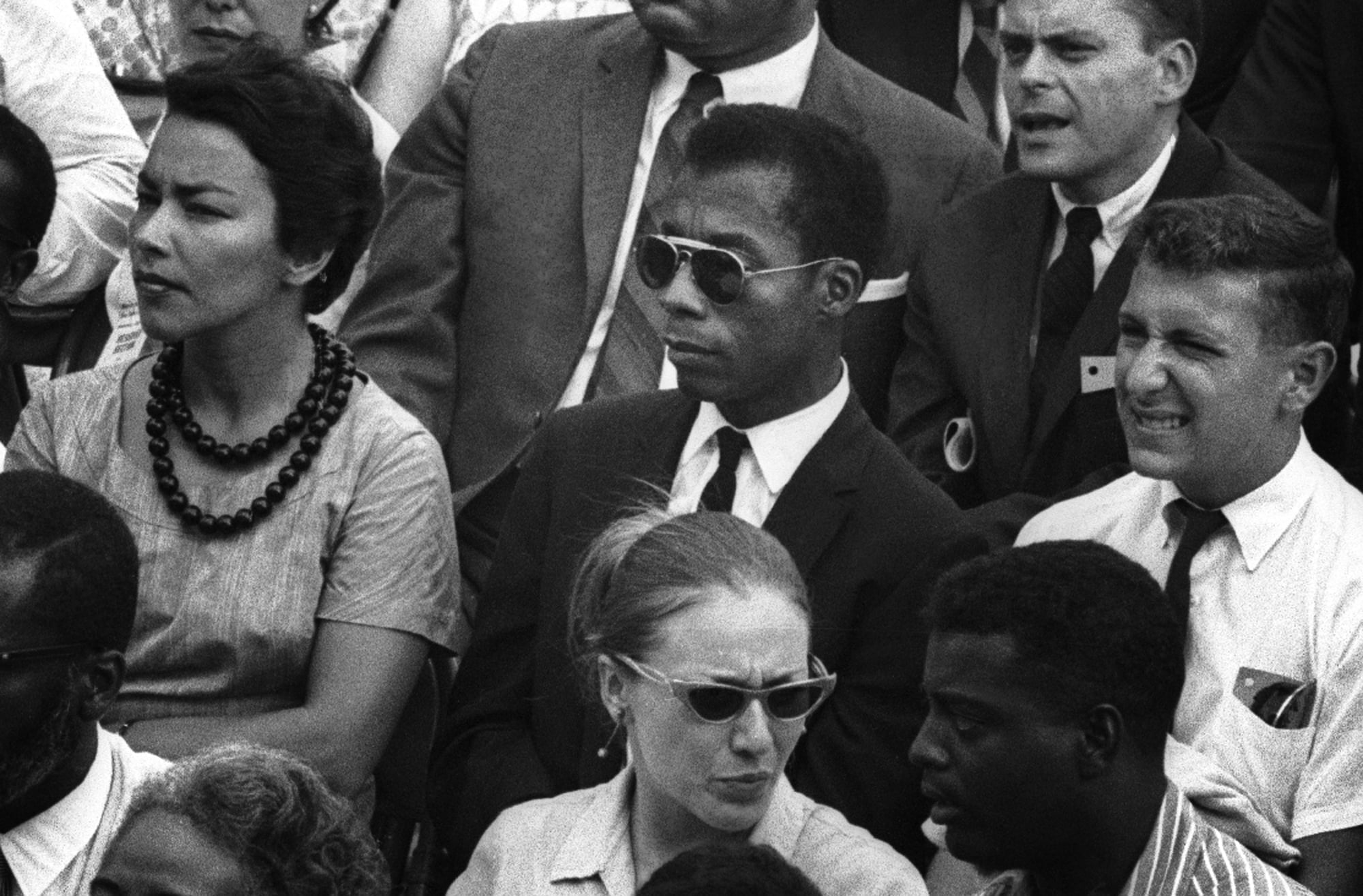
It would be an understatement to say that Raoul Peck’s Oscar nominated documentary I Am Not Your Negro – a look at the life, fortitude, and scholarship of writer James Baldwin through a close examination of his final, unfinished work – is a work of great cultural importance. The words and actions of Baldwin as depicted in Peck’s film are just as relevant today as they were at the time of his passing in 1987, and quite depressingly not much has changed regarding race relations in America during those intervening years. In the wake of Hurricane Katrina, Rodney King, Ferguson, Trayvon Martin, Mike Brown, and countless other tragedies that saw black people in America marginalized – all of which happened after Baldwin’s passing – I Am Not Your Negro strikes as a warning and wakeup call that has been ignored for far too long.
I Am Not Your Negro takes the shape of a historical montage, with Peck blending Baldwin’s written and spoken words with modern and archival footage. Most of the film has been built around the creation of Remember This House, an ambitious work that sought to combine biography, scholarship, and cultural commentary through a linking of the lives and murders of Medgar Evers, Malcolm X, and Martin Luther King Jr., all men that Baldwin had been friendly and collegial with and all of whom died before the age of 40. It was a tome that Baldwin announced to his literary agent in 1979, but thanks in part to an extensive research process, only thirty or so pages of the book were completed upon his death. Samuel L. Jackson joins Peck to read and narrate the written works and correspondences kept by the author, imbuing Baldwin’s words with a weary solemnity and intellectualized sense of frustration throughout.
It sounds on a cursory glance like Peck strives to resurrect Baldwin’s final work while crafting a link between Baldwin’s past, the lives of three historically significant figureheads of black culture, and the current American reality, and while the film is successful in those aims, there’s a lot more to unpack throughout I Am Not Your Negro. While effective in its underlining and elucidating of Baldwin’s personal anger and frustration and the struggles faced throughout his career in trying to bring racial inequality to light, I Am Not Your Negro uses this approach as a jumping off point for a wide range of larger issues. Peck places the viewer in similar proximity to the sometimes differing ideologies of the men whose shadows loom so large over the film, but also looks at how these differing viewpoints stem from the same issues. It’s a film more concerned with the roots than the branches; the things that remained largely unseen and harder to parse.
Thanks to unprecedented access granted to Peck and his crew by the Baldwin estate, I Am Not Your Negro has the resources to sprawl outward and make necessary, unambiguous connections to historical and cultural precedents that might initially seem tangential to the work of the core subjects, but in reality are links that can’t be separated from the works. As Baldwin tried to do throughout his life, Peck seeks to deconstruct the myth of the “docile negro” and look into what longstanding injustices perpetrated by the largely white establishment are worth getting angriest over.
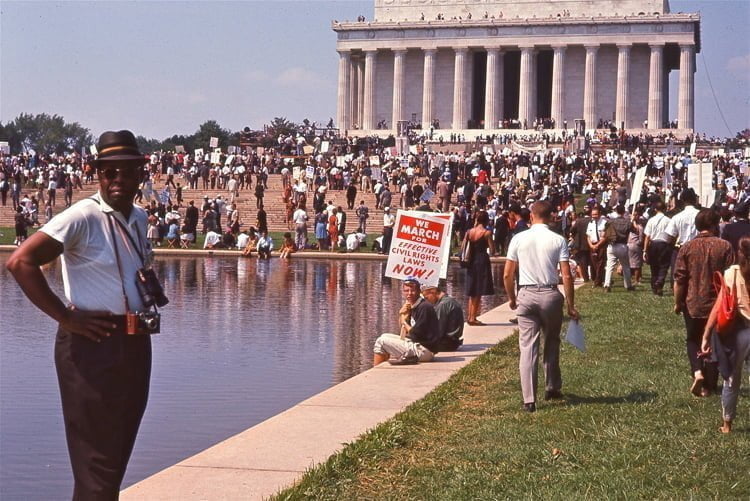
There are some more obvious injustices fleshed out in great detail here; like how an entire nation can be built from slave labour and the eradication of indigenous peoples, and how “simplicity” is seen as a uniquely American virtue that can give way to complacency and intellectual infantilism. Beyond the most basic of critiques, however, lie a lot of racial inequalities that people don’t pay closer attention to, and they’re often the more insidious hidden causes of racism.
Via Baldwin and his colleagues’ works, Peck illustrates how popular culture created with a sense of “simplicity” and “nostalgia” can effectively demonize or hold back an entire race. Popular culture thrives on happy memories of the past instead of looking forward to the future, and an emphasis on fantasy over reality creates a toxic mixture where discussions surrounding representation and depiction of various races, sexes, and orientations are often lost. As Baldwin notes, Harry Belafonte and Sidney Poitier were always seen as great actors, but the Hollywood establishment and the movie-going public in their heyday would never have labelled either man as a sex symbol or anything more than just a performer.
From these pointed looks at culture, Peck builds one of strongest cases yet against the folly of “not seeing race,” or the fallacy that suggests that racism doesn’t exist in the hearts of people who self-consciously choose to believe in a false sense of equality. Just because one person staunchly believes that a black person and a white person are equal doesn’t mean that society as a whole will fall in line behind this individual’s point of view. It’s a point driven home in the film’s best moment: an interview segment on conducted by Dick Cavett where Baldwin tears apart a philosopher’s assertions that racism is a thing of the past. That segment was from the 1970s, and it feels like it could have taken place several hours ago in a similar fashion between two different people.
This “colorblindness” that some white people claim as the hill they’d like their ideologies to die on is often what plants the seeds of white frustration and causes the kind of reactionism currently on display in Trump’s America. After centuries of oppression and mistreatment, expecting black people to be instantly grateful for more professional opportunities in a world that sometimes overtly seeks to continue their marginalization is disingenuous and wrong. Peck wants to show why this point of view is backwards and entitled, but also why white America hasn’t really changed at all in the past hundred years.
That link between the past and present is frightening to think about, which is why the main and perhaps unsurprising message of I Am Not Your Negro is about how those who do not learn from the past will be doomed to repeat it. While some of the imagery here is a bit overblown and on the nose (a side effect of the structure Peck employs) and uncomfortably little here that deals with the perspective of black females, I Am Not Your Negro makes a searing case for such ignorance to come across as criminal.
I Am Not Your Negro opens in Toronto, Montreal, and Vancouver on Friday, February 24. It expands to other Canadian cities throughout the winter.
Check out the trailer for I Am Not Your Negro:
