
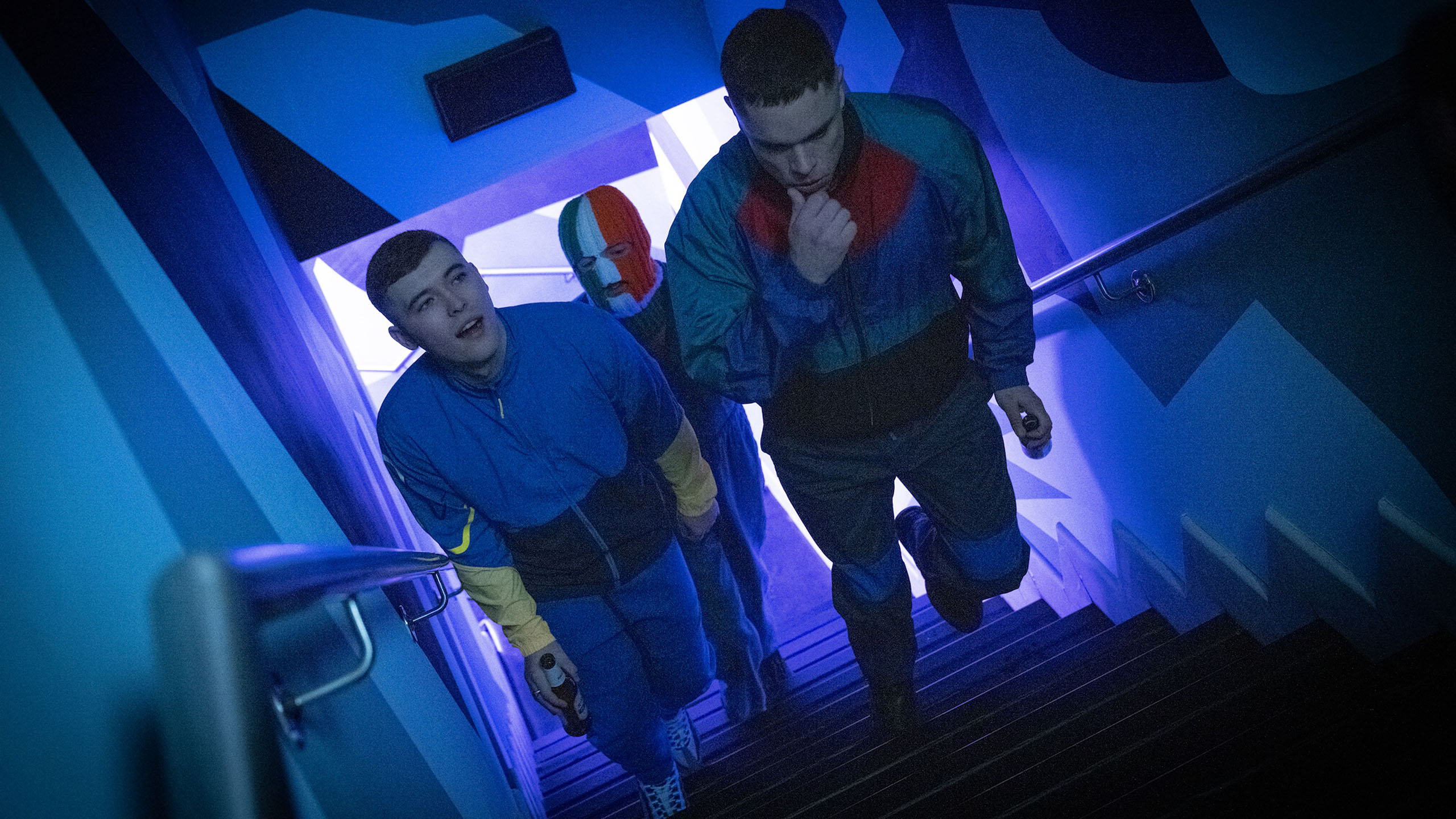
In the longstanding tradition of films where famous bands or musicians play themselves in fictionalized versions of their lives, there has never been anything quite like Kneecap. A movie that mashes up vibes from The Commitments, 8 Mile, the Harold & Kumar films, Trainspotting, and Michael Collins into a single package and still somehow works, Kneecap’s profile of a hip-hop group from Northern Ireland that’s as politically minded as its members are strung out on booze, pills, weed, and anything snortable is one of the few truly original movies of the year. The fact that it stands for something worth fighting for is an extra bonus.
Best friends Naoise (Naoise Ó Cairealláin, a.k.a. Móglaí Bap) and Liam Óg (Liam Óg Ó Hannaidh, a.k.a. Mo Chara) spend most of their days trying to score, sell, or ingest narcotics in a bid to dull the pain of their humdrum Belfast lives, all while trying to stay one step ahead of the peelers (a.k.a. cops), who have it in for them because Liam’s missing/inaccurately presumed dead father (Michael Fassbender) was a major player during and after The Troubles. Naoise is a talented lyricist – writing rhymes down in a notebook, all of them in his native Irish tongue – and both are talented M.C.s. During one such run-in with the law, Liam crosses paths with JJ (JJ Ó Dochartaigh, a.k.a. DJ Próvai), a frustrated Irish language and music teacher who makes beats out of his garage on the side. Together they form the hip-hop outfit Kneecap, and in the face of what they fear will be overwhelming apathy from the public they become unlikely success stories, and targets of increasing scrutiny from the community at large.
Directed and co-written by Rich Peppiatt (penned alongside the members of the band), Kneecap is a drug fuelled romp that inherently understands the vulgarity of politics and everyday life. The lyrical content of Kneecap’s tracks might not appeal to everybody – even if they can speak or understand proper Irish – but within these sometimes juvenile tracks about wasting the day away while high there lies a potent message about the preservation of language. Outside of having a good time, living hard, and hopefully not dying young, Kneecap (both the band and the film) is able to connect by having a rock solid sense of identity and culture. If Irish is the language of the people, and Kneecap raps the language of the streets, the band then becomes an invaluable keeper of the word. If the oppressors want to get pedantic about language, Kneecap is there to show them what it truly means to be pedantic.
It’s not a huge jump from what Kneecap does to what’s happening around the world when it comes to the preservation and reawakening of other indigenous languages, something Peppiatt shows his understanding of via a flashback where Fassbender’s patriotic father tells the young boys to watch an old American western and try to understand it from the “Indians” perspective. The same character also teaches the kids that every word of Irish spoken is a bullet for freedom, and they take it to heart and use the advice to rebel, empower themselves, and express great pains with a sense of cheeky humour. Naoise and Liam Óg refer to themselves as “ceasefire babies,” and espouse their feelings of generational trauma. They might be saying this just to score pharmaceuticals at some points, but they also speak a great amount of truth. Although they can sometimes target others with their lyrical content, they themselves are targets simply because they’ve made choices that vex the establishment.

Like many homegrown musical acts rooted in a specific culture and ethnicity, Kneecap also show a deep love for their community. They understand the reputation that Belfast has outside of the country, and they’re keenly aware how it informs their narrative. Even those in opposition to what the group represents and their adolescent leanings – including Liam Óg’s father and JJ’s wife, both of whom are part of organizations that think the lads are damaging the cause – are show a great deal of love and respect throughout the film, proving that the goal here is to continue a conversation and provoke meaningful arguments rather than ignoring the issues at hand. The members of Kneecap don’t fear being labelled as layabout dopers and hoods, just so long as the listener considers the overall intent.
That’s the most pleasing thing about Kneecap. No matter how narratively or stylistically insane Peppiatt gets with the material, an engaged viewer always feels like they have been invited to a gathering they might’ve never been privy to otherwise. Mo Chara’s sharp narration helps to guide the uninitiated through a lot of the cultural specificity with a great deal of playfulness and anarchic attitude. Whether trying to explain what it’s like to be bitten by a police dog while high on MDMA or soundtracking a claymation primer on the continued importance of radio airplay, Mo Chara proves an astute, charismatic teacher. The boys in the band know most of the viewers are outsiders, but in spite of their posturing, they’re more than willing to welcome any and all into the fold and the cause.
Kneecap gets off to a lightning quick start, but never quite finds a proper narrative groove. The trio of leads always carry the day, all of whom do great work, especially for non-actors, but the situations they find themselves in lead to Kneecap getting sometimes bogged down in an overabundance of plotting. The idea of groups opposing the band – both more intellectual and more thuggish – makes for a good wrinkle, but they also take up a lot of space and screen time, lessening the more subtle and fun aspects of the film. A thread involving Naoise’s mother, Dolores (Simone Kirby), growing increasingly despondent, depressed, and frustrated with her stuck-in-the-past husband also fights for screen time, despite being well handled. Similarly, a romantic, lustful subplot where one of the lads gets involved with the tough talking daughter (Jessica Reynolds) of a cop (Josie Walker) spins its wheels without giving too much back except for some silly titillation. Peppiatt handles these sequences well, and it’s always well done, but the added bloat and inclusion of performances that are basically just music videos leave Kneecap with a start-stop sense of momentum. Somewhat admirably and equally to the film’s detriment, Kneecap is trying to do anything and everything because the parties involved might not have such a grand platform again.
But the film remains a potent balance of debauchery and teachable moments. In one of the film’s best jokes, a frustrated JJ gripes to a co-worker that he needs modern Irish textbooks because the one’s at his disposal are still trying to teach the language in relation to plowing fields, cutting grass, and shovelling shit. Kneecap (which picked up an audience award at this year’s Sundance Film Festival) represents a new form of teaching: a subversive co-opting of lowbrow aesthetics to foster cultural and political freedom and enlightenment. If only all teachers were this creative, maybe the world would be a better place.
Kneecap opens in select Canadian cities – including at TIFF Lightbox in Toronto – on Friday, August 2, 2024.
