

Here is filmmaker Robert Zemeckis’ most openly experimental film to date, but that doesn’t mean it’s a successful one. Bouncing back and forth across time periods and attempting to recreate the style of reading a graphic novel – both to little reason or rhyme – Here takes a fixed point of view spanning centuries and muddies its own waters by never sticking to anything it might actually be good at. It’s jittery, overstuffed, unabashedly corny, and out of date in spite of all the technology Zemeckis has at his disposal. Here is a mess and sweet enough to rot your teeth, but it’s kind of an interesting failure because it is swinging as hard as possible at a pitch it could never hope to hit.
It’s a hard movie to explain. Here takes place mostly in the living room of a house, and examines the lives of all those who dwelled within its walls. Actually, it’s mostly just about a single family that owns the house from the 1950s until sometime in the early 2000s. Wait. Even that’s not true. You see, it’s kind of about the land itself, because in three of the threads – one set in the ice age, one amongst pre-verbal indigenous peoples, and one that shows how the land was across the street from the home of Benjamin Franklin’s illegitimate child (!) – the house doesn’t even exist.
Zemeckis’ camera is affixed to a single location, never moving from it’s spot until the very end, meaning that there’s little movement or framing outside of the actors. Zemeckis tries to compensate for this by annoyingly trying to layer frames within frames, much in the style of a graphic novel (which the film is based upon, written by Richard McGuire), but the results are only more visually schizophrenic. To add to the visual distortion, most of the effects to show the passage of time find Zemeckis still toying with the de-aging, motion capture, and green screen effects he has been embracing since making The Polar Express. Although these techniques and tricks have come a long way, they remain unconvincing and uncanny here, especially at making known and established faces belonging to the likes of Tom Hanks, Robin Wright, and Paul Bettany look older or younger than they are in real life.
The majority of the story concerns a typical American family. After returning home from the war with some obvious PTSD, Al (Bettany) buys the property with his expecting wife, Rose (Kelly Reilly). They raise their family through any number of personal struggles, but mainly they all have to put up with Al’s woes as a travelling salesman being passed over for promotions and his alcoholism. Their eldest son, Richard (Hanks), dreams of being an artist, but Al isn’t having any of that. Richard’s life goals derail after falling in love with Margaret (Wright) and getting her pregnant, resulting in the two youngsters getting a shotgun wedding. Without enough money to strike out on their own, Richard and Margaret end up living under Rose and Al’s roof for much longer than they would like.
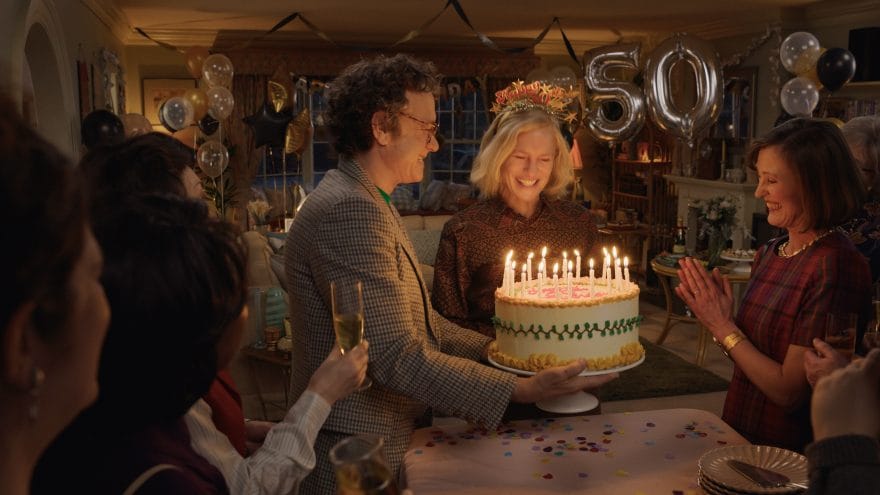
If Here had simply stuck with that storyline, it still wouldn’t be a great movie, but at least it would’ve been contained and manageable. It’s melodramatic, manipulative, and predictable in the extreme, but at least this portion of Here has the kind of structure that would make any other complaints about its construction easier to swallow. Hanks and Wright, two outstanding performers with proven chemistry working under Zemeckis, never find much of a way to differentiate their younger selves and older personalities, but at least the latter gets a really strong and well delivered monologue on their character’s 50th birthday. Reilly gets a couple of good scenes, but she’s relegated mostly to the role of a traditional 50s and 60s housewife. Bettany fares the best by far, understanding how his character needs to change over time perfectly, and while his performance often feels like a stage actor projecting to a back row that isn’t there, it’s nothing if not energizing to watch whenever he becomes the focal point.
But at various points in Here, Zemeckis and co-writer Eric Roth jump back in history to look at other melancholic dwellers of the land, most of their lives marked by tragedy and sorrow. There’s the pilot (Gwilym Lee) from the early days of aviation and his worrywart wife (Michelle Dockery). There’s the aforementioned indigenous lovers (Joel Oulette and Dannie McCallum). There’s whatever the heck is going on in the Revolutionary War timeline (which no matter how hard I try to reason that one out, it still eludes me). There’s the well-to-do, modern day black family (Nicholas Pinnock, Nikki Amuka-Bird, and Cache Vanderpuye) who take over the house after Hanks and have to deal with the pandemic and a newfound resurgence in American racism. All of these storylines – including the one involving the core family – are an absolute drag, save for one involving the eccentric inventor of the La-Z-Boy recliner (David Fynn) and his free spirit wife (Ophelia Lovibond): the only genuinely happy people to inhabit the space. But in comparison to the bulk of Here, all these additional threads add precisely nothing except ways for Roth and Zemeckis to underline, boldface, and make connections to points that are already patently obvious. They’re so underdeveloped and threadbare that their inclusion in Here makes little sense beyond unnecessary stylistic choice.
Nothing in Here is tackled with subtlety or depth, and the material plays into Zemeckis’ worst, most maudlin tendencies. The foreshadowing looms so great that the whole film seems to be taking place under a spotlight. And worst of all, the viewer is locked into a single space, with no sequences on display that allow them to get out and stretched, doomed to an eternity of watching a flimsy, hyperkinetic scrolling through American history. But Here is certainly ambitious, and it’s clear that Zemeckis wants to go as big as possible with the material. It’s an unconvincing film that’s overthought and under-realized, but within all of these parts that add up to an unfulfilling whole lies something worth pondering: how something this seemingly easy could go so terribly wrong.
Here is now playing in theatres everywhere.
