

The mega-budgeted prequel series Dune: Prophecy is less satisfying as a tie in to the recent film adaptations of author Frank Herbert’s beloved novels and is currently better viewed as a way for HBO to dutifully kill some time until the next instalments of House of the Dragon and The Last of Us are ready to air. Suitably grandiose, but altogether familiar to anyone with an understanding of the current HBO formula or developing such series, Dune: Prophecy (which premiered this past Sunday) isn’t much more than okay viewing. But is that good enough when series creators Diane Ademu-John (Empire, The Haunting of Bly Manor) and Alison Schapker (Westworld) are trying to tell such an elaborate and complicated story? That’s a question best left to viewers, and after seeing the first four episodes (which were all that were available for review by press time), I’m still not quite sure. But colour me cautiously optimistic.
Dune: Prophecy takes its inspiration from Herbert and co-writer Kevin J. Anderson’s novel Sisterhood of Dune and (with the exception of some flashbacks) unfolds 10,148 years before the events of Denis Villeneuve’s adaptations. Mankind is trying to regroup following an all out war for survival against “thinking machines,” and a lot of technology has been outlawed. In the aftermath of the war, the Atreides clan have been branded heroes, while the Harkonnen are seen as cowards. One person who would beg to differ with this distinction is Valya Harkonnen (Emily Watson), leader of the Bene Gesserit, an all female sect that trains Truth Sayers. Often flanked and aided by sister and fellow instructor Tula (Olivia Williams), Valya keeps her ancestry at arms length while showing women how to get in touch with the powers inside of them, hoping these cunning fortune tellers will be able to steer the world away from falling under the influence of tyrants and false prophets.
Valya is in the midst of fulfilling a decades old prophecy passed down by her predecessor, with the ultimate goal of getting one of the sisters from the order on the throne, and if that sounds familiar, it’s because Dune: Prophecy feels very much like a sci-fi epic made to fit the fantastical, highly political Game of Thrones model. Valya’s goals are compounded by an ongoing power play between Emperor Javicco Corrino (Mark Strong) and the rest of the known universe, most notably the leader of House Hagal (Callum Coates), who hopes a marriage between his young son and the lovely Princess Ynez (Sarah-Sofie Boussina) will strike a balance. All of that is compounded when one of Emperor Corrino’s soldiers (Travis Fimmel) returns after being presumed dead, saying that he has passed through the body of a sandworm and now has mystical powers, claiming that the Emperor’s troops have been double crossed from within.
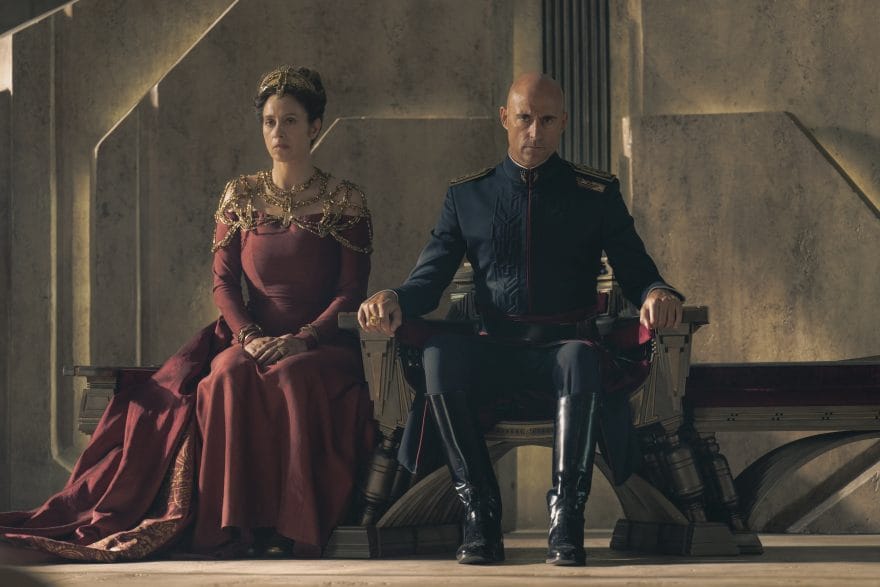
It’s a lot to explain, and I can’t do Dune: Prophecy justice without getting into spoiler territory. Needless to say, it’s a lot to take in, but those willing to get heavily invested in deeply layered mythology aren’t likely to be disappointed. The most refreshing element of Ademu-John and Schapker’s take on this type of series is how it predominantly adopts a female perspective throughout, only briefly cutting back from time to time and peeking in on whatever the emperor and his nutty new sidekick are up to. The series finds a perfect centre in Watson (and also in Jessica Barden, who impresses in flashbacks as the younger version of the character), and her interactions with any of the other supporting characters carry a considerable amount of dramatic weight. It’s a powerful lead, nicely backed up through the work of Williams, Strong, and Boussina throughout. (Although the less said about Fimmel’s terminally goofy, seemingly Jack Sparrow inspired wild-man, the better. Things screech to a halt whenever the story circles back to him.)
Dune: Prophecy doesn’t have the same directorial vision as the films did, but the lavish production values, top notch visual effects, and key elements of the story link the projects rather nicely. Where Dune: Prophecy differs the most, however, is in the HBO-ness of it all. This is a very soapy and comparatively tawdry production that inorganically goes out of its way to provide the occasional shock (no matter how unsatisfying the landing) or elongated bits of steamy sex (no matter how unsatisfying the landing). It’s a denser text and also harder to take seriously, in spite of its resolutely dour and hopeless world view. In each of the first four episodes, an event will happen that seems to be shoehorned in for either titillation or gasps because someone at a higher level of production said these things had to be in there for the show to be a hit; not because they make the most sense. It’s made to keep viewers coming back for more, but that tack is starting to become more transparent the more series try to lean on it for longevity.
But while that adherence to a network induced formula frustrates, and not all the pieces fit together naturally, Dune: Prophecy has a lot more going for it than it does against it. The “historical” context that Dune: Prophecy imbues into its parent franchise is enriching and interesting, and the pacing of the show thus far is confident and assured. If the series can break away from the established formula that has been thrust upon it even further, there’s potential for something game changing and everlasting on the horizon. But for now, viewers will just have to settle for something familiar and pretty good. It could be going somewhere, though.
New episodes of Dune: Prophecy premiere every Sunday night at 9pm EST/6pm PST on Crave, Canada’s home for HBO series.
