
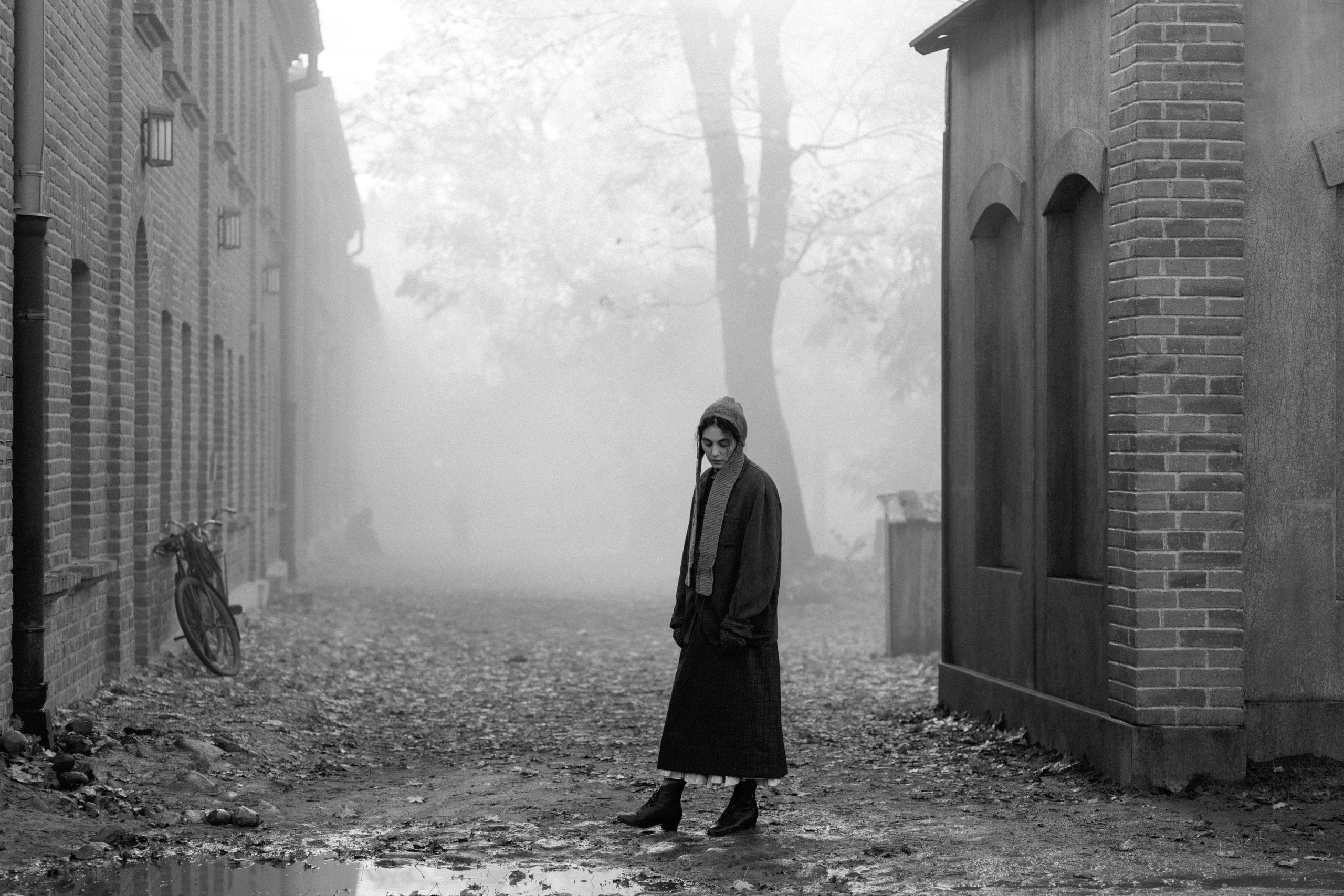
Danish director and co-writer Magnus von Horn’s The Girl with the Needle is a relentlessly bleak melding of true crime, anti-nostalgic history lesson, and intricate character study. It’s an oppressive, but impressive movie to sit through, and nothing that could be in any way be considered light viewing. It’s tough, but a good film pitched at this level ought to be, and von Horn’s endlessly referential stylistic touches suggest that the filmmaker has taken notes from some of the best to ever do it. Not only does The Girl in the Needle shine a light in dark places, but it also thoughtfully considers the wartime experiences of the marginalized people – specifically women – who are ground up and spit out of the labour force in service of military mobilization.
World War I is coming to a close, and struggling seamstress Karoline (Vic Carmen Sonne) is in a difficult situation. She’s being evicted from the modest room she has been renting. Her husband (Besir Zeciri), who hasn’t been heard from in over a year and was presumed dead, suddenly reappears, deformed from battle, and at a time when she has already started up a sexual relationship with her boss (Joachim Fjelstrup) that has left her pregnant. When both of her personal relationships crumble and her life becomes untenable, the desperate Karoline finds a lifeline in the form of Dagmar Overbye (Trine Dyrholm), a candy shop owner who runs an illegal “adoption agency” that can take care of unwanted children birthed to single mothers. Karoline moves in with Dagmar and her new boss’ “daughter,” Erena (Ava Knox Martin), and tries to make herself useful. But the longer she stays with Dagmar, the more Karoline begins to suspect that this supposedly altruistic venture is hiding a darker secret.
It’s easy to spoil where The Girl with the Needle is heading, because the case of Dagmar Overbye is an infamous one in Danish history. One Google search and the biggest reveal von Horn can offer is right out the window. But von Horn (Sweat) and co-writer Line Langebek work around the obviousness of their story by focusing exclusively on Karoline’s struggles and experiences in post-WWI Copenhagen. While the crimes committed on the periphery of The Girl with the Needle are real (and gross), the overall intent of von Horn is to create a setting so oppressive and devoid of hope that extreme measures and answers often feel like the only means of survival, especially for women struggling in both the labour force and at home. Many of the characters, and at times even von Horn’s antiheroic protagonist, are foul people, but one can see how they have been twisted by circumstance and general societal sickness.
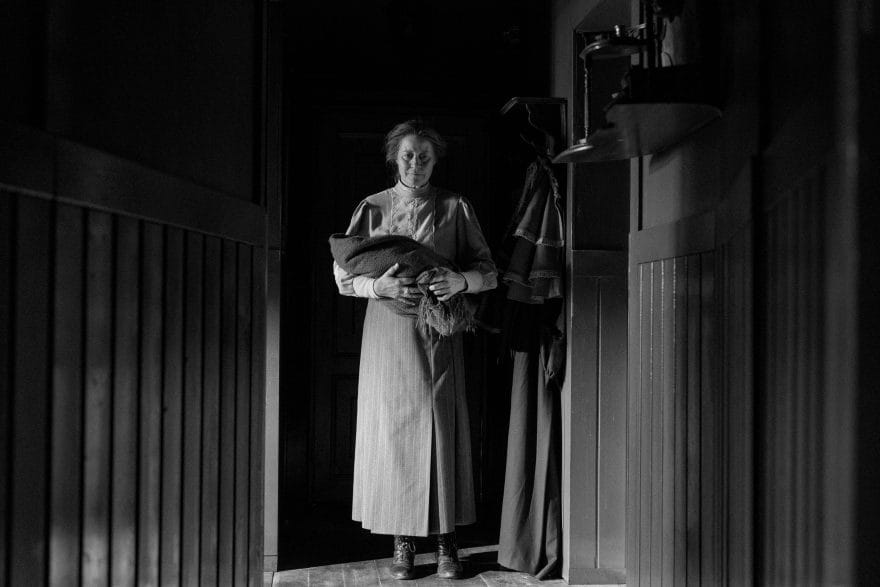
The Girl with the Needle can’t be comfortably classified as a thriller, as the pace is generally slow and not traditionally pulse racing. It’s more like a prolonged anxiety attack told through visual techniques that hearken back to the silent cinema of von Horn’s setting. The black and white cinematography from Michal Dymek (whose work can also be seen on screens currently in Jesse Eisenberg’s very different dramedy A Real Pain) captures period details in a striking, authentic manner, and with a minimum of obvious modern day technique or trickery. Thought it never lapses into gothic horror, there’s an eerie restraint to von Horn’s approach that makes a potent impression. That restraint can often become at odds with a script that starts laying the convention on pretty heavily in its later stages, but it always provides The Girl with the Needle with an air of uncomfortable stillness and gritty stagnancy that makes Karoline’s increasingly untenable situation all the more oppressive and disheartening.
Veteran performer Dyrholm excels at playing characters harbouring repressed desires and secrets, and her turn as Overbye is another feather in their cap. But the biggest shining stars of The Girl with the Needle are unquestionably Sonne and young Martin, the latter of whom gives a delicate and remarkably layered performance as a little girl forced to pretend she can’t understand what’s going on with her adoptive mum. Sonne, for her part, provides a necessary emotional anchor for von Horn’s material, depicting Karoline as chronically exhausted (with great reason) and beaten down by life, but never as a pushover. Sonne’s Karoline is a resourceful survivor in touch with her own desires and ambitions, but unable to act upon most of them due to societal and social circumstance. Supporting performer Benedikte Hansen also makes one heck of an impact as the dominant, demanding baroness mother of the man whose baby Karoline is carrying.
The Girl with the Needle is more than an historical drama about a salacious case that’s been ripped from headlines of the past. More time is devoted to Karoline’s general struggles in a post-war landscape than the actual criminality at hand, and Overbye doesn’t have much impact on the story until closer to von Horn’s halfway point. It’s more an examination of the ways war can make marginalized peoples feel lower class and unwanted. When the war effort ramps up, they become valuable members of society. Once it ends, they’re forgotten about and tossed aside like the used garments produced in Karoline’s factory. The Girl with the Needle has death on its mind at all times, but also societal decay and exploitation of the masses. You know, feel good stuff that’s in no way a metaphor for the current (and possibly future) state of the world.
The Girl with the Needle opens in select cities, including at TIFF Lightbox in Toronto and VIFF Centre in Vancouver, on Friday, December 6, 2024. It will be streaming on MUBI in the near future.
