

An intelligently made look at the inequality faced by many female athletes – especially those of lesser means – The Fire Inside starts off as a run-of-the-mill inspirational tale before morphing into something a lot more satisfyingly dramatic and pointed. The first feature directorial effort from Rachel Morrison (the first female cinematographer to ever be nominated for an Oscar in such a male dominated category), The Fire Inside gives the audience what they traditionally want in a sports movie before forcing them to question what all of it could mean in the long term and the price of continued success. It’s a crafty approach that uses worn out tropes to lure the viewer in to a project with a lot more on its mind than making the viewer feel inspired. In fact, Morrison kinda wants the viewer to feel bad by the time it has wrapped up.
Flint, Michigan teenager Claressa “T-Rex” Shields (Ryan Destiny) has been training to be a boxer ever since she wandered into the rec-centre classes being taught by former fighter Jason Crutchfield (Brian Tyree Henry) at the age of eleven. Although Jason initially refused to ever train a female fighter, Claressa’s tenacity and focus made him a believer, leading her all the way to the US Olympic Team trials and eventually to the country’s first gold medal in the sport for a woman. While that journey comes with its own struggles, the real battle comes after Claressa’s shining moment. Claressa always saw boxing as a way to get her constantly struggling family a house and a better life, but it quickly becomes apparent that there’s almost no money to be made as a female boxer.
Based on a true story, The Fire Inside balances emotion and scholarship in its plea for female athletes (especially those who don’t participate in sports that are seen as traditionally genteel) to be compensated in line with their male (and in most cases, white) counterparts. Adapting Shields’ story for the big screen is none other than Barry Jenkins, the writer-director of Moonlight, and the helmer of this week’s big seasonal blockbuster, Mufasa: The Lion King. Jenkins frames Shields’ early career like a film of two halves. In the first half of the film, Shields has to overcome the standard obstacles faced by most athletes: poverty, a tumultuous home life (mom parties hard, her dad just got out of prison and wants to insert himself back into her life, her little sister gets pregnant), and a power structure within the US Olympic committee that doesn’t respect her training methods or thought processes. She wins. She loses. She gets back up. She considers walking away. She goes on to fight another day.
This section of the film is what most filmmakers would choose to focus on exclusively, but while Morrison and Jenkins give their best version of the traditionally uplifting sports movie narrative, the best stuff is in the film’s second half. The climb from being a nobody to being a somebody comes hand in hand with plenty of big speeches, obvious platitudes, and cliched plot points. While Morrison does well by making all of these elements less melodramatic than many other filmmakers might’ve, there’s a sameness that might make viewers yearning for something deeper and more original a bit antsy.
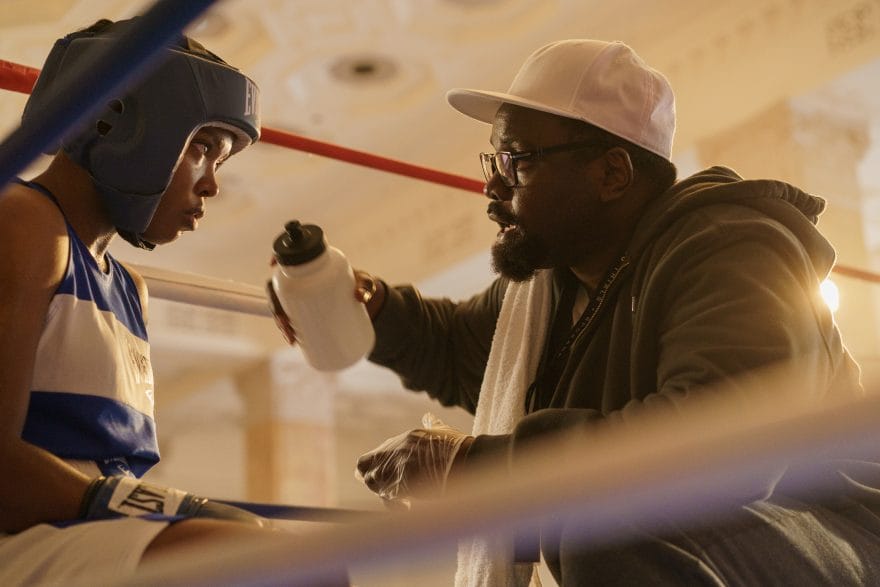
But Morrison makes the sharp decision to not dwell on the upswing of Shields’ story too strenuously. Yes, winning a gold medal is a huge part of her experience, but Morrison ensures that it’s not the boxer’s only defining characteristic. Six months removed from the Olympics, Shields has no money to show for her success. If anything, her family’s dire financial situation has only gotten worse with the arrival of a new mouth to feed. Jason tries to get agents and sponsors to take notice of Claressa’s accomplishments, but is frequently told that no one can make money from female athletes, and that boxers specifically are an impossible sell.
The fight for financial equality in sports is a hard thing to translate to film, but Morrison finds a perfect way in thanks to Jenkins’ script. It’s clear that Shields deserves her fair share and equal pay to her male counterparts, especially when she has no additional income and she’s expected to devote herself to training just as hard as the men. The Fire Inside isn’t all that inspirational of a story, despite having some happy moments of victory both in and out of the ring. It’s more a story of disillusionment and how hard it can be for an amateur athlete to keep proving their worth virtually for free while their personal lives might be crumbling down around them.
Morrison pulls from her background as a cinematographer expertly, showcasing Flint as a destitute section of America without ever feeling the need to sermonize or add further comment. Claressa’s hometown is steeped in hardship that buries some and sharpens others into diamonds, but within the wreckage of the American dream there can still be great beauty. Comparatively, the trappings of the film’s Olympic settings and scenes where the boxer and coach have to converse with the purse string holders have an eerie, safe, and antiseptic quality to them that makes the protagonists stand out even further. Morrison handles the plotting and emotional beats of Shields’ story gracefully, but never at the expense of some stunning visuals.
The Fire Inside also boasts a star making performance from Destiny. Herself a Michigan native, Destiny shows how Shields’ tenacity and drive are rooted in a profound sense of empathy and understanding. Her physicality and dramatic abilities align perfectly. She also shows outstanding chemistry alongside the always reliable Henry (who remains one of those most underrated actors working today) and Olunike Adeliyi, who plays Claressa’s comparatively immature mother. Morrison has a great vision for The Fire Inside, but it’s Destiny who allows her to translate the material’s bigger ideas to the screen with electrifying feeling.
It took me awhile to really unravel how I felt about The Fire Inside, particularly because of the film’s standard first half. But the longer Morrison’s film sat with me, the more engaged I felt upon reflection and moved by its overall message. It’s a take on the inspirational sports movie genre that I hadn’t really seen before. It burrowed its way into my mind and has stayed there since.
The Fire Inside opens in theatres everywhere on Wednesday, December 25, 2024.
