

A worthy, thoughtful, and visually accomplished furthering of an established classic, the prequel Mufasa: The Lion King adequately sets itself apart from its more straightforward “live-action” remake predecessor. While this prologue isn’t entirely necessary, Mufasa: The Lion King makes a case that other great stories can still be spun off from the material without damaging the legacy of the original. It’s certainly a step up in storytelling craft from Jon Favreau’s 2019 passably uninspired and beat-for-beat re-imagining of 1994’s Disney animation landmark. Mufasa: The Lion King shines brightest whenever it carves its own path, a worthy reflection of the struggles faced by its titular character.
Mufasa: The Lion King is framed as a bedtime story of sorts, as now adult Simba (Donald Glover) and Nala (Beyonce) are leaving behind their daughter, Kiara (Blue Ivy Carter), while they go off to have another cub. Kiara is left under the care of the bumbling Timon (Billy Eichner) and Pumbaa (Seth Rogen), who get a much needed babysitting assist from the wise mandril Rafiki (John Kani). To assuage Kiara’s fears about being a big sister and being left alone, Rafiki tells her the story of the grandfather she never got to meet.
Mufasa (Aaron Pierre) was separated from his loving parents at a young age due to a natural disaster, getting rescued from almost certain death by fellow cub Taka (Kelvin Harrison Jr.) and his mother, Eshe (Thandiwe Newton). Mufasa isn’t welcomed by the other lions he meets and is forced to stay with the women, not the other males. Taka is earmarked as a successor to his pride’s throne, but over time it becomes apparent that Mufasa – who has no claim to any royal bloodline – is braver and has a more rounded skill set. Mufasa’s leadership capabilities are made apparent when a vengeful white lion named Kiros (Mads Mikkelsen) and his crew attempt to wipe out anyone that won’t bow down to them. Mufasa and Taka are exiled for the safety of the latter and so the former can act as a protector, but their run in with fellow lion and refugee Sarabi (Tiffany Boone) creates tension between the two inseparable best friends and adoptive brothers.
Screenwriter Jeff Nathanson (Indiana Jones and the Kingdom of the Crystal Skull, Rush Hour 2), returning from Favreau’s version, has a lot more leeway to work with in Mufasa: The Lion King. The stuff with loveable goofballs Timon and Pumbaa play like a tacked on consolation for kiddies who need some much needed levity in an otherwise serious story, and the array of original songs created for this new vision are fine, but not remotely on the same level as the original. But beyond that, Mufasa: The Lion King fleshes out its characters in intricate detail.
Amid a lot of obvious and metaphorically simplistic dialogue about learning responsibility and growing up, Nathanson weaves a credible and engaging character piece that aligns nicely with the original film’s previously established tropes and plot points. The arcs of Mufasa and Taka are quite interesting, with Harrison, Pierre, and Mikkelsen getting plenty of interesting character quirks and motivations worth sinking their fangs into. It’s a well told story about what it takes to be a leader, even if some viewers (and even characters in the movie itself) can predict where all of this is heading. This depth does come at the cost of creating a slower burn than younger audiences and impatient adults might be expecting, but on a narrative level, this is vastly preferable than its predecessor: a film that coasted by on the strength of its visuals, a reusable story, and little else of note.
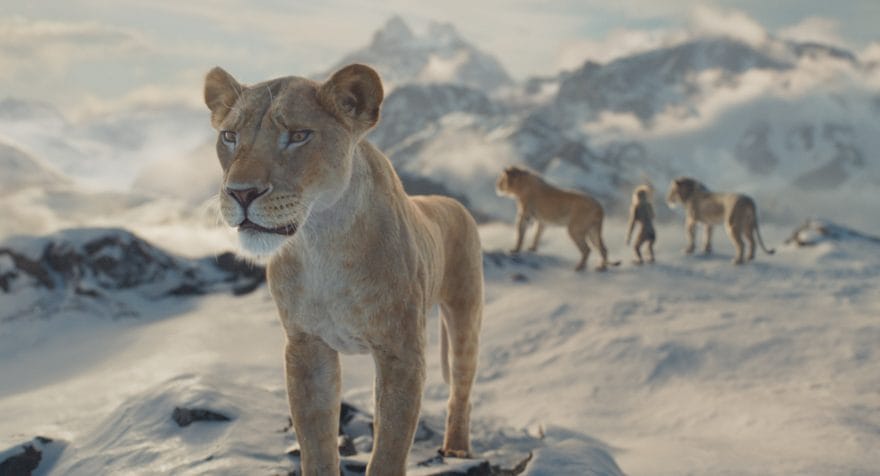
Directorial duties this time out fall to critically acclaimed and award winning filmmaker Barry Jenkins (Moonlight, The Underground Railroad, If Beale Street Could Talk), which proves to be a double edged sword for Mufasa: The Lion King. On one side of things, Jenkins is a great fit for a drama that’s resolutely focused on character motivations and interactions. He’s also a great fit for some of the finer visual details of this world’s lush landscapes, snow capped mountains, and parched deserts, crafting moments of visual poetry and power. On the other hand, Mufasa: The Lion King is so beholden to the technology being employed and an adherence to an established emotional formula that there’s no authorial voice to be discerned. It moves and feels a lot like just another studio picture, albeit a well made one that values its story and the viewer’s intelligence. Those expecting a Barry Jenkins film should modify their expectations accordingly. Those expecting some classic Disney magic should be satisfied.
Mufasa: The Lion King nearly dips in quality by launching into its gigantic third act set piece with little set up or warning that it’s happening, but visually and narratively Jenkins, Nathanson, and company have built up enough good will that the inorganic conclusion isn’t much of a deal breaker. While there are some disappointing elements to Mufasa: The Lion King, the end results are preferable to the regurgitation Favreau provided with his remake. Mufasa: The Lion King proves there are other stories from this world worth telling, making me (and probably others) wonder why they didn’t just start here in the first place.
Mufasa: The Lion King opens in theatres everywhere on Friday, December 20, 2024.
