
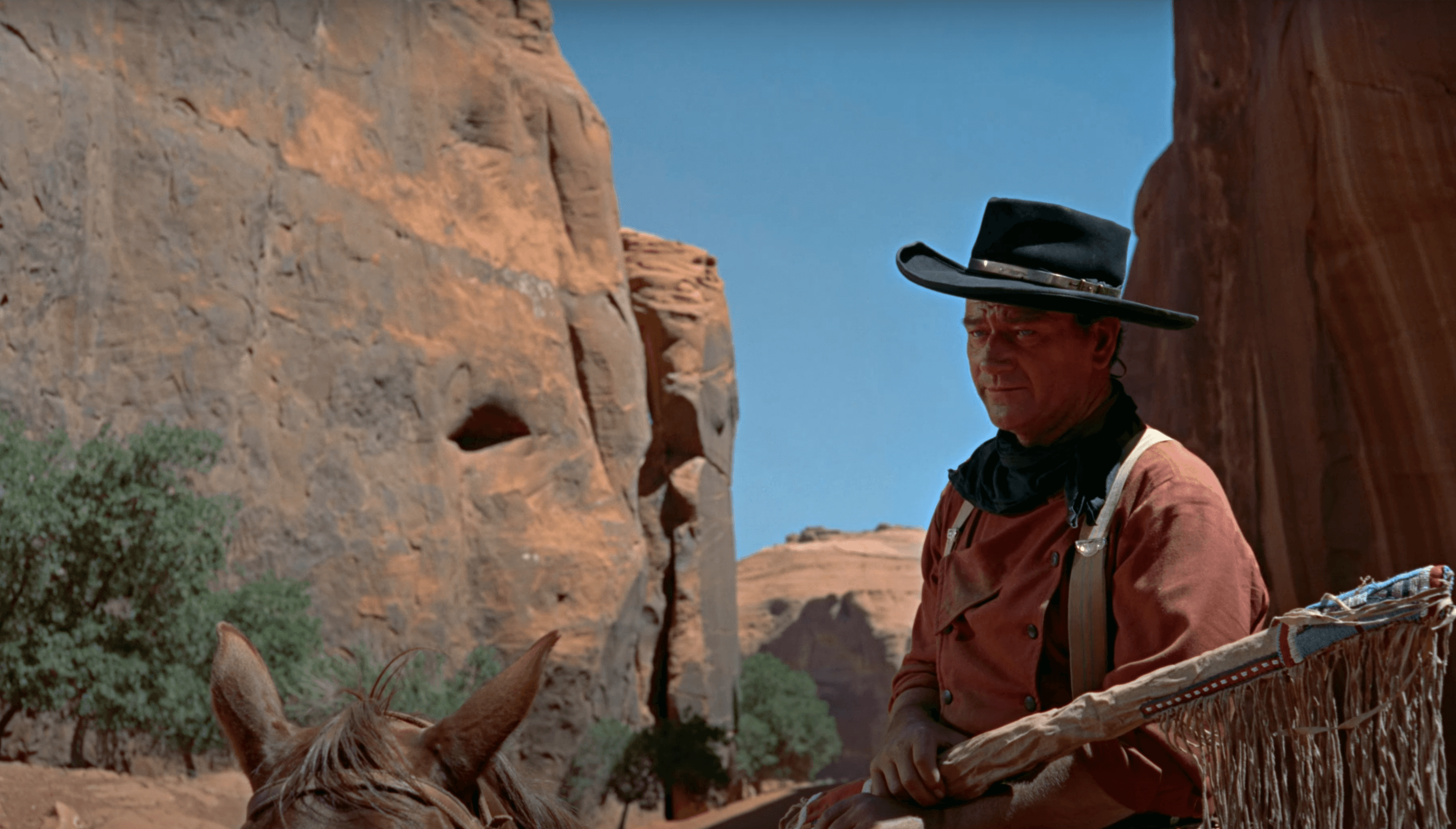
John Ford’s The Searchers is one of the most revered films of all time, and with good reason. It’s the standard by which all other films in the western genre are measured, even if it was made and released at a time when audiences’ fascination with hard living, westward expansion, gunslingers, and “cowboys” versus “indians” stereotypes were starting to slowly decline (or at least before these things worked better on television). Released in 1956, The Searchers is a gorgeous looking, but thematically bleak and despairing movie that both embraces genre conventions and seeks to subvert them. In adapting the work of novelist Alan Le May, Ford and frequent collaborator and star John Wayne mount a forceful and confident classic that endures to this day, even if some of the film’s racial politics obviously don’t stand up.
Ethan Edwards (Wayne), a former Confederate soldier, returns to his extended family’s ranch in Texas circa 1868. The war has been over for years, and Ethan, who’s oddly flush with money that he might’ve stolen, is cagey about his whereabouts over the past several years. He’s happy to be home with his brother, Aaron (Walter Coy), and the rest of the family, but not everyone is thrilled by his resurfacing. Ethan’s post-war life is shaken when a Comanche tribe, led by the brutal chief Scar (Henry Brandon), slaughters almost his entire family while he’s out, save for young niece Debbie, who is taken captive. When Ethan becomes frustrated with the search efforts, he teams up with his adopted, partially indigenous nephew, Martin (Jeffrey Hunter), to search for Scar and Debbie. The search lasts for five years – through broiling heat and sub-zero chill – but when they finally find Debbie (played by Natalie Wood as a young woman), their viewpoint and motivations change.
The Searchers is the first 4K Blu-Ray from the venerable Warner Archive Collection, and they couldn’t have picked a better title to launch with. Shot originally in sumptuous Vista Vision (which is seeing a nice mini-resurgence thanks to current Best Picture nominee The Brutalist), the transfer over to Ultra HD captures all of the crisp skylines and horizons that were a trademark of Ford’s over the years. One might even be able to make the argument that The Searchers looks better than it ever has, even on film stock. The only way for a clearer picture than the one provided by Warner is to be on set as it was being filmed. It’s a revelatory piece of preservation and restoration, and while the 4K disc contains only the feature, it’s nice that Warner Archive has included a Blu-Ray that includes some of the best special features from previous home entertainment releases, like filmmaker and Ford biographer Peter Bogdonavich’s enlightening commentary track, and the artfully produced 1996 short length documentary A Turning of the Earth, which is made up almost entirely from raw footage taken from the set.
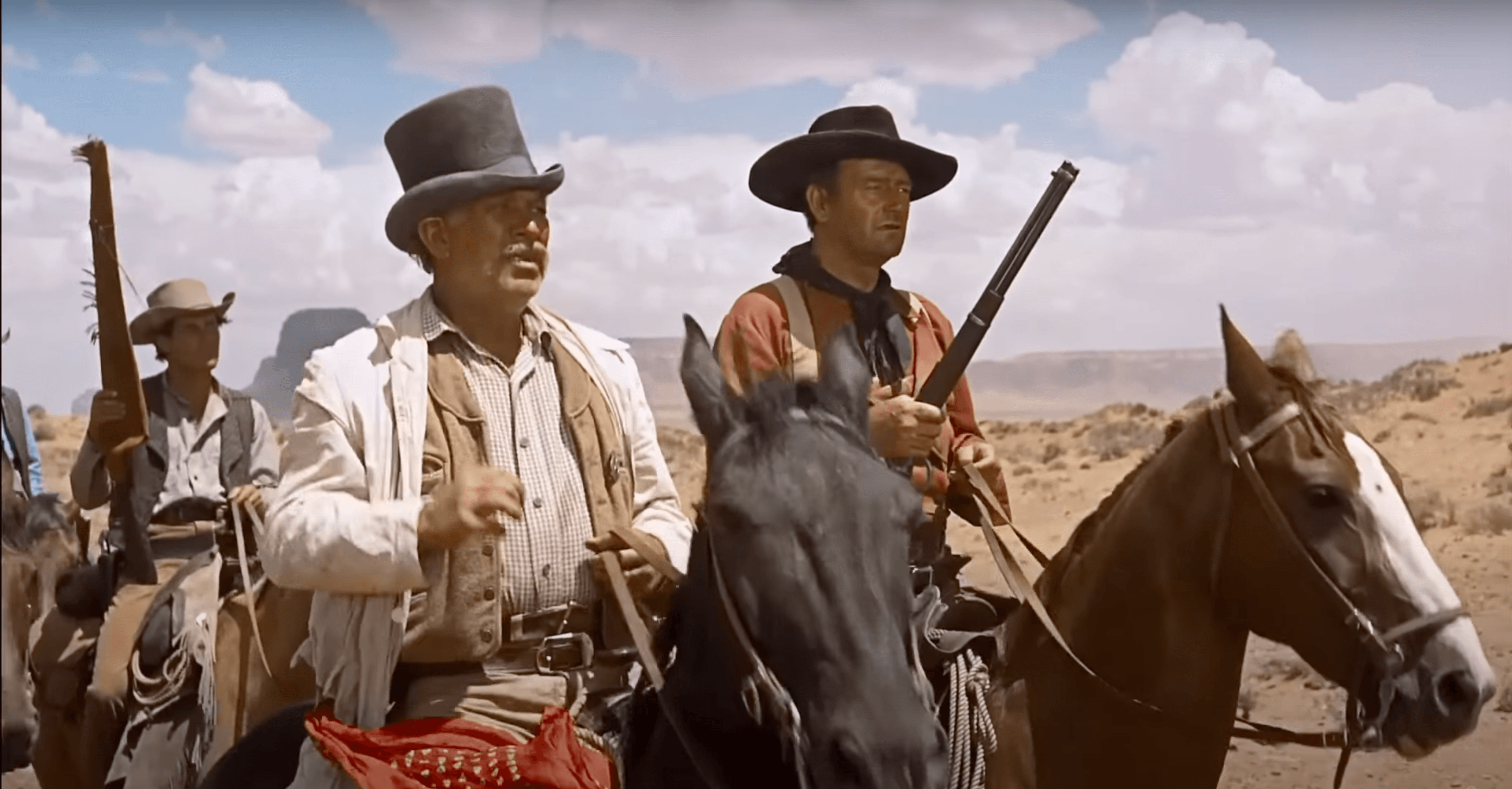
But the film itself is the star of the package. In his best performance, Wayne gets a chance to showcase equal parts fire and subtlety. Not everything about Ethan is spelled out, but Ford and screenwriter Frank S. Nugent (Fort Apache, The Quiet Man) give subtle hints along the way regarding the character’s transgressions and the roots of his obvious racist tendencies, and Wayne embraces the chance to only show little bits of those motivations and leanings at a time.
While I wouldn’t say The Searchers is the most progressive movie ever made when it comes to settler/indigenous relations, it’s also a film that doesn’t excuse the biases and singlemindedness of its main character. Visually, the representation of Scar and the Comanche people (many of whom are actually played by Navajo extras thanks to Southern California filling in for Texas) is generic and stereotypical, but their relationship towards those encroaching on their ancestral lands feels fully realized, even if the standards of the time are somewhat demonizing them.
It’s fascinating to see The Searchers get a proper reissuing right around the time Peter Berg’s comparatively dreadful series American Primeval (which has a not one, but two plotlines ripped straight out of Ford’s playbook) is getting so much recognition. Both are projects that are devoted to showing how there was widespread malice and hatred across the western frontier, and that all sides, races, and religions were capable of committing large scale violent actions to carve out their space, but The Searchers is infinitely better at ensuring that the violence and despair isn’t empty and meaningless. As it reaches its disarmingly complex final act, The Searchers suggests an antiquated way of life giving way to something new and more hopeful. While that isn’t entirely what happened on an historic level, it fits the film’s themes about humanity’s rootless wandering perfectly.
