
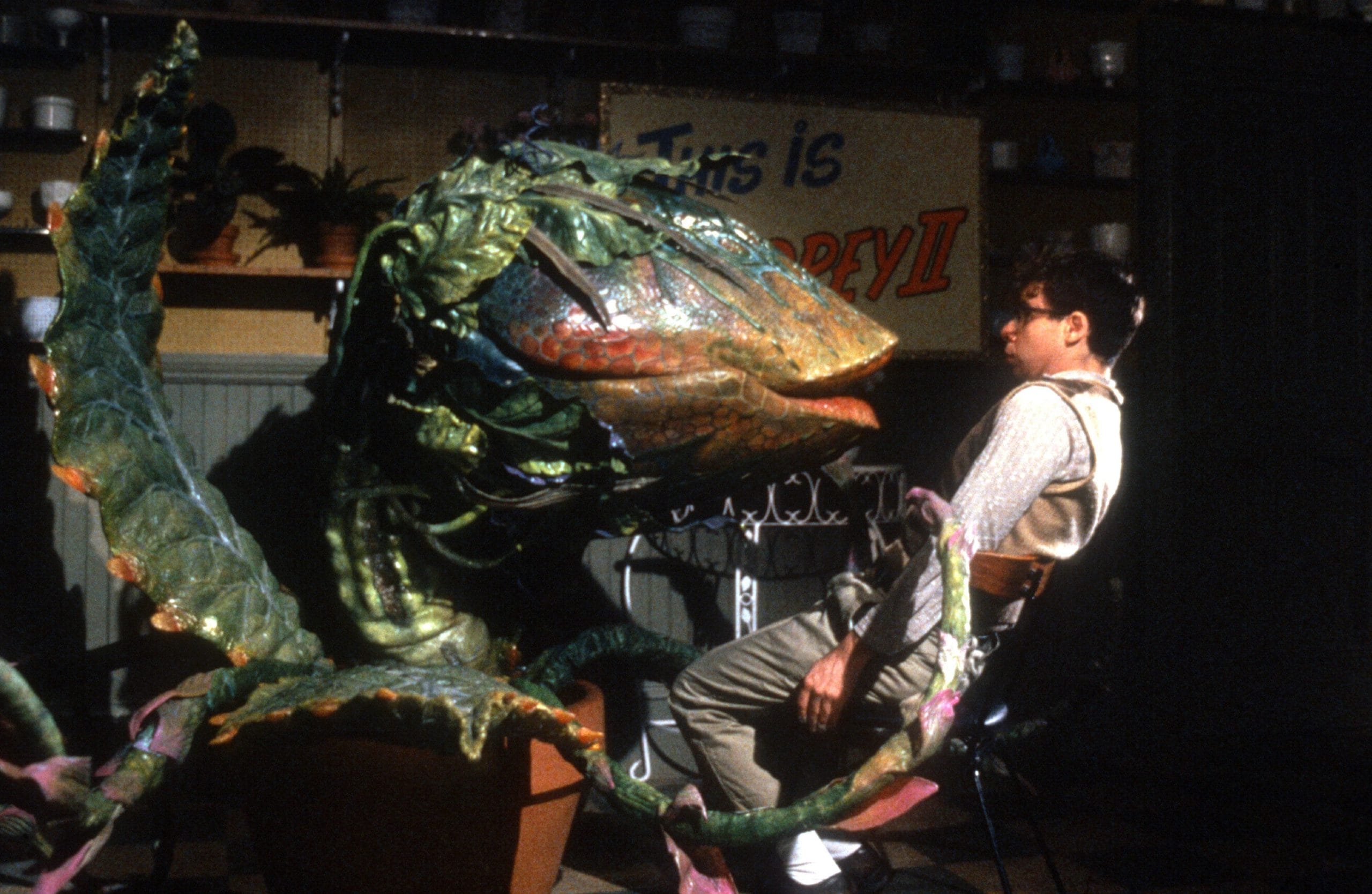
Frank Oz’s darkly comedic 1986 musical Little Shop of Horrors is an exceptionally rare example of a film where the director’s cut and the final theatrical cut are both classics in their own right. A film that boasted one of the most noteworthy, expensive, and visual effects heavy alternate endings to ever get axed at the behest of test audiences and the studio involved, Little Shop of Horrors became a hit with moviegoers who were largely none the wiser about how the story of a nerdy florist, his dream girl, and a man eating alien plant originally concluded. With the director’s cut of Little Shop of Horrors now reissued on DVD from Warner Brothers, it seems like as good a time as any to revisit why both the theatrical and original visions for Oz’s film work so well.
Needless to say, this column includes spoilers for two versions of an almost forty year old movie. And to some extent, spoilers for the sixty-five year old movie it was based on and the 1982 stage musical that it’s more properly a remake of. But even if you haven’t seen any of these projects, spoiling what happens doesn’t dampen any of the fun or wonder to be had by discovering them.
Well, maybe not entirely in the case of B-movie maven Roger Corman’s original 1960 horror movie. Corman’s Little Shop of Horrors was a tossed off production that made use of pre-existing sets that he wanted to milk a couple of extra bucks out of before tearing them down. The entire film – which is most noteworthy today for an early appearance by Corman regular and collaborator Jack Nicholson – was shot in just two days. It plays like a lawnmower edited it, the lighting is some of the worst of its era, and the performances were, to put it charitably, uneven. But the story itself had a hook that was so strangely appealing that the film became an unlikely hit and cult curiosity. The original Little Shop of Horrors was a bad movie, but the story of a couple of lovebirds running afoul of a man eating, blood craving plant gave viewers something they had never seen before. The movie didn’t work, but the idea certainly did.
In 1982, the film was adapted into an off-Broadway musical that leaned into the comedic potential inherent in the material, making a fair number of story and character tweaks along the way, and boasting songs and music from soon-to-be-legends Alan Menken and Howard Ashman. The intoxicating blend of musical theatre royalty, dark comedy, and the eye catching puppetry that brought evil plant Audrey II to life contributed to Little Shop of Horrors becoming one of the most successful and longest running off-Broadway shows of all time; never getting proper awards consideration at the time because by being off Broadway, it wasn’t eligible for the Tony awards.
One of the producers of the stage version of Little Shop of Horrors was David Geffen, soon to become one of the biggest moguls in stage, screen, and music. After attempts to get the film made with Steven Spielberg and Martin Scorsese behind the camera were unsuccessful, Geffen turned to Frank Oz, whose experience working with Jim Henson’s Muppets could be an asset when it came to both the musical numbers and the puppetry required to make the killer plant bigger and badder than ever. After some restructuring of the original material to make things more cinematic and less stage-y, Little Shop of Horrors went into production on the famed James Bond Sound Stage at Pinewood Studios in England with a (then quite generous) $25 million budget.
The plot was generally in line with previous incarnations of the material: lovesick Hell’s Kitchen florist Seymour (Rick Moranis) pines for his kindly co-worker Audrey (Ellen Green, who originated the role on stage), who’s dating a bullying, psychotic, nitrous addicted dentist (Steve Martin). To make matters worse, Seymour and Audrey have been informed by their high strung boss Mr. Mushnik (Vincent Gardenia) that if their fortunes don’t turn around soon, they’ll all be out of work. With few other ideas for how to bring in business, Seymour (with Audrey’s encouragement) presents his boss with a strange, Venus-Fly-Trap looking succulent he found while out and about one day. The three agree that they’ve never seen anything like it in their life and place the plant in the shop window. The plant, which Seymour has named Audrey II, starts bringing in customers almost immediately, but it’s also quickly dying. It turns out that the plant needs human blood to survive and thrive, so Seymour starts secretly feeding it drops from his finger. Soon, Audrey II (voiced by Levi Stubbs) is big and strong enough to start talking (and singing) to Seymour, and starts demanding more food, while nastily playing to his caretakers sympathies.
Needless to say, things get out of hand, but just how out of hand depends on whether you watched the material on stage (where an NYC revival is still doing great business) or screen. In the stage version, Audrey II’s plans to propagate and take over the world come to fruition. Everybody dies, including the heroes and pretty much the rest of humanity. For a frivolous lark with a bunch of catching songs, Little Shop of Horrors has a pretty serious ending with Andrew Lloyd Webber levels of seriousness. Not so if you watch the theatrical cut of Oz’s 1986 film, where (sequel baiting stinger notwithstanding), Audrey II is vanquished and Audrey and Seymour live happily ever after.
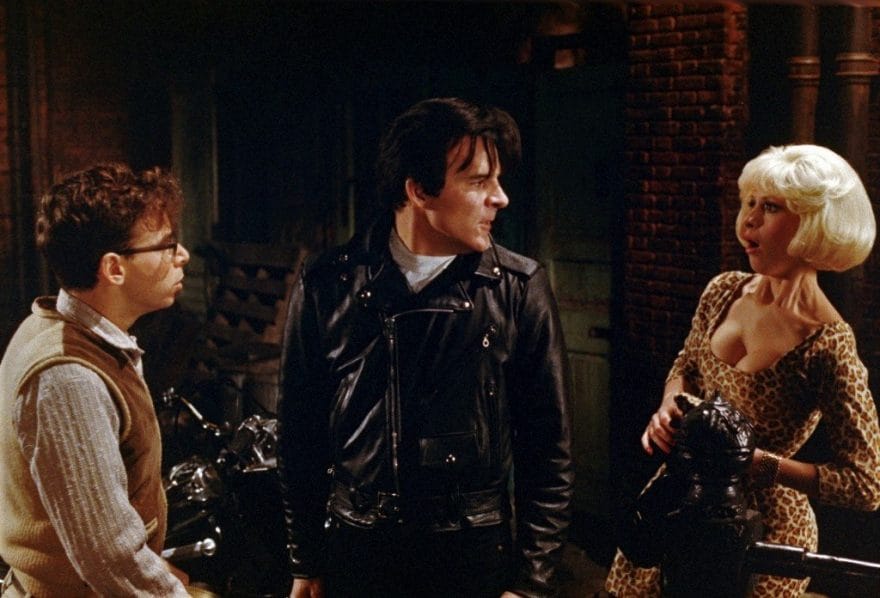
Oz shot the original ending to the stage musical, which included several additional musical numbers and heaps of ambitious puppetry, tons of models, and stop motion and digital effects, all overseen by Oscar winning technician Richard Conway. The characters played by Moranis and Green die tragic deaths, and humanity descends into chaos. The shooting of the climactic sequences in Little Shop of Horrors went as smoothly as they could given all the highly technical moving parts and effects. But the rough part came when the film went before test audiences.
Up until the point when the film kills off the main characters, Little Shop of Horrors was doing well with test audiences. Once the rug was pulled from beneath them and it became apparent there was no happy ending in sight, those ratings and reactions plummeted through the floor. It became apparent to everyone that despite their disappointment to the reactions, drastic reshoots to the final act would be necessary. Without them, this new version of Little Shop of Horrors would be virtually unreleasable.
But what gives? Wasn’t the movie tapped to end in the same way as the stage production, which was successful, but also had a bleak ending? In an interview included on the DVD (and on the original Blu-Ray this re-issue was sourced from), Oz stated that while it stung at the time to have all of his and Conway’s hard work undone and over twenty minutes of movie were now patently unusable, he began to understand where audiences came from in their disdain. At the end of a musical, everyone in the cast comes out, takes a bow, and there’s a reassurance to those in attendance that they were just watching a show, and that these people are actually okay. Movies don’t have that same luxury. Someone dies in a movie, that’s it.
When the dust settled and Little Shop of Horrors was released just before the peak of the holiday movie season in 1986, it went on to become a modest hit in theatres and a more endearing success through home video and cable airings. It was nominated for two Oscars: Best Visual Effects (losing to Aliens) and Best Original Song (for “Mean Green Mother Outer Space,” a Menken and Ashman original, which lost to “Take My Breath Away” from Top Gun). Unless one had seen or read about the original versions of the material, viewers and audiences probably didn’t notice the massive changes to the ending.
Many probably didn’t know the original ending still existed until 1998 when the initial DVD release of Little Shop of Horrors made unlikely, somewhat infamous history. Warner Brothers released a special edition of the film that included the 23 minute original ending, in black and white, with unfinished visual effects and music, taken from a VHS workprint of the film. Within days of the disc’s release, producer and rights holder Geffen became incensed at the decision to put the unfinished version out before the public. Geffen stated that he had a more finished version of the ending in colour in his possession, and that he had intentions to remaster the film with this footage and put it back into theatres. In just a couple of days, Warner Brothers had all copies of that special edition DVD pulled from shelves, making the first film in the history of the format to be taken out of circulation for content related reasons. But like when many other things get recalled, the genie is released from the bottle. Collectors snapped up whatever copies of the recalled edition they could find, and the original ending (in black and white) was the kind of thing that would pop up on YouTube all the time before getting taken down due to copyright infringement.
This oversight, Geffen’s anger, and public curiosity all probably led to Warner Brothers finally restoring the original ending of Little Shop of Horrors to its former gory glory. Warner Brothers provided Oz with post production and sound restoration assistance to complete an ending that was previously only screened in an unfinished form to test audiences. With the release of the Director’s Cut of Little Shop of Horrors on Blu-Ray in 2012, viewers were finally able to see the grandeur of Oz’s original, go-for-broke effects extravaganza ending in living colour. Maybe if the Academy saw the visuals that were present in this cut of the film, Little Shop of Horrors would’ve given Aliens more of a run for its money at the annual awards. (But probably not. Aliens is pretty untouchable.)
But no matter which version of Little Shop of Horrors I think about (and I own both), the memories remain just as fond. Oz’s director’s cut might be the more ambitious, gutsy, and visually impressive version available, but there’s also something genuinely nice about watching Seymour and Audrey finding some degree of happiness in their harsh, Hell’s Kitchen lives. Both cuts of the film work well, a testament to the material itself, Oz’s direction, the charisma of the cast, and the strength of the visual effects. In either take, Little Shop of Horrors is a snappy, sassy, entertaining movie. Sometimes, arguments can be made that either a theatrical cut or an extended cut of a movie is better, but in the case of Little Shop of Horrors, you can’t go wrong either way. And the movie is so good that – in a modern era where people are more accustomed to downbeat endings – you could watch either and have a great time.
The Director’s Cut of Little Shop of Horrors is now available on DVD from Warner Brothers.
