

An intense post-apocalyptic survival thriller with a strong sense of identity and purpose, R.T. Thorne’s first feature 40 Acres is a genre movie revelation. It’s an intense and bleak film that adopts black and indigenous perspectives and applies them to traditional survival narrative tropes. This cultural shift works wonders for 40 Acres, a film that could only be told from a marginalized point of view put under further societal pressures. Despite its low key trappings and most of the film’s dangers being relegated to the shadows for its running time, 40 Acres balances smarts and suspense with expert precision.
Thorne and co-writer Glenn Taylor set the stage fourteen years after the full on collapse of society, the result of a fungal pandemic that led to a Civil War and widespread famine. In this world, farmland that survived the blight is the most coveted resource and food is currency (not literally, but you know what I mean). Somewhere in rural Canada is Hailey Freeman (Danielle Deadwyler) and her family. She’s a descendant of black farmers who settled in the country centuries ago. Surrounded and aided by her indigenous husband, Galen (Michael Greyeyes) and their four kids, Hailey runs a tight ship on the farm. No outsiders are allowed, they don’t give charity, and (as evidenced in a bloody opening sequence that sets a perfect tone) they’re more than capable of defending the homestead with ruthless, brutal efficiency. They live an isolated life, but things start to change when teenage son Manny (Kataem O’Connor) discovers an injured girl of similar age (Milcania Diaz-Rojas) and decides to care for her in secret. If anyone else finds out what Manny is doing, they’ll surely kill the outsider on sight.
After the initial flurry of action, 40 Acres settles into a more contemplative groove, offering up its own take on the traditional narrative that states one can’t trust anyone else during an apocalypse. There is a union of other farmers that Hailey communicates with via ham radio, and even has a bit of a friend in a woman named Augusta (Elizabeth Saunders) who doesn’t live too far away. But to protect her family and ancestral land, Hailey is hardened and reticent to help others. 40 Acres, much like 28 Years Later did last month, doesn’t show an apocalypse in its infancy, but rather something that has been fully formed, twisting everyone in its aftermath and slowly breeding humanity out of those who’ve survived. These are exhausted, skeptical, and highly vigilant people who spend every day taking the old adage “I’ll rest when I’m dead” to heart, especially Hailey.
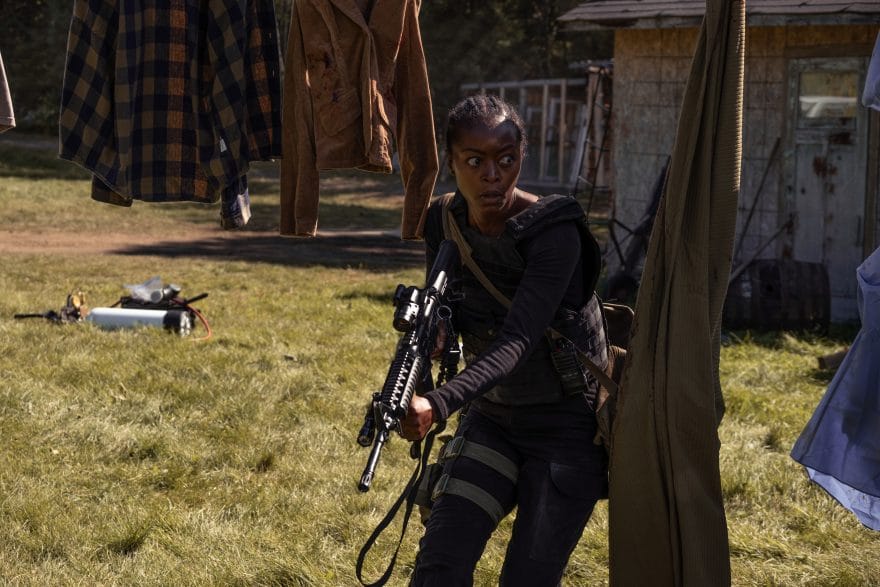
Thorne and Taylor’s narrative perspective adds a profound and moving layer of historical and cultural poignancy and trauma. With a title that clearly references broken promises of the past that were made to black Americans, Thorne isn’t content to leave things at that. Thorne, via Greyeyes’ soulful performance, also extends that same outrage towards the indignities suffered by indigenous peoples, the original keepers of the land, to whom Hailey and everyone else on the broken continent are still in debt. Themes and subtext regarding land grabs, oppression, toxic capitalism, and Wendigo mythology penetrate every inch of 40 Acres, lending the thriller aspects a much more globally impactful and deeper meaning than if the material were played strictly for theatricality and shock value.
Deadwyler’s commanding and physically demanding performance takes centre stage throughout 40 Acres. The actress refuses to make Hailey into a traditionally likeable person, but into a stressed out tyrant that the audience can understand. The methods and means employed by the Freeman family might not be the same choices a viewer would make, but Deadwyler and Greyeyes are able to make them see things from their perspective and reasoning. Some flashes of dark humour also help to keep viewers invested in a story where survival often forces people to make harsh choices towards their fellow human beings. As the antithesis of his mother, O’Connor is able to match his adult co-stars beat for beat, illustrating the ways that teenagers eventually form identities of their own and begin to find their own ways and opinions as adults.
Although it becomes a more traditional siege movie down the stretch, 40 Acres remains thoughtful and complex. Thorne’s visual representation of rural grime and decay is stunning in detail and stylish in scope, and the score from Todor Kobakov is perfectly pitched to the tenor of the film’s direction and tempo. Even when working from limited resources (meaning the budget of an average Canadian film), Thorne is able to make 40 Acres into something impressive, all while working in a genre that has grown stagnant and regressive over time. 40 Acres delivers on expected thrills, but also values the audience’s ability to grasp and wrestle with deeper meaning along the way.
40 Acres opens in Canadian theatres on Friday, July 4, 2025.
