
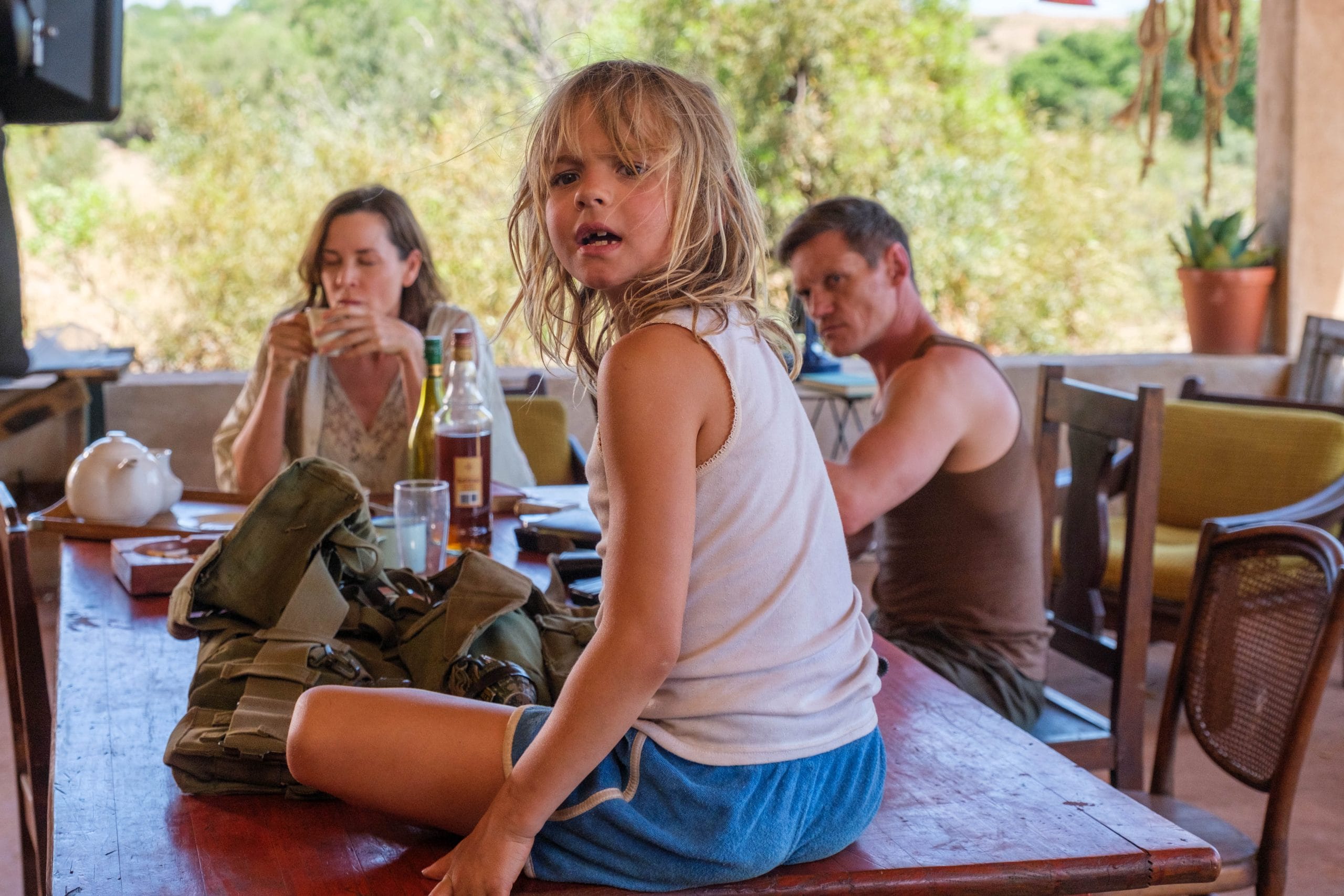
Embeth Davidtz’s first feature as a writer and director, Don’t Let’s Go to the Dogs Tonight, is a well intentioned look at colonizer history in Africa that falls short of its intended goals. Told from the perspective of a young, white child of British ancestry who learns about the history of her people in predominantly black Zimbabwe, Don’t Let’s Go to the Dogs Tonight attempts to be noble and equitable in its approach, but is held back through its narrowed down point of view and perspective. An adaptation of Alexandra Fuller’s memoirs, Don’t Let’s Go to the Dogs Tonight gets bogged down in precociousness thanks to its chosen method of story delivery, making for a muddled, problematic whole that retains an uneasily frightened white perspective on African race relations at the end of the 1970s.
Seven year old Bobo (Lexi Venter) lives on a rural farm in what was then known as Rhodesia in 1980, at the tail end of the Bush War, otherwise known as Zimbabwe’s War for Independence. Her father (Rob Van Vuuren) is a soldier, away from home for long periods as the country readies itself for its first ever free and fair elections. Her mother (Davidtz) is a police officer who sleeps with an assault rifle next to her every night in case “terrorists” try to break in and harm the family. Mom is also a heavy drinker, PTSD sufferer, and seems to care more about the family’s livestock and the farm than her own children. Bobo’s older sister (Anina Hope Reed) is of the age where she’s clearly over being around the farm and isn’t much of a friend. Bobo spends most of her time causing mischief, sneaking cigarettes, asking lots of questions, getting dirty in the fields, and being looked after by the family’s black maid, Sara (Zikhona Bali), something that doesn’t please her more revolutionary minded husband, Jacob (Furmani N Shilubana). The family’s already difficult situation becomes more complicated after the election of Robert Mugabe, who believes that land belongs to all people, not just the colonizers.
As someone who lived for a good part of their younger years in South Africa, Davidtz has an understanding of the divide between white settlers and indigenous black people on the continent, and as such Don’t Let’s Go to the Dogs Tonight comes from a perspective rooted in some degree of truth. As a director, Davidtz understands the terrain, personalities, and conflicts better than most outsiders might, even if she lived one country over on the map from where Fuller’s memoirs take place. Visually, the film captures a dusty, contested land where not much grows, but people keep trying to make something happen. It’s inhospitable in both appearance and overall vibe. There’s tension in the air that’s mirrored nicely in the film’s production design and cinematography. The film very much looks the part, even if the Davidtz’s script tends to let things down a bit.
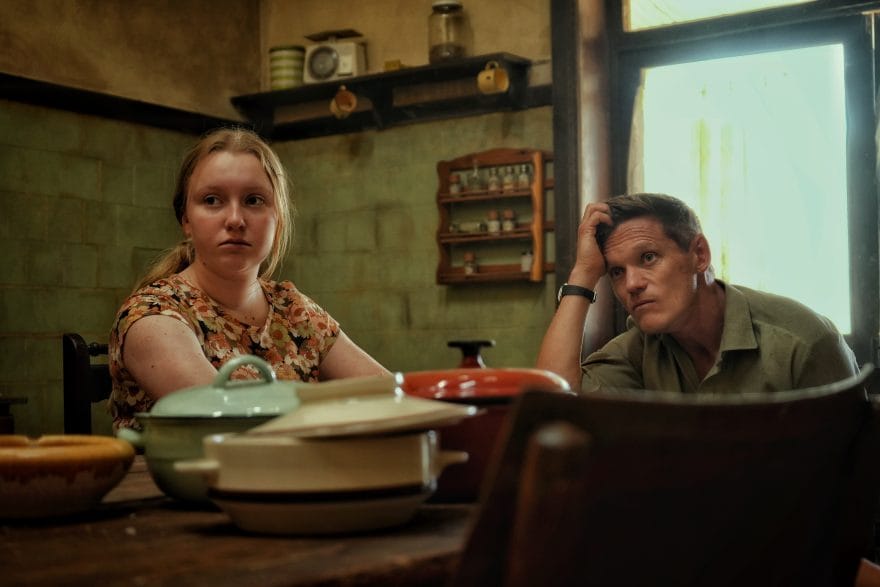
Venter is a revelation in the lead; a youthful performance that is wise and instinctive beyond her young years. It’s a turn that elevates the movie as a whole because Davidtz’s material is so dense and overly melodramatic that it takes a tremendous talent to make any of it work. Don’t Let’s Go to the Dogs Tonight requires its young performer to play some resolutely dark and distressing material with complete innocence and precociousness, or else the tone Davidtz is going for is completely lost. As a filmmaker, Davidtz so overexposes the need to make Bobo into an impish free spirit that the whole thing almost falls apart around young Venter. Davidtz dialogue is so fussy that the characters start to feel inorganic. Think Beasts of the Southern Wild, but without anything metaphysical or fantastical to fall back on; that’s close to what Don’t Let’s Go to the Dogs Tonight feels like.
The portrayal of Bobo as a youngster without a filter is believable, with the kid often asking questions of adults that adults in a time of change and crisis don’t want to think about. (“Are we racists?” “Are we Africans?” “Were your ancestors magical?”) But at the same time, that youthful lack of decorum leads to plenty of faux pas, like treating young black children as servants during playtime because it’s all she’s been led to believe. She’s bossy and entitled – borderline feral – but her parents probably just think she’s sassy. There are some consequences for this behaviour, but it’s mostly the adults who pay the price. Some children, like Bobo, are blunt to a point where they have fluctuating levels of empathy, and Venter captures that naturally and with a good deal of perspective.
That’s all well and good, and also believable, but this narrow reading of history and troublesome family dynamics – one that seemingly tries to make poverty cute – isn’t satisfying. The perspective of Don’t Let’s Go to the Dogs Tonight isn’t only a young one, but a profoundly white one. To Davidtz’s credit, her debut feature isn’t a white saviour story where black people should be grateful for the contributions of the colonizers, but it is a white trauma story. As the film reaches its latter stages and things get dangerous for Bobo’s family, the performances – especially that of Davidtz’s increasingly paranoid mother figure – reach a fever pitch, and not in a good way. The focus becomes squarely on the ways that violence against black people negatively impacts the white people who once employed them, and the terror they feel when those the once oppressed begin fighting back. (This says nothing about a subplot revolving around the sexual abuse of the older sister at the hands of her sleazy white uncle, which is awkwardly handled in its own way.) A much more delicate take on these events would be possible if Don’t Let’s Go to the Dogs tonight adopted a character beyond the comprehension of a child. Without a more seasoned point of view, the film is an uneasy “all sides shoulder equal responsibility” take on painful history. To that end, terrible things do happen to some of the black characters in the film, but the focus remains on how the white people suffered more.
Don’t Let’s Go to the Dogs Tonight is frustrating because there is a good movie in there somewhere, and Davidtz’s shows lots of talents as a director. But the script is too unfocused and verbose to a point where none of this is hitting close to the bone. It’s an okay bit of drama, but one where the weight of the history behind it isn’t resonating like it should.
Don’t Let’s Go to the Dogs Tonight opens in select Canadian cities on Friday, July 18, 2025.
