
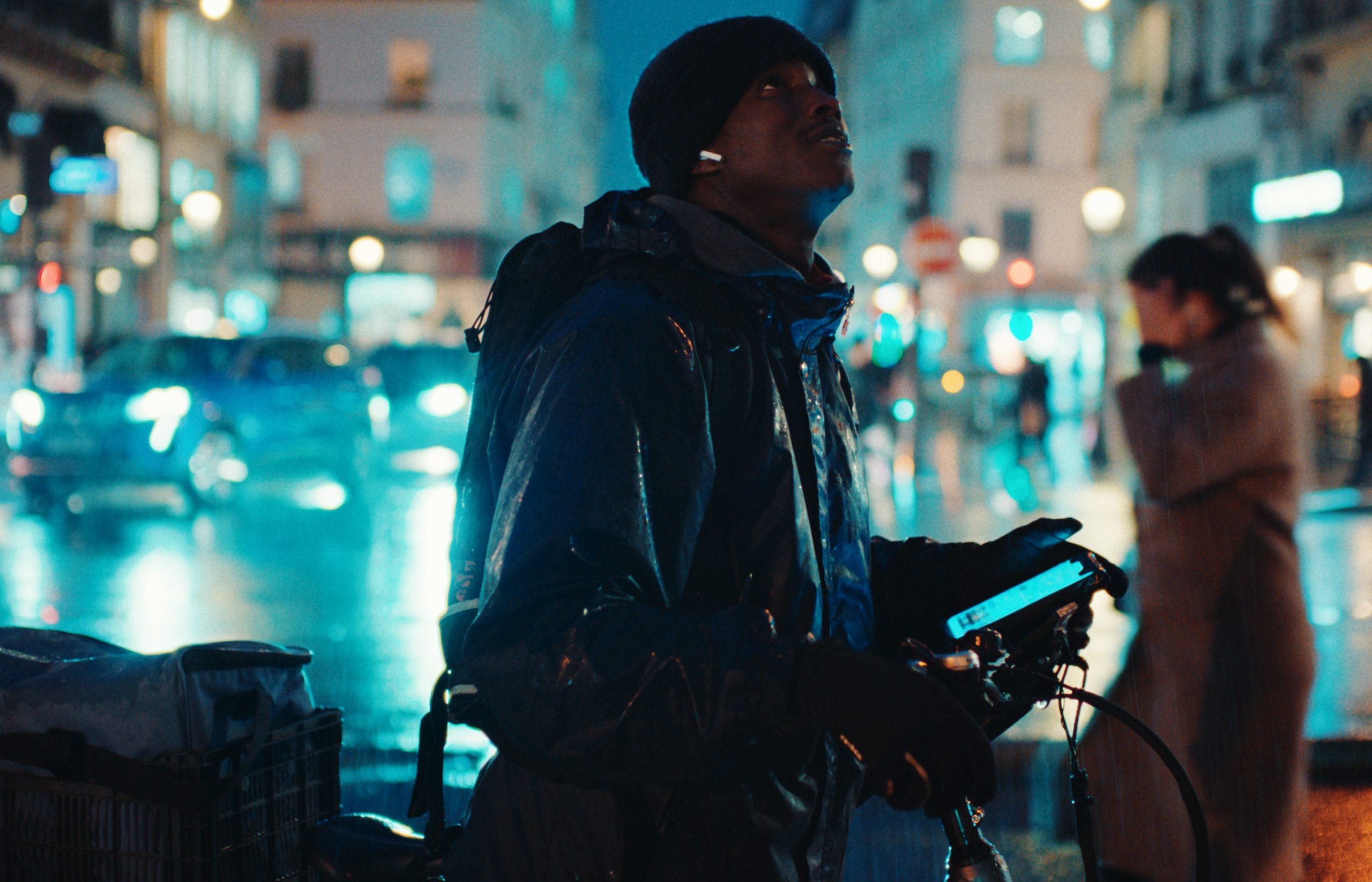
Taking place across a scant few days that go by in the blink of an eye, the clockwork drama Souleymane’s Story captures the stressful, unstable lives of many refugees and migrants. Paced like a thriller, but as gutting as any realistic human drama, Souleymane’s Story grants the viewer no quarter because the main character doesn’t have a moment to waste when it comes to establishing his new life. Director and co-writer Boris Lojkine (Camille) shows tremendous empathy for his titular food courier simply through not sugarcoating the hardships he faces, and similarly refusing to lay the melodrama on thicker than necessary. Souleymane’s Story hits hard because it lives from moment to moment and tells a story that could easily be unfolding anywhere in the world right now.
Souleymane (Abou Sangare) is a migrant from Guinea seeking asylum in Paris, France. He works a gig job making food deliveries on a bicycle he can barely afford and through using an app account maintained by a shady acquaintance (Emmanuel Yovanie) who takes a big cut and never pays Souleymane his share on time. Souleymane – who spends most of his nights in the chaotic confines of a local shelter – needs that cash to pay an “expert” (Alpha Oumar Sow) to coach him on what to say during a big meeting with an immigration officer (Nona Meurisse) in two days time. Without the money from his deliveries, Souleymane can’t pay to get the documents that are necessary to back up the story his advisor has concocted to tell the department of immigration.
Time and money are at the heart of all of Souleymane’s troubles. It takes forever for an undocumented immigrant to make any money, and it takes a lot of money to establish oneself in a foreign country. When the story (written by Lojkine and Delphine Agut) begins, one can already sense Souleymane’s desperation and frustration. He’s not nearly as jovial as some of his colleagues on the streets and in the shelter, moving forward with consistent focus and determination. Souleymane is on the verge of losing his girlfriend back in Guyana, and the pressure to gain some form of permanent residency weighs upon him. He also struggles with his cover story, which is patently untrue. Souleymane is repeatedly told that he has to have a story that speaks to Guinea’s political troubles for him to be taken seriously, but nothing about his motivation to leave his homeland has to do with politics and persecution.
The life of a migrant – legal or illegal, documented or undocumented – is taxing. They’re told they need to be at a certain place, at a certain time, with a certain amount of money or their livelihood and the new life they’re trying to establish will either end or be put in jeopardy. Every potential step forward comes with a ticking clock, a rigid list of requirements that need to be met, and a need for everything to go according to plan. It also places one into an uneasy diaspora, where it’s sometimes hard to tell who’s genuinely trying to be helpful and who’s trying to scam unsuspecting migrants out of the little money they earn.
It’s easy to become jaded in such an environment. Each day he’s out on his bike, newly arrived migrants are begging Souleymane to tell them how they can establish similar gigs for themselves. One can imagine that Souleymane did something similar upon his arrival, but in his current situation and amid all of his anxieties, he’s unwilling or unable to give any meaningful advice to those inquiring about such thankless employment. It’s also a job that forces Souleymane to come into contact with irritable customers, uncaring restauranteurs, and racist cops, not to mention the constant dodging of cars on the shared, narrow roads of Paris. It’s a job no one really wants to take except those who have it forced upon them by circumstance.
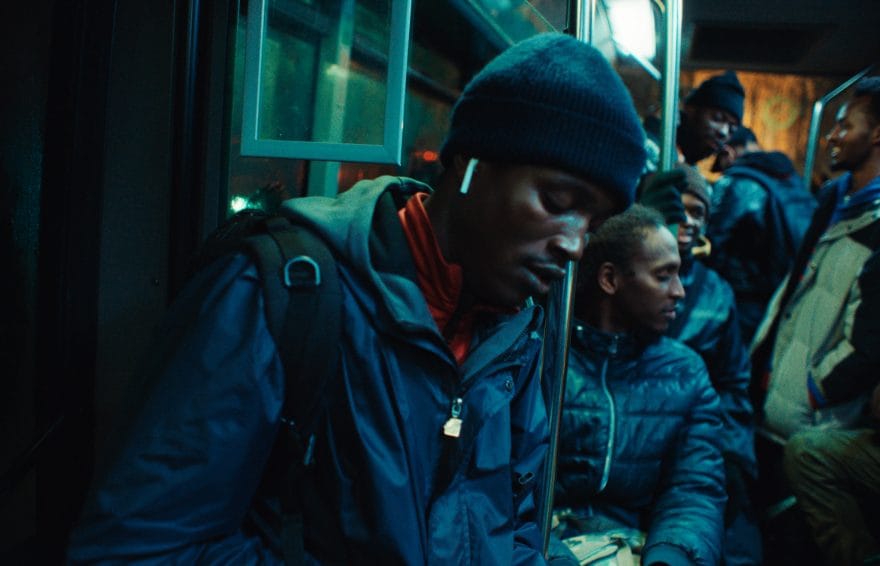
The realistic, socially loaded drama of Souleymane’s Story is reminiscent of works from Ken Loach, the Dardenne brothers, Cristian Mungiu, and Sean Baker. Lojkine’s film (which won a jury prize and an acting award at Cannes last year) is indebted to those politically conscious naturalists, but Souleymane’s Story is also imbued with a lot of restless energy befitting of the character. Souleymane’s Story revolves around a person running on a combination of adrenaline, fear, and fumes. He’s living a lie, but he desperately wants to start living his truth. He’s in a hurry to move forward, but everyone else is forcing him to move even faster.
If Souleymane isn’t zipping around the city on his bike, he’s racing to catch a train or bus. If he’s not doing that, he’s pacing on the pavement. And at almost all times when he’s not interacting face to face with another person and even when he should be getting some sleep, he’s working the phones, trying to buy himself time to come up with money, get paid, or reassure his mother and girlfriend back home that he’s doing okay. Sangare (who shares the same surname as his character) portrays Souleymane as a bundle of nervous energy stuck in perpetual fight or flight mode. Sangare leads a cast largely made up of non-professional actors with a great deal of confidence and force. There are no false notes to be found amid any of the performances in Souleymane’s Story.
Adding to the sense of realism already provided by the performances and the story is Lojkine’s taut direction. Souleymane’s Story is so locked into the moment and the frantic nature of the situation at hand that it hardly feels directed at all, which is a high compliment for a film that thrives on feeling realistic. Whether on a bike or on foot, Lojkine’s sensibilities follow along with the character so well that nothing appears contrived or staged. The film moves as fast as Souleymane moves, almost as if Lojkine is capturing a documentary and not a drama. If Souleymane doesn’t get much rest or time to think, then the audience is forced to follow along in kind, only building their empathy towards the character.
Souleymane’s Story builds to the climactic make-or-break immigration board meeting, and only then is the viewer allowed to know what has been driving Lojkine’s protagonist to his physical and emotional breaking point. It’s an exceptional conclusion to a film built around a search for belonging and catharsis. Lojkine’s work is strong enough to make viewers stand up and take notice of the hoops and barriers faced by migrants around the world, and how sometimes the truth doesn’t make for the sexiest of stories to the ears of an immigration officer. Governments around the world demand migrants to be the best of the best to be accepted as citizens and residents – fully formed, unproblematic, upwardly mobile, ready for cultural assimilation, and physically and mentally flawless – but they’re also treated like the dirt beneath the shoe of capitalism when they first arrive. Souleymane’s Story looks at the price people pay in pursuit of imperfect perfection in the eyes of the law.
Souleymane’s Story opens at TIFF Lightbox in Toronto on Friday, August 8, 2025. It screens at Carbon Arc in Halifax on Saturday, August 9, and opens at ByTowne Cinema in Ottawa on August 15, The Westdale in Hamilton on August 17, and VIFF Centre in Vancouver on August 22.
