

Alien: Earth bears all the hallmarks of an exceptional continuation or spin-off of a series. Elevating pre-existing lore and franchise expectations, while also fitting perfectly into an episodic series format without a hint of unnecessary padding or slow points, Alien: Earth continues the revitalization of concepts created by Dan O’Bannon and Ridley Scott. It’s intelligent, well paced storytelling on a epic scale that doesn’t feel out of place with everything that came before it (even some of the more maligned or misjudged entries in the Alien saga), while also taking the world built around the franchise to new heights. And in some of its best moments, it’s also scary as hell.
Alien: Earth opens in the year 2120. The Earth is run by five major corporations who’ve taken control over various regions and countries. Spaceship USS Maginot is owned by the ubiquitous Weyland-Yutani corporation is preparing for a return to Earth at the end of a 65 year journey. On board are several alien specimens (including, but not limited to, the dreaded and deadly xenomorphs) the corporation demands to be brought back at any cost, even the lives of the crew. Things go horribly awry and the Maginot crashes upon re-entry.
Instead of landing near Weyland-Yutani’s home base in North America, the ship crashes into the city of New Siam, in a territory run by the world’s fifth and newest corporate overlord, Prodigy, presided over by youthful industrialist Boy Kavalier (Samuel Blenkin). Kavalier’s primary goal at the moment is to eventually create a source of immortality through the invention of hybrid bodies. Not quite a cyborg and not quite a synthetic human being, hybrids are designed to implant a person’s consciousness into a robotic body. The first test case for the experiments is a terminally ill girl, whose life is spared by being more or less uploaded into Wendy (Sydney Chandler), who has the appearance of a young woman in her twenties. When the ship crashes in Kavalier’s backyard, the Peter Pan obsessed wunderkind is immediately intrigued by the ship’s cargo.
When military forces aren’t able to bring things under control, Wendy suggests that Kavalier’s new team of highly capable and immortal hybrids take on the mission. Wendy has personal reasons for volunteering, as the older brother from her previous life, CJ (Alex Lawther), is part of the military squad that was sent to recover the cargo. Alongside several other hybrids and synthetic scientist and Kavalier’s chief advisor Kirsh (Timothy Olyphant), Wendy sets out to save her sibling and discover what onboard the Maginot could be worth dying for. But in addition to the horrors they are about to unleash on Earth, the team also has to contend with Morrow (Babou Ceesay), the downed ship’s cold and calculating cyborg Chief Security Officer, who continues Weyland-Yutani’s mission to claim the aliens as their own.
Alien: Earth packs a lot into eight episodes, not just in terms of character and plotting, but in terms of action. The creative tasked with carrying on the franchise is Fargo and Legion creator Noah Hawley, and the writer-director is more than up to the task, and his crew of collaborators are willing to push the boundaries of what a franchise based series is capable of accomplishing. Hawley, his fellow writers and directors, and the craftspeople handle the original mythology and “rules” set out by previous instalment of the Alien franchise with love and respect, whether dealing with visual motifs, sound effects, jump scares, nitpicking minutiae, or imbuing the new story with plenty of philosophical, psychological, and literary allusions.
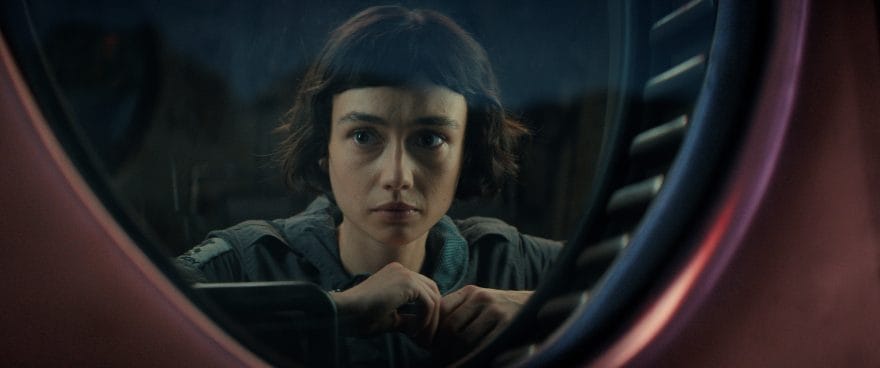
At it’s base, Alien: Earth is a forwarding of everything that came before it, set around the same time period as Scott’s original film and the more recent prequel Alien: Romulus. But upon that base Hawley builds one of the most inventive and out there adaptations of Peter Pan ever created, reframing the titular boy who would never grow up as an image obsessed, power hungry, Zuckerberg-coded tech bro, Wendy as the real hero and leader of a team of “lost boys” (half of whom are girls), and Ceesay’s Captain Hook surrogate as a complicated figure whose villainous tendencies belie deeper, more compelling truths. By taking on the framework of an established franchise and hybridizing it with one of the most analyzed, relatable, and well recognized fairy tales of all time, Hawley is able to effortlessly plot out a multi-episode arc that can branch out in multiple different narrative directions without ever once feeling stagnant or dull.
Those who come to Alien entries for close quarters combat, flashing lights, leaky roofs, cat and mouse stalking, face huggers, and gnarly gore won’t be disappointed by the work put in by Hawley and company. The world of New Siam is stunningly realized and closer in appearance to what Scott did with Prometheus, but the elements aboard the Maginot take the franchise straight back to the layout of the first two films. Hawley also ensures that the action and horror elements of Alien: Earth adhere to these suspense created by Scott in the first film and James Cameron in the second, which is to say that anything can happen at any time and without warning. Hawley’s team isn’t above foreshadowing when something bad is going to happen, but he’s also more than willing to deliver a sudden gut punch. Those who prefer their Alien films to follow a very specific template of action and suspense will find the series’ fifth episode (masterfully written and directed by Hawley) to their devilish liking, but there’s more than enough throughout the series to satiate those only looking for cheap thrills and entertainment value.
But it’s the character based approach to horror that makes Alien: Earth compelling and rewarding. Wendy, brilliantly played by Chandler with a sense of childlike wonder and fear, is a capable, driven, and empathetic hero; someone with genuine feeling and care for those around her stuck in a greedy world where life is cheap and the greed rules. Blenkin’s thoroughly contemptible and campy villain might be a bit obvious to decode by modern standards, but is a perfect fit for a franchise where corporate overlords are routinely pillared. Olyphant gets to play pleasingly against type, working in a lower emotional register than usual as the smartest (cyber)man in the room; a brilliant mind with innate understanding of the human condition who also has to put up with a tyrannical boss that constantly puts him down. But the biggest scene stealer throughout the show is Ceesay, who gets to play both an unstoppable force and a richly layered character whose motivations grow more intriguing as the series moves forward.
Alien: Earth finds a way to marry innovation and imagination with convention in an exciting way. It always feels like watching an Alien movie in terms of style, appearance, and terror, but the storytelling provided by Hawley and his crew expands the franchise without breaking or bending anything along the way. And that expansion shows limitless potential and new direction for future instalments. As the iconic tagline from Scott’s original film says, in space, no one can hear you scream, but on Earth, someone is bound hear it. One just starts to wonder if anyone would actually do something about the screaming, though. And therein lies the crux of Hawley’s bleak, but surprisingly emotional vision for Alien: Earth. If nothing is real, mortality is almost a thing of the past, and the world is run by those living out their own fairy tales, what’s left to be afraid of, and more importantly, who will care enough to stop the screaming?
Alien: Earth premieres on Disney+ and FX in Canada on Tuesday, August 12 at 8pm EST, with new episodes each week at the same day and time.
