
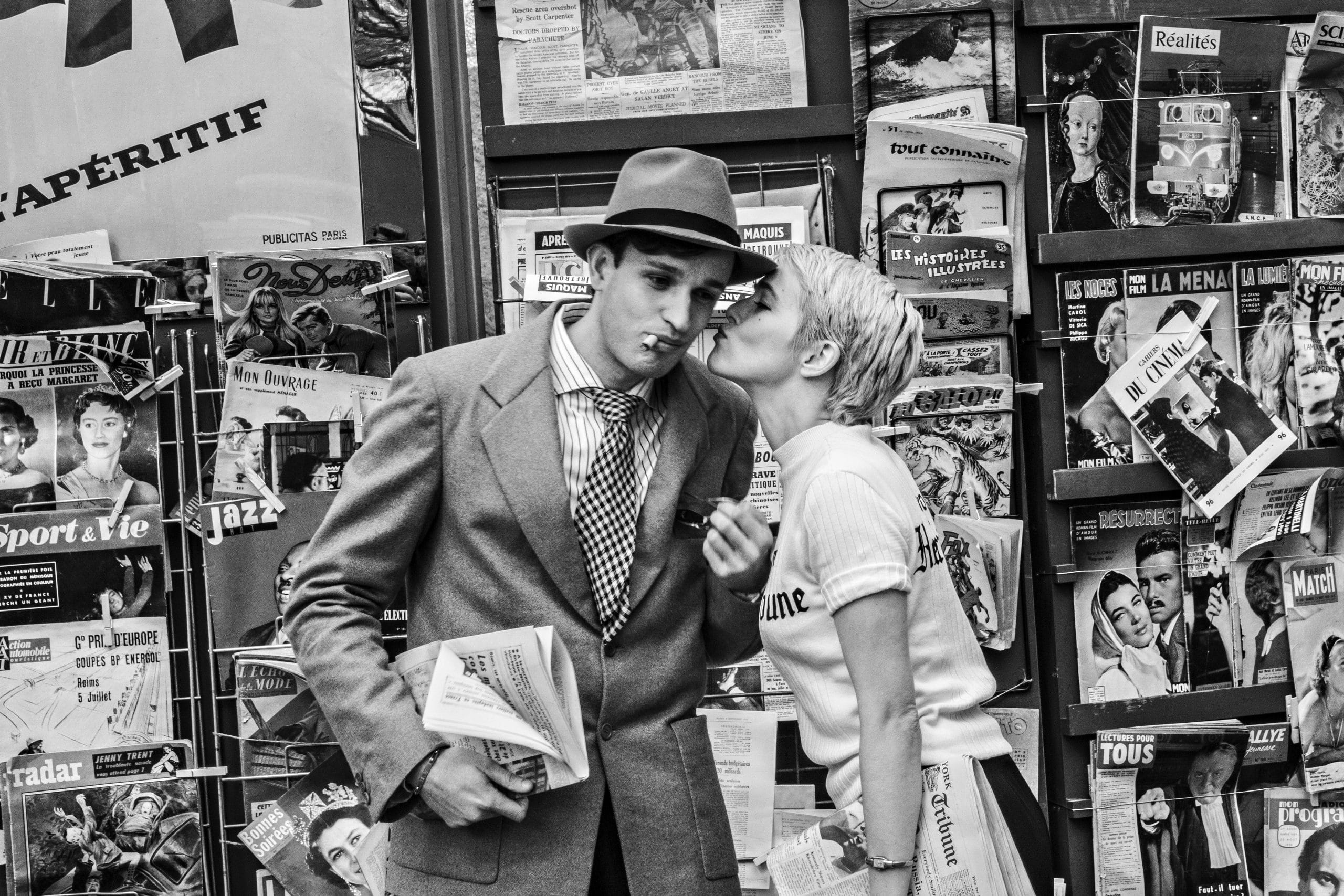
Richard Linklater’s Nouvelle Vague is a giddy, glossy, and sometimes overly reverential work of fandom. Films about other filmmakers are always subject to subjectivity, and Linklater’s look at Jean-Luc Godard is certainly no exception. It’s freewheeling, nostalgic, and fawning approach to the behind the scenes creation of Godard’s 1960 feature Breathless comes with boundless admiration from Linklater and only small slivers of drama or criticism. In that respect, the lack of tension and drive makes Nouvelle Vague a bit of a letdown, but in the hands of Linklater it also feels somewhat pleasingly like the kinds of hangout movies he’s made throughout his own career.

Read our TIFF coverage including news, reviews, and interviews, with over 25 years of archives from the best of the Toronto International Film Festival.
Nouvelle Vague follows film critic and director Jean-Luc Godard (a nicely studied performance from Guillaume Marbeck) from pre-production to the editing room of his first feature. Godard feels pressured to deliver a masterwork of the emerging French New Wave, as he’s the last of the major writers and critics at venerable publication Cahiers du Cinéma to make a major impact on screen. Working loosely from a script co-written by already established filmmaker François Truffaut (Adrien Royard) and based on a true crime story ripped from the headlines, Godard takes a familiar noir concept and elevates to a different form of art altogether; one headlined by a top name American performer (Jean Seberg, as played by Zoey Deutch) and an amateur boxer (Jean-Paul Belmondo, as played by Aubry Dullin).
Nouvelle Vague isn’t as boundary pushing as the film it builds its plot around. Linklater’s look at Godard is more of a character study of the filmmaker, who comes across as thoughtful, obstinate, unflappable, and flippant, all characteristics that can make for a great artist. But as much as Linklater (who’s also at the festival this year with another film, Blue Moon) shows a kinship with Godard, he’s just as enamoured with the community that surrounds him. Many moments are taken to give simple introductions to even the most minor of players, as if to marvel at all the talent that was present in Paris around this point in history.
Shot in black and white amid a loving re-creation of the time period, Nouvelle Vague finds Linklater having a bit of a play in Godard’s sandbox. There’s not much to propel it, and the film’s assertion that the French New Wave started with Breathless is very much debatable (sometimes within Linklater’s text itself), but as a romantic ode to times gone by, Nouvelle Vague works.
Tuesday, September 9, 2025 – 6:30 pm – Visa Screening Room at The Princess of Wales Theatre
