
Visually poetic documentarian Viktor Kossakovsky’s Architecton pays careful consideration to landscapes and structures in a bid to better understand why humanity has forsaken the ingenuity of its past of the sake of a more convenient, overcrowded, and less imaginative future. A meditation on the nature of impermanence that muses on lost arts, thrifty hubris, and global catastrophe, Architecton rounds out a trilogy of similarly minded works from Kossakovsky, including his breakthrough feature ¡Vivan Las Antipodas! and Aquarela, both of which examined our relationship to the world around us without much dialogue or dramatic embellishment. It’s a fine way to round out Kossakovsky’s trilogy.
Although some of the greater answers to Kossakovsky’s grander questions are staring the viewer in the face, and the filmmaker is choosing to tap dance around them for more poetically profound answers, Architecton ponders why humanity shifted from creating structures made to last centuries to prefabricated, run of the mill skyscrapers and apartment styled housing that will be lucky to last fifty years or more. The simple answer, which never fully gets broached by Kossakovsky, is capitalism. In an age where fashion and furniture aren’t made to withstand more than a few years of usage before being tossed aside in favour of a refresh, what chance do grand structures stand?
But what are we forgetting for the sake of expedience, ease, and expansion? As Kossakovsky illustrates hauntingly by showing the aftermath of a massive 2023 earthquake in Türkiye, humankind has seemingly forgotten that the world we live on changes as much as its inhabitants do. The mountains that line the Turkish countryside didn’t pop up overnight. They were formed over millions of years of tectonic shifts and continue to undergo changes in the form of fissures, rockslides, and weather related modifications. Our manmade structures are also at the mercy of the Earth’s crust, so why do we no longer make things that are built to last and evolve with the landscapes instead of falling victim to global changes?
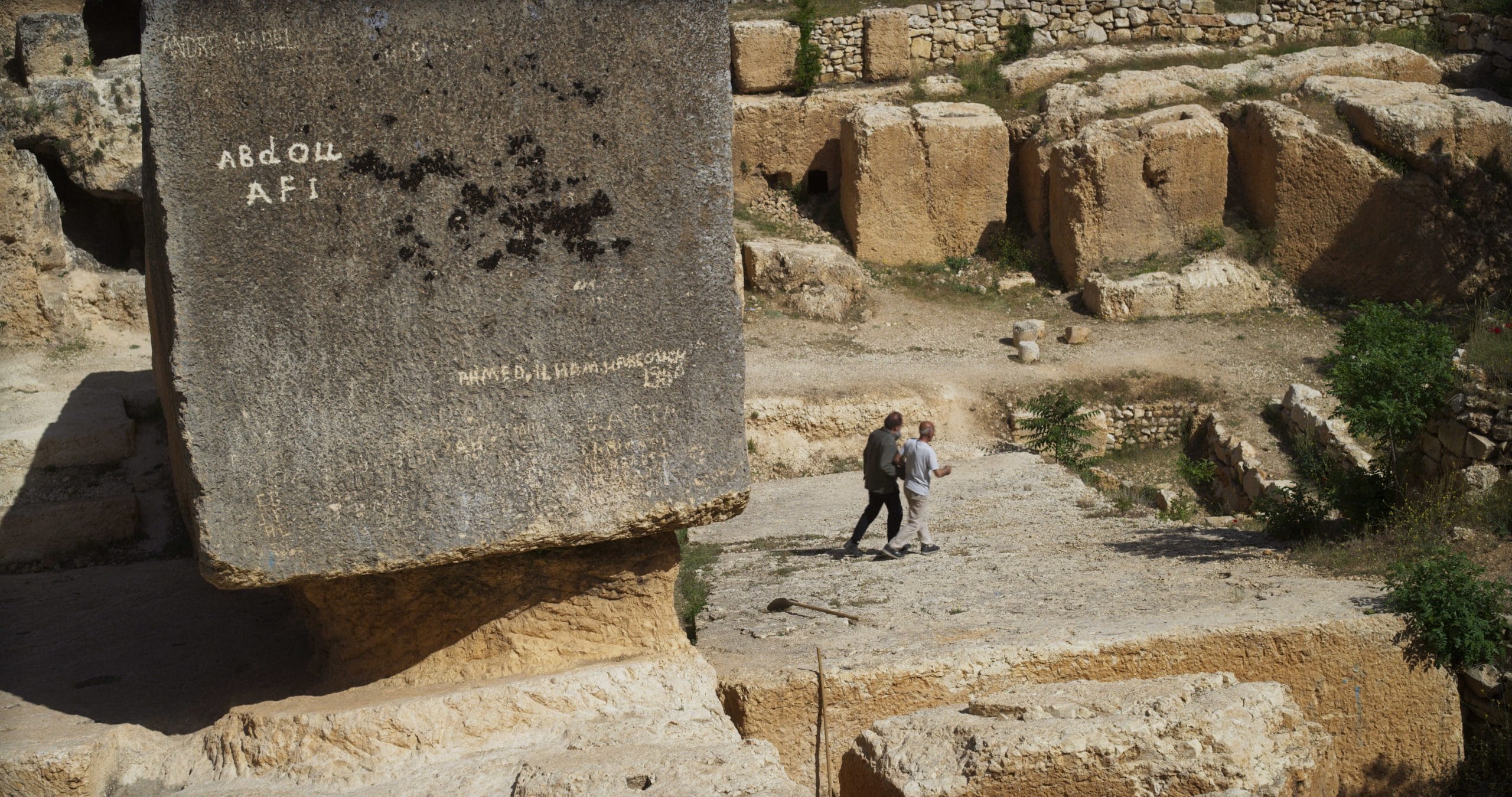
It’s not as if humans don’t have the knowledge or capability to make things last for centuries. Some of the greatest monuments of the modern world have been around for generations, built of enormous stone slabs that modern technology couldn’t move without considerable effort or innovation. Somewhere along the way, that knowledge was lost or ignored, and building became more streamlined and conventional. Structures were aren’t built as monuments and accomplishments as much anymore. They’re built as a means to an end, and not always made to withstand worst case scenarios.

Architecton (which gets its name from Tolstoy’s War and Peace) only focuses on the work of a single architect, Italian Michele De Lucchi, as he attempts to create a sacred circle on his property, inspired by an ancient compass. While this narrow cross section fits Kossakovsky’s intent with Architecton, it also willfully ignores any other architects who might think similarly, making these sequences and the film’s more elucidating epilogue land somewhat hollow. Architection works best when it is in the moment, carving out a matter of fact depiction of both grandeur and decay that’s hard to categorize as being either hopeful or hopeless. Concrete and cement made up from ground up bits of stone might be the scourge of modernity in the eyes of Kossakovsky and De Luchhi, but in raw form, rock could provide salvation.
Kossakovsky’s film is anything but banal. In terms of visual spectacle, Architection is impressive, with cinematographer Ben Bernhard capturing both ancient monuments and urban decay in granular detail, with some particularly commendable drone photography that can take the viewer places where it’s now hard for humans to tread without the help of heavy machinery. A select number of black and white segments also add a considerable amount of texture and depth to the images.
The observations made by Kossakovsky are meant to provoke not only reactions and connections in the mind of the viewer, but also a sense of curiosity and wonder, even when peering into the darkness of what it could look like in other parts of the world in the wake of a devastating natural or manmade crisis. Visions of freestanding ancient temples in Lebanon nicely contrast those depicting Turkish cleanup efforts that show how humanity’s follies are just further burying the world in more trash.
Architecton plays into our latent fears that humanity’s place in the world is always tenuous. It also doesn’t have many easy answers about how to assuage those feelings. Is a space sacred or liveable because a human being has deemed it so, or does a place hold reverence because it hasn’t been touched by human hands or tinkered to death? There’s a distinct sense throughout Architection that engineering could provide a path to a more sustainable and resilient future, provided that advancements are made with regards to durability and design instead of merely cranking things out for the sake of making the fastest, best use of space. Again, this would all be a bit more pointed if Kossakovsky had the input of another architect who could provide Architecton with a creative counterpoint, but as a work of poetic observation, the film remains remarkable to look at.
Architecton screen at Hot Docs Ted Rogers Cinema in Toronto on Sunday, October 19, 2025 at 4:00 pm, and again on Sunday, October 26 at 4:00 pm.
