
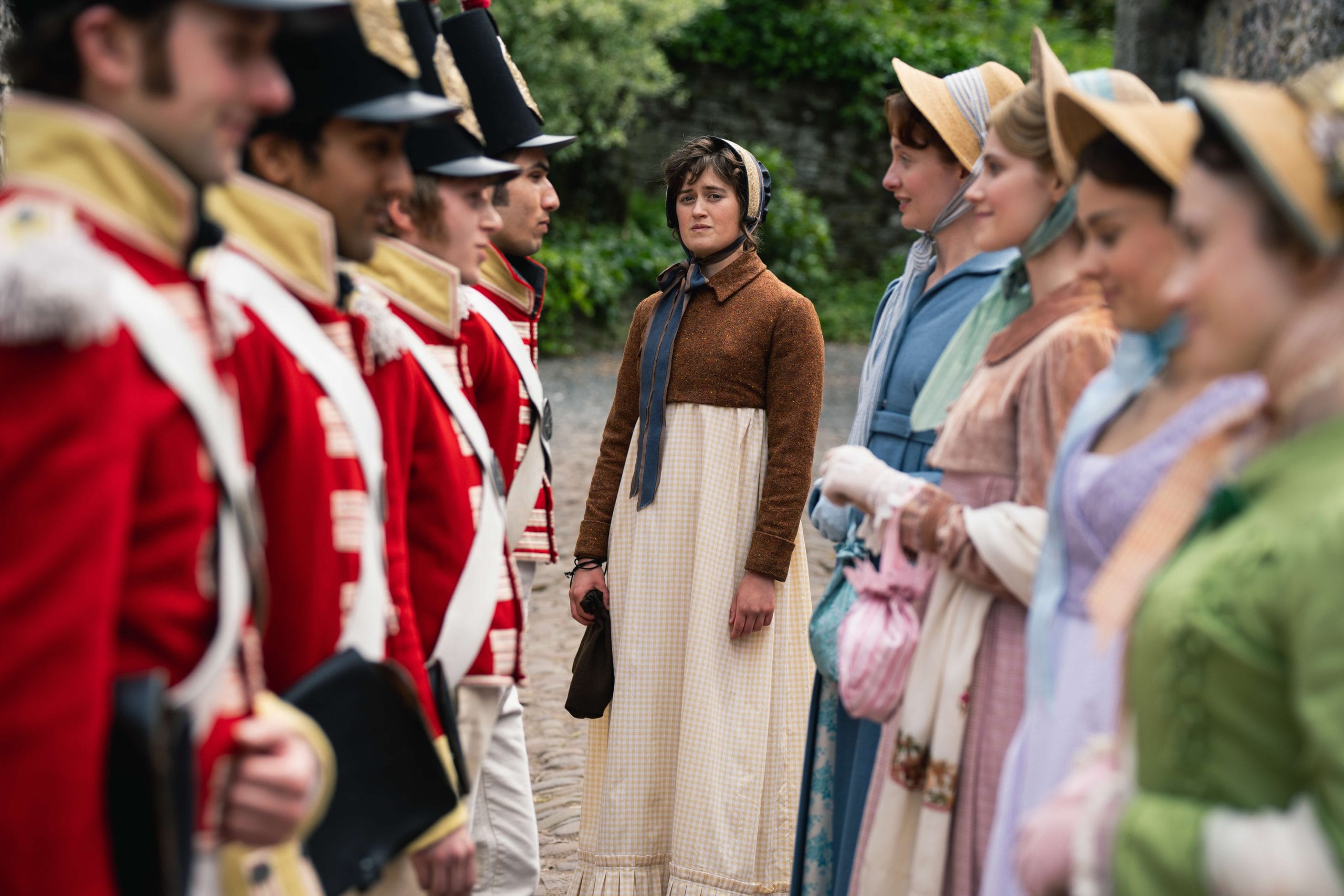
Taking on the assignment of bringing The Other Bennet Sister to the screen proved a unique challenge for series writer Sarah Quintrell. The ten part series, which premiered to huge ratings in the UK earlier this year and makes its North American debut on BritBox starting this week, isn’t based on one, but two bestselling novels almost at the same time, meaning the pressure of ensuring a smooth transition from page to screen increases exponentially.
The Other Bennet Sister is based on the bestselling 2020 novel by author Janice Hadlow and tells the story of Mary Bennet (played here by Ella Bruccoleri), the middle child of a once well to do, now almost destitute Regency era family. Not as traditionally gorgeous looking as some of her sisters, nor blessed with a quick and cunning wit, Mary is a bit of a bookworm whose prospects for marriage seem slim to none in the eyes of her domineering mother (Ruth Jones).
If you’re unfamiliar with Hadlow’s work, you still might’ve guessed from that description that The Other Bennet Sister is spun off from Jane Austen’s classic Pride & Prejudice, this time told from the perspective of a character that’s seen as a sort of black sheep in the family. Set some time after the events of Austen’s novel, The Other Bennet Sister follows Mary as she makes a trip from her childhood home in rural Meryton to London, where she becomes a live-in governess for her aunt and uncle’s three children. Although she has been told to conform to traditional gender roles and practices, Mary discovers that its much easier to be herself and find happiness in London, eventually striking up close relationships with a pair of different men: the forward thinking, devil-may-care Mr. Ryder (Laurie Davidson) and the kind hearted, charitable, but sadly taken Mr. Hayward (Dónal Finn).
Naturally, the task of adapting a popular bestseller that heavily references one of the greatest novels from one of history’s finest writers is a daunting one. But when it comes to sitting down with the material and figuring out its onscreen dynamics, Quintrell just had to put a lot of that pressure out of sight and out of mind to focus on the characters and their world.
“I mean, firstly, the the Austin fandom, in the UK and globally, is like an institution, isn’t it? So I never let myself think about that, because I just wouldn’t get out of bed or write anything,” Quintrell joked when chatting during a Zoom call late last month to talk about the show. “So I start from the point of view of ‘what a privilege to play in the world of Pride and Prejudice,’ a novel I have loved since I was in my teens, and I know Austin’s work well, and have been a huge fan. And then I have Janice’s novel, which when I was given, I also loved, and felt like I had things to say about that as well, and the experience of a character like Mary. So I sort of fill myself up with it all, reading and reading and reading until I really feel like I know it, and then I put it all to one side, and I kind of jump off the cliff and I write like as if I was writing an original, because ultimately, it needs to be a really entertaining TV show that hangs together properly, and it’s got something to say for itself. And I think the only way to do that is to write how I normally write, and use my process and not be there with kind of stacks of novels.”
“But I then do go back to the books. And I think, ‘Have I missed anything?’ And I took it on really, because I felt like thematically, it had things about it that I returned to in my work, about female vulnerability, about friendship, about the transformative power of kindness on a young life. It’s not so dissimilar from my first social realist film, thematically. So that’s where I felt like I could come in quite naturally, and I had plenty to say on those subjects.”
“It was a challenge because it’s a 500 page book, and I had five hours to work with, so it had to be a real economy of storytelling. But ultimately, it was the biggest joy of my career to write.”
The ubiquity of Austen’s characters also posed another unique challenge for Quintrell, who started her career as an actor. Many of Austen’s characters are highly familiar to performers, especially those living and working in the UK. To make these characters appealing to the widest talent pool possible, the show would have to subvert expectations and find new layers to showcase instead of just forcing actors to play the same roles that have existed for over a century now.
“I think that the gift that I had with that was that we were examining these very familiar people, very familiar characters, but through a brand new lens, which is the point of view of Mary Bennett,” Quintrell says about what sets these characterizations apart. “If you think that Pride and Prejudice is kind of told from the view of Lizzie… and that’s a slightly more generalized point of view, but basically so much of that is Lizzie. With this, it was tight in Mary’s point of view. And in the whole series, there’s maybe one scene that Ella isn’t in, and it was that was to give her, like 11 minutes off. (laughs) So as soon as you put that lens on it, it shifts them all. [Characters like] Mr. Collins can be seen in a different light because Mary’s looking at him, and she’s open, and she’s not judgmental, because she knows what it’s like to be an outsider. Lizzy suddenly becomes, well, not horrible, but she’s a tiny bit thoughtless in the way older siblings can be, and Mrs. Bennet becomes quite brutal when viewed through Mary’s lens, because that’s how Mary receives her. So, I think just putting Mary’s lens on it just allowed me to completely look at them in a different way.”
That depiction of Mrs. Bennet as Mary’s chief antagonist fuels a great deal of the conflict within The Other Bennet Sister, allowing veteran performer Jones a grand chance to shine, alongside Richard E. Grant as the more unbothered Mr. Bennet. Mrs. Bennet can often treat Mary with a great deal of contempt and cruelty, and the key to making this contentious mother-daughter dynamic work on screen required going back to Austen and Hadlow’s source and examining where these feelings are coming from.
“I think when Janice was writing the novel, she’s an expert on the Regency period and on Austin’s work, and I think she took everything that Austin has written about Mrs. Bennet and Mary, and she used those as her clues,” Quintrell says about finding one of the story’s major tentpoles. “And when you pull them out, they’re quite brutal. And I think what Janice did was fantastic. She wasn’t afraid of that brutality. She wasn’t afraid to explore a really complicated mother-daughter relationship in which the mother is almost the child’s antagonist. It’s highly unusual to have that story told on screen. It’s not highly unusual in life, and I think that’s why a lot of people have related to it, because they maybe feel they’ve had something of that experience, or they know someone who’s had that experience.”
“Mrs. Bennett, traditionally, is more sort of hysterical and funny, because we see her as Lizzie’s mom. At the end when Mrs. Bennet says, ‘I had five daughters,’ and she sort of explains herself and why she’s done what she’s done. And I think it’s really interesting in modern context, to look at this woman and what drives her. We normally look at Mr. Bennett as the kind of sarcastic, droll, funny one, and then she’s the hysterical, slightly silly one. And actually, when you look at it, he’s refusing to get involved in any of this. He’s teasing her about whether he’s going to go and see Bingley, which could save them from absolute destitution, and it’s a situation where, for them, the stakes couldn’t be higher. And he sort of teases her and uses that as a joke and something to prod her with. You can see how she could be quite angry. You can see how that marriage has become kind of tetchy and difficult. So I think it was really important to show Mrs. Bennet’s desperation. I mean, in Austin’s hands, she sends one of her children, Jane, off in the rain, which could have killed her just to go to Bingley’s house. So she that’s how high the stakes were for her. And it’s not unthinkable that she would be this frustrated with Mary, or that she would treat Mary this badly, and that Mary would receive her so brutally. I think it’s really interesting to reframe these characters and think, ‘Well, hang on a minute. What’s he actually doing to help?’ rather than thinking, ‘isn’t he funny and she’s really silly?’ I mean, in Austen’s novel, within a few pages she’s telling Kitty off for coughing. She’s not a patient woman, and desperation can take that in a person to extremes.”
But on a more positive level, The Other Bennet Sister is about more than a black sheep finding romance and learning their self-worth. It also shows how sometimes self-realization and living up to one’s potential is as simple as a change of scenery; leaving the comfort of one’s narrow minded hometown and seeking out like minded people to serve as friends and a surrogate family.
“I think that is so true,” Quintrell responds when asked about the timelessness at the heart of Mary’s journey to London. “The advice that Mrs. Hill says to Mary – get out and see the world outside your family – is from Janice’s novel. To me, that feels essential. Just personally, when I was writing, I always felt like an outsider. I didn’t quite fit in, and all the things that made me not fit in at school actually have given me a really interesting adult life as an actor. I mean, if you’re 14, and you can get up on a stage and kind of do anything with no vanity, then people think you’re weird, whereas as an actor, that’s a real strength and a necessity.”
“So for me, like there’s a point where Mary, in episode three, arrives in that little attic room at the gardeners. And when I first saw that on the rushes, I did well up because it reminded me of when I arrived in Manchester to go to drama school. It’s about finding your people, isn’t it? It’s not about inherently changing who you are. It’s about finding an environment in which you can flourish. You can still make mistakes, you can still say the wrong thing, you can still be clumsy. It’s just not a problem in that environment because you’re just being who you are. So there’s something there about how lucky you are if you do find that place or that community where you can be yourself, and that feels so important in a young life. And I think it’s helpful to say to young people watching, ‘please don’t worry if it all feels horrific now, because there’s a whole world out there, and within it will be your people.’”
The first three episodes of The Other Bennet Sister are now available to stream in North America on BritBox, with new episodes every Wednesday.
