
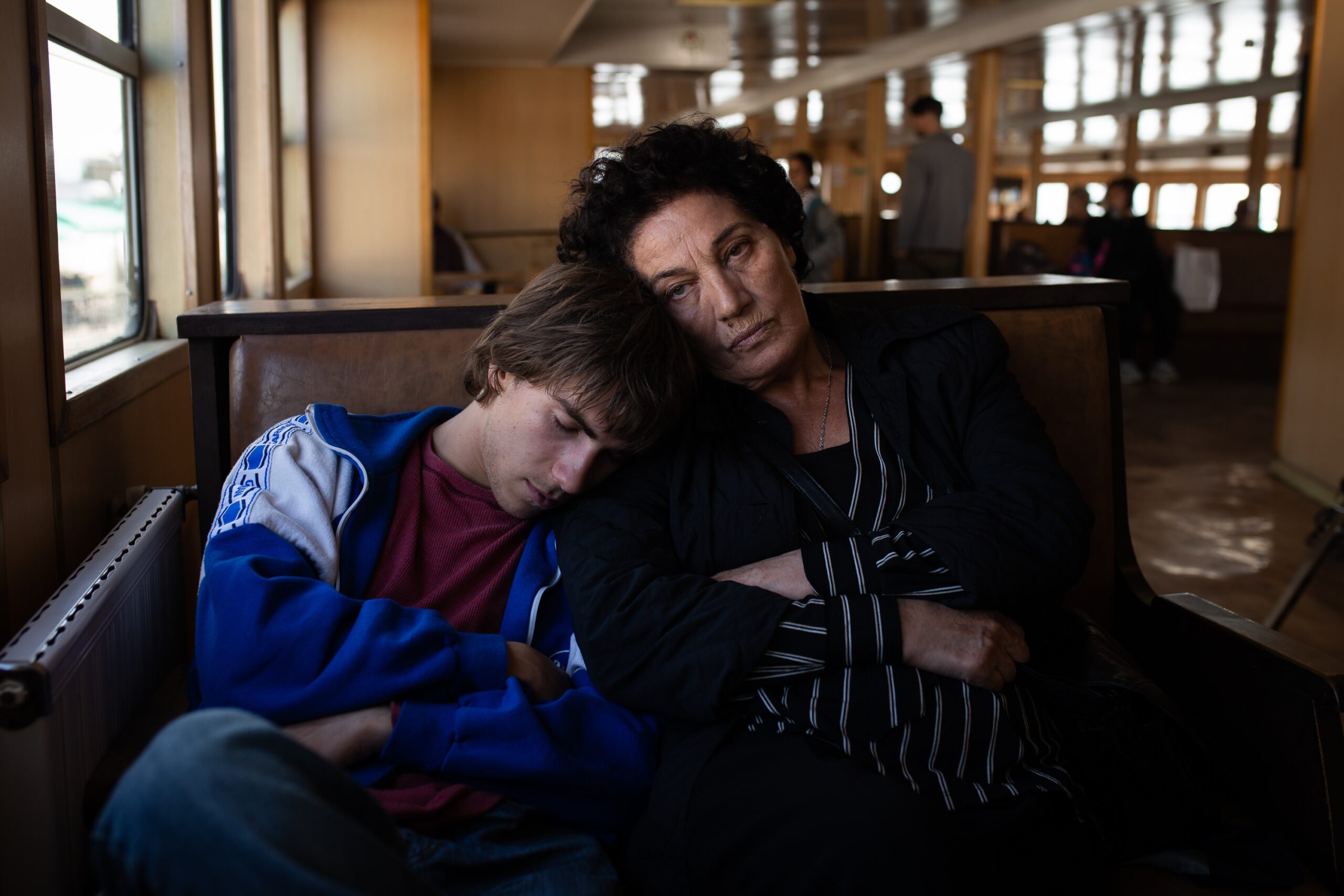
Subtle in its approach but resounding in its overall emotional impact and intent, Swedish-Georgian filmmaker Levan Akin’s Crossing looks at familial rifts and the politics of living as a transperson from unique, unforced perspectives. A film full of well calculated reveals and revelations, Crossing is the sort of work that’s more concerned with the steps taken towards formative moments than the actual moments themselves. In some respects, it’s not as conventionally dramatic as one might expect from such loaded material, but Akin’s film eschews convention and cliche in favour of something a lot more tender and respectful of the viewer’s intelligence.
Lia (Mzia Arabuli) is a gruff, retired school teacher from Georgia on a mission to find her estranged, 28-year old niece, Tekla, a transperson. Lia learns from a former student (Levan Bochorishvili) living on the Georgian-Turkish border that Tekla was living nearby, but evicted from the home they shared with a group of others quite some time ago. The former student’s overly-eager younger brother, Achi (Lucas Kankava) insists that Tekla has made their way to Istanbul, begging to accompany the cantankerous aging woman on her journey to the city. Lia and Achi do whatever they can once they get to Istanbul to try and track down Tekla, but have trouble finding concrete answers and are on a bit of a goose chase. Help for the unlikely, tenuous duo comes in the form of Evrim (Deniz Dumanli), a transperson and recent law school graduate who performs tremendous acts of charity and outreach for marginalized people within their community, most notably advocating for the rights of the trans community and assisting two troublemaking kids with perpetually absentee parents.
Crossing looks at two different divides in Georgian and Turkish culture: that between young people and old people and the one that exists between transpeople and the state. Akin notes early on that the Georgian and Turkish languages are both gender neutral – meaning they don’t differentiate between male and female when using descriptors – but the countries’ practices and treatment of the LGBTQ2+ community couldn’t be more separate. Akin isn’t keen on making grand speeches about the politicizing of personal autonomy and sexual identity, but rather showing a thriving community of people that are trying to survive in the face of consistent marginalization.
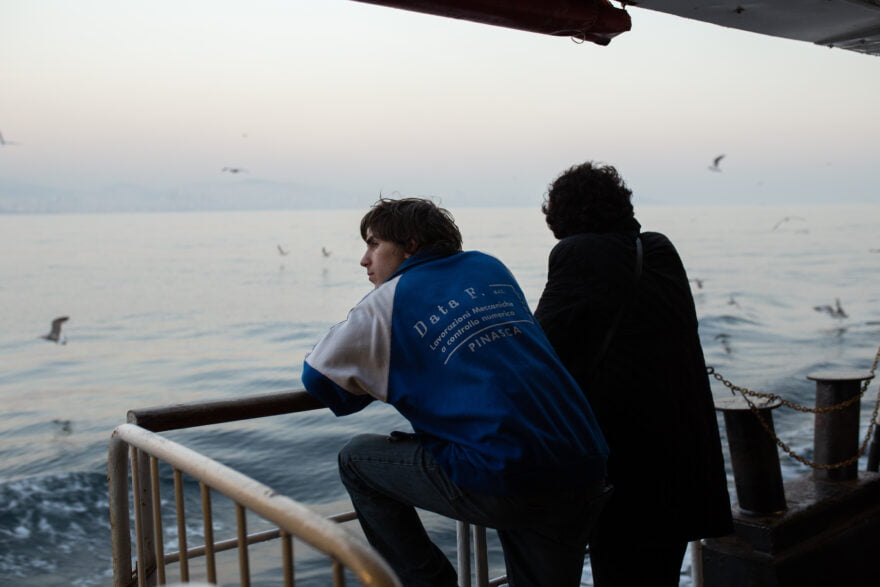
Lia, who takes to her task with extreme seriousness, wants to understand her niece, but remains unsure what to say to them in the face of past prejudices. Achi is excited by the experience of seeing a new culture far removed from his own, but his aims aren’t entirely altruistic towards Lia. Evrim has recently completed their transition, but in a pivotal scene is cruelly told that they need to get every department in the hospital to sign off on their identity before being allowed to get a new ID. The people Lia and Achi encounter along the way are understandably wary of these Georgian outsiders, but there’s always a hint of gratefulness that anyone would be curious about their well being at all. All parties involved in Akin’s film wander through life like people without a country to belong to, having to find happiness wherever they can.
Akin portrays Istanbul as a place where people go to disappear and lose themselves, like many major cities around the world. Crossing takes loose inspiration from a true story Akin heard while researching for one of his previous films, And Then We Danced, and quite similarly to that work, the writer/director captures a lot of personality and local colour. It’s a fitting visual and narrative motif for what starts off as a story about an odd couple of travellers basically going door-to-door looking for someone. The streets of Türkiye are teeming with a variety of personalities, run down buildings running up against newly built structures blocks away, and the country’s legendary number of stray cats. Crossing depicts a place where the ordinary always feels overwhelming, making it a perfect setting for people trying to accomplish a task that initially feels impossible. It’s a classic road movie with a pronounced sense of purpose and relevancy.
The motivations for Lia’s journey and Achi’s desire to help the old lady are always hinted at, but in one of the few downsides to the film, they remain rather obvious. The core mystery as to what happened to Tekla and the steps towards finding them are far wider reaching and better handled than the overall characterizations here, but the trio of stars in Crossing give performances that raise their characters to another level. Arabuli is perfection as the perpetually unimpressed, but gradually warming woman on a mission. Kankava embodies the feeling of a young man grateful to be out from under the shadow of their family and experiencing cultural and sensory overload for the first time. And Dumanli provides a pillar of strength and grace as someone who is personally struggling, but still refuses to give up the good fight.
Crossing weaves a delicate story of a society at war with its own ideals that seems so simple that one might not even realize the complexity of it until long after the movie has ended. The people and situations are effortlessly realistic, and so too is the setting. Crossing has the ability to be deeply political and moving, and it accomplishes those goals honestly and without resorting to generalizations. Outside of a few well telegraphed twists along the way, Crossing is organic in its approach to life’s experiences and our understanding of them. Like many great films, it has cultural specificity, but feels like it could be unfolding anywhere in the world at this very moment.
Crossing opens at TIFF Lightbox in Toronto on Friday, July 26, 2024. It expands to Metro Cinema in Edmonton on July 28, select locations in Montreal on August 2, ByTowne Cinema in Ottawa on August 7, and to Vancity in Vancouver on August 30. It will be available to stream on Mubi starting August 30.
