

A politically charged and paranoia driven thriller about a fight for faith, Edward Berger’s Conclave makes the viewer feel the ground moving beneath the characters’ collective feet. A look inside an insular and incomparable world that few have experienced and even fewer have talked about openly on the record, Conclave weaves a story about various figureheads and factions fighting for control over one of the largest Christian subsets in the world, the Catholic Church. It’s part thriller, part mystery, and a wholly intelligent examination of how the church perceives its own senses of piety, purity, and importance. And all of it is built around the leading performance of an actor as the unlucky (or possibly very lucky) person caught in the middle of the spiritual whirlwind.
The Pope has passed away, and Cardinal Lawrence (Ralph Fiennes) is in charge of gathering the conclave together. The conclave is an assembly of high ranking clergy who are sequestered in a highly secured setting within The Vatican until a candidate for Pope reaches a 2/3 majority with members and ascends to their highest rank. The clear front runners at the start of the meeting are the progressive, likeable Cardinal Bellini (Stanley Tucci) and the hard right, devout traditionalist Cardinal Tedesco (Sergio Castellitto), but unlikely contenders emerge in the form of an African leader (Lucian Msamati) and the mysterious Mexican Archbishop of Kabul (Carlos Diehz). Cardinal Lawrence would love for things to go smoothly and amicably, but over the course of 72 intense hours, allegations of sexual impropriety, internal cover-ups, and questions of procedure will dog the conclave, putting him into an unlikely (and possibly unwanted) position of being one of the few members everyone can agree upon as a potential leader going forward.
Berger (All Quiet on the Western Front) imagines the conclave – a very real event for which there’s no definitive, publicly disclosed rundown – as duelling political conventions running concurrently with an election, a perfect reflection of the current global landscape where voting cycles never appear to stop. There’s always a whisper campaign going on in the background, and staunch supporters of current candidates dig their heels in for a real fight. But those fights also have to be rooted in faith, meaning the attacks against peoples’ characters are just as personal as the ones everyday voters throughout the world see on the campaign trail. But within the heavily guarded, barred up Vatican walls, there’s no escaping the onslaught of information, muckraking, and mudslinging. Some people are obvious opportunists throughout, while others who seem more easy going will either be outed as equally duplicitous or calculating personalities who are simply waiting for the right time to speak and sway popular opinion. It’s a world that proves that any one voice is capable of swinging a movement with a few choice sentences.
Adapted from a Robert Harris novel by screenwriter Peter Straughan (Tinker Tailor Soldier Spy, The Men who Stare at Goats), Conclave revolves around characters with large amounts of divine self-importance who give grand speeches for a living. But instead of coming across like a film where people are always stopping the show to pontificate about the role of the Pontiff, Conclave is more observational in its approach to such personalities. The characters butting heads are always able to choose their words carefully around like minded company, but their actions outside the gathering belie a certain amount of reckless disregard for their standing. Accusations are hurled, opinions are constantly swayed, and momentum during vote tallies swing like pendulums, all on the basis of some well chosen words delivered with righteous conviction.
It’s a system that forces unlikely players on the periphery into the conversation, whether they want to be or not. Sister Agnes (Isabella Rossellini) and Prefect of the Papal House, Janusz (Jacek Koman), are both sitting on bombshell information that can change the course of history. Moderate candidate Tremblay (John Lithgow) knows more about the late Pope’s final moments than he is letting on. This says nothing about growing unrest in the world outside the cavernous arena walls of the conclave, which is not only in danger of encroaching on the proceedings, but also the very people the membership should be listening to and heeding in the first place. And through it all, it’s on the shoulders of Lawrence to try and keep bitterness and confrontation from sending the train off the tracks.
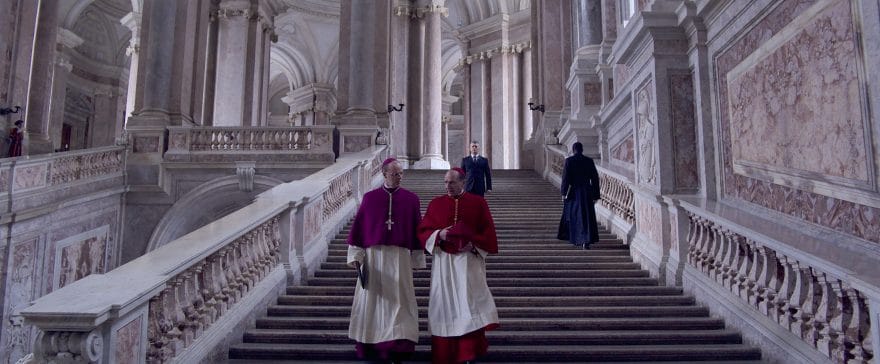
Conclave is a film with no insignificant roles and many moving parts, with Tucci, Rossellini, and Lithgow adding more feathers to their veteran caps with their performances here. Koman, Msamati, Castellitto, and Diehz make major impressions in their pivotal roles, each getting a great scene where their character has to stand alone against powers beyond their control. The enormity of the situation is nicely conveyed on a visual level by Berger, who depicts the conclave as both spacious and stifling. But the film will be most widely regarded because of the work of Fiennes, who hasn’t had a role this substantial and subtextual in decades.
Fiennes portrays Lawrence as a perpetually stressed out but devoted man of the cloth. His overall faith in Catholicism isn’t being put to the test, but his belief in the piety of others and his patience are being stretched as thin as can be. Berger and Fiennes never come out and say whether or not Lawrence actually wishes he could be Pope or not. Lawrence always insists that he’s not cut out for the part, but if he wasn’t, why would he have risen so high in the church in the first place? Even though Lawrence’s motivations are some times murky and unclear, Fiennes always makes the character appear humble, driven, and intelligent without succumbing to the darkness around them. He might not be the best choice to lead, but there’s a reason he has been entrusted to wrangle so many stray cats. There are hints that this could all be an act – another testament to the enormous dexterity of Fiennes’ performance – but Lawrence always seems like the best of a flawed bunch, making his frustrations all the more relatable to outsiders.
Berger keeps viewers on their toes, asking them to question whether the evidence presented to them about these candidates is the truth, deliberate misdirection, or something that falls into a morally grey area that would be permissible outside the walls of the Vatican, but has no room in discussions of faith. These supposedly clean humans in their pristine palace are supposedly devoid of sin, but as Berger points out quite nicely, the certainty in which they hold their beliefs is a sin in and of itself. It asks the viewer to examine the type of person who have to address unanswerable questions with a degree of certainty that can afford them unparalleled authority. And within that examination lies the futility of certainty, and the basis for all of Berger’s rousing dramatic beats.
Conclave opens in select theatres on Friday, October 25, 2024.
