
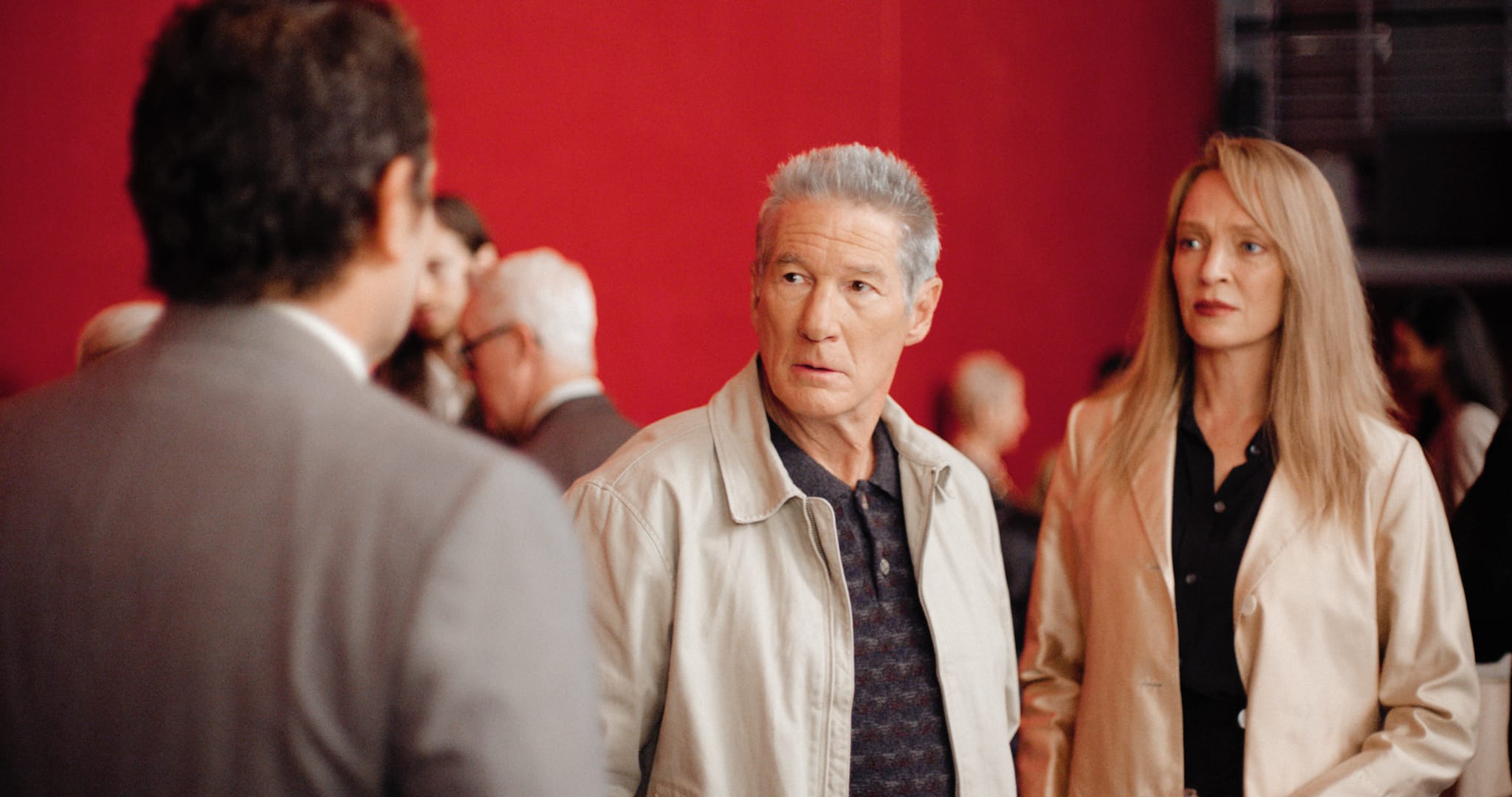
Oh, Canada, writer-director Paul Schrader’s latest reflection on regret and mortality, is well in line with many of his other recent efforts, but on the high side of things. After settling for some mushy, existential middle ground with the likes of Master Gardener and The Card Counter (which are still beloved by many critics, but are lesser works), Schrader’s re-teaming with star Richard Gere and late novelist Russel Banks (who provided the source material for the director’s masterful, underrated Affliction) offers more contemplations and musings worth wrestling with and pleasingly less obvious cultural and social signposts. Oh, Canada still has a lot of the purposefully scrappy edges and caustic bite that mark a lot of Schrader’s work as a director, but here those imperfections nicely reflect the story being told.
Montreal based professor and documentary filmmaker Leonard Fife (Gere) is dying, and he has been pulled out of hospital by former student Malcolm (Michael Imperioli) for an interview that will make Leo look “totally sympathetic.” Leonard’s wife, Emma (Uma Thurman), stands dutifully by while Malcom, his partner/camera operator Diana (Victoria Hill), and blunt talking camera assistant Sloan (Penelope Mitchell) ask questions that would be softballs under normal circumstances. But plagued by guilt and regret, Leo uses this opportunity to deliver a final testament, prayer, and confession, painting himself as a poor mentor, a bad role model, and a terrible life partner.
Leonard Fife is a fascinating character, and not just the same old tragic, male loner Schrader tends to gravitate towards in so many of his projects. Leo is an estimable talent, but like so many people who portend to speak truth to power, his career has been built upon a mountain of carefully assembled lies and half truths. He fled the United States in 1968 as a conscientious objector to the Vietnam War, but in the process left behind a wife (Kristine Froseth) and son without much explanation. He reinvented himself as the “Ken Burns of Canada,” but he has no real sense of nationality anywhere. He’s a man who has lived without mooring, direction, or a sense of purpose beyond his own political and artistic beliefs, and now, on his death bed, understandably has to reconcile with his actions, and the nagging regret that his civil disobedience was never heroic, as some made it out to be at the time.
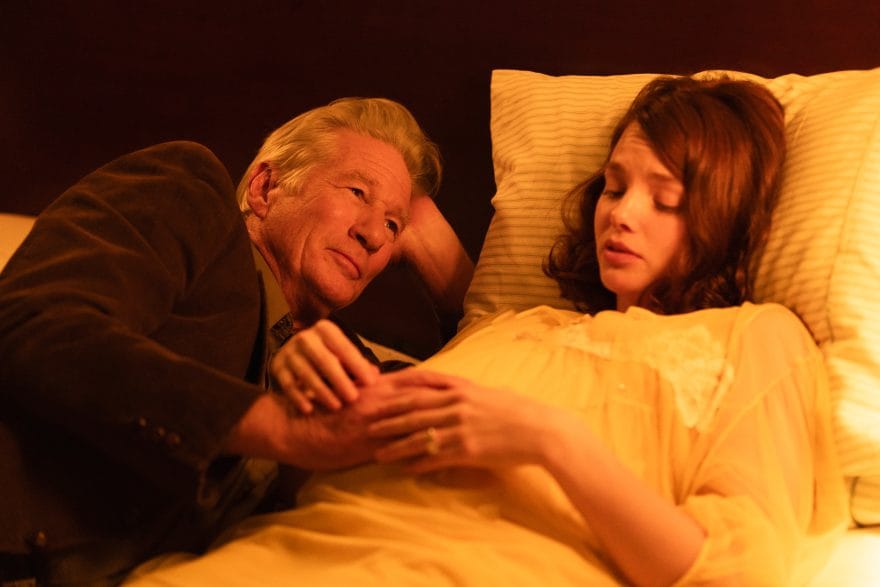
Leo’s memory is also failing, which allows Schrader to play with structure and pacing, though not always successfully. While Gere sometimes plays a younger version of Leonard, other times the character is played by Jacob Elordi. In better moments, the switching back and forth between the performers helps Schrader to balance a fine line between recollections of the past and even more subjective framing of bygone events through the lens of a man whose memory and faculties are failing him. In lesser moments, the swapping of actors can feel like a stylistic choice that never pays off and seems overthought. (Although, that could be the point, given the fraying reality of the protagonist.) And while Gere and Elordi are putting in great performances on their own, the differing approaches to the character never fully mesh together into a cohesive whole, both dramatically and visually. Oh, Canada has an element of character study to it, but comes about it from a confused direction.
Oh, Canada exists in a space between comfort and curse. Leo romanticizes his past via flashbacks that are made to look like the kind of cinema one could imagine comforts him in times of loneliness, with black and white sometimes nicely employed to note moments of perceived or implied pretension. But at the same time, Leo can’t stop admitting how much of a selfish coward he has been, much to the shock of the idol worshiping Malcolm and the obviously concerned Emma. Leo’s position as a documentary filmmaker also adds a nice questioning about subjectivity in art; an untrustworthy person who makes cinema purporting to be hard truth.
The pacing of Oh, Canada is brisk, but mixed up by design. In a lot of narrative ways, Oh, Canada is a mess, but it’s a purposeful one, allowing Gere and Schrader the opportunity to parse the traditional deathbed confessional without dwelling in one physical or emotional space for long stretches at a time. At times, the purpose and intent of Oh, Canada is confounding and curious, but it’s consistently interesting and thoughtful. It’s the kind of project I could see getting better with age and space, not altogether unlike the film’s conflicted main character.
Oh Canada opens at Scotiabank Theatre and Carlton Cinemas in Toronto, VIFF Centre in Vancouver, The Vic in Victoria, Sudbury Indie Cinema, Princess Cinemas in Waterloo, and Carbon Arc in Halifax on Friday, December 13, 2024. It opens at Playhouse Cinemas in Hamilton and ByTowne Cinema in Ottawa on December 20, The Broadway Theatre in Saskatoon on December 27, Tivoli Cinema in Charlottetown and The Gorge Cinema in Elora on January 3, 2025, and Cinéma du Museé in Montreal on January 10.
