

A fascinating and fun piece of Japanese cinematic history, Kinji Fukasaku’s 1983 epic Legend of the Eight Samurai is pure 1980s blockbuster filmmaking that’s finally available in a properly restored form after decades of subpar transfers. Restored in 4K and released on Blu-Ray in North America through Eureka Entertainment as part of their Masters of Cinema series, this historical horror/sci-fi/fantasy/horror mash-up is truly something to behold. Boasting some big name talent, a big budget (by Japanese film standards at the time), and a lot of over the top personality, Legend of the Eight Samurai was a huge hit at the time, but has faded somewhat into cult status and would never be confused with high art. It’s a silly film, maybe a tad overlong, but its endearing, off-the-wall nature and grand visual style sucks the viewer in almost immediately.
Princess Shizu (pop idol Hiroku Yakushimaru) is the last living member of the once ruling Satomi Clan. Her family has been slaughtered by the evil and quite literally bloodthirsty Hikata Clan, led by their undead leader Tamazusa (Mari Natsuki) and her tempestuous, scar-faced son Motofuji (Yûki Meguro). Following the death of her father, Shizu is rescued by a pair of travelling samurai – Dosetsu (martial arts legend Sonny Chiba) and Daikaku (Minori Terada) – who once worked for their father. They tell Shizu of the curse that has befallen her family, and that the only way for her to seek revenge and rid the world of the Hikata Clan for good is to seek out eight skilled “dog warriors” (don’t worry, the script explains everything) who will go into battle alongside her. Shizu’s troubles are compounded by the hounding of Shinbei (recent multi-award winner Hiroyuki Sanada), a blowhard farmer turned ineffective soldier who wants to capture the princess in turn for a massive reward.
An adaptation of Toshio Kamata’s Shin Satomi Hakkenden, which was itself already a riff on Kyokutei Bakin’s epic novel Nanso Satomi Hakkenden (The Eight Dog Chronicles), Legend of the Eight Samurai only bears a passing resemblance to everything that inspired it on paper. In practice, Legend of the Eight Samurai is the kind of blockbuster that western audiences have been just as accustomed to as those in the east. Producer Haruki Kadokawa (a fascinating figure for a lot of reasons and a convicted cocaine smuggler) was not only pulling from a trend in Japanese cinema during the 1970s and 80s that dusted off old classics with new twists, but also from established American blockbusters, right down to the inclusion of some supremely 80s (and very American) song choices from singer-songwriter (and first ever Star Search winner) John O’Banion.
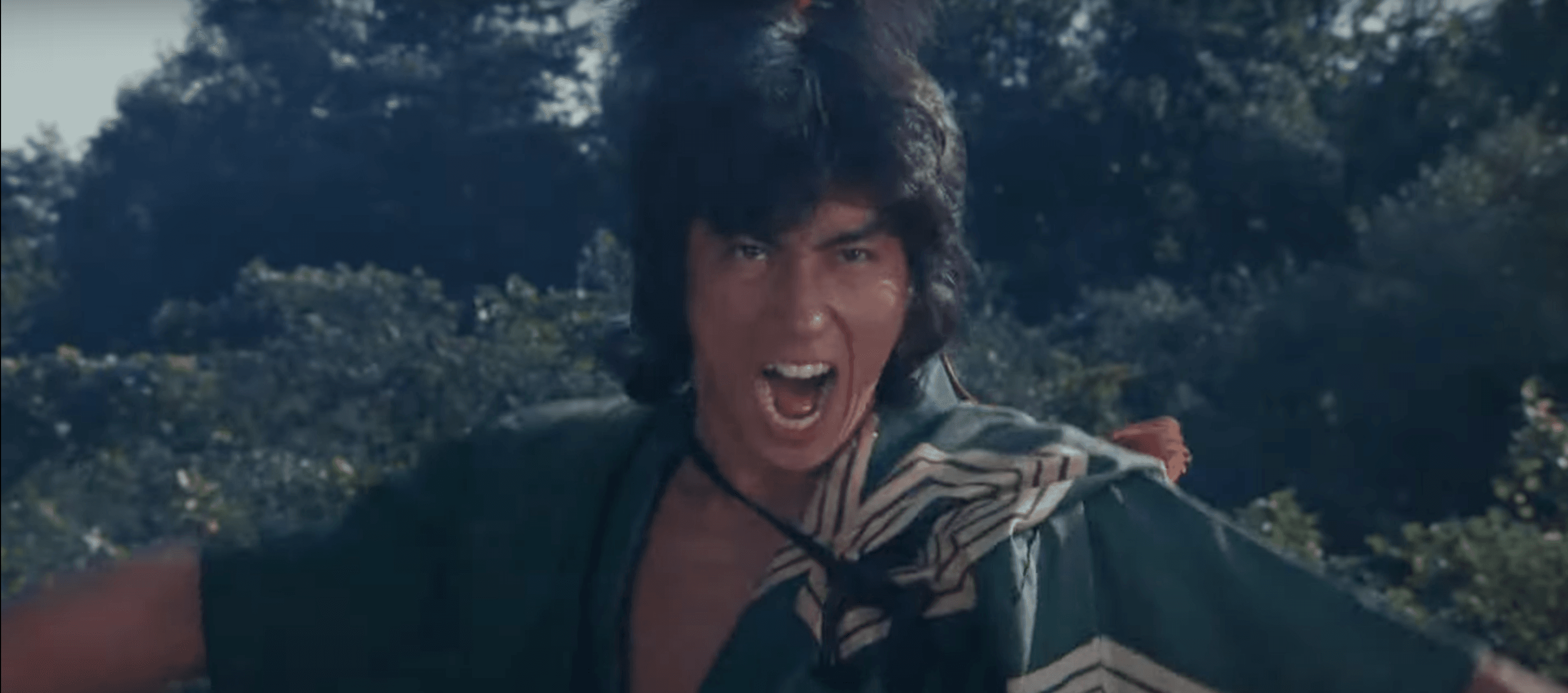
Directorial duties for Legend of the Eight Samurai fell to Fukasaku, who had just left behind a successful career making yakuza pictures (most notably five entries in the Battles Without Honor and Humanity series), and had most recently delivered his most successful film to date, Fall Guy. Although, western audiences probably know him best by his final film, cult favourite Battle Royale. Known for employing quick cutting edits and unafraid of embracing the ambitious, effects heavy scope of the project, Fukasaku delivers something that would’ve been in step with the cutting edge at the time and hits like a blast of pure 80s nostalgia when viewed in a modern context. The guiding edict from the producers was to make something that could feel like and compete with things like Star Wars, Raiders of the Lost Ark, and Flash Gordon, with some set-pieces and throwaway moments in the film being somewhat blatantly ripped off without even trying to hide it. It’s a movie that’s hard to take “seriously,” but in terms of entertainment value and spectacle, Fukasaku delivers splendidly.
Part of the film’s appeal and box office success can surely be attributed to the derivative nature of the style being employed and the obvious pandering to the audience that goes along with that, but at least the film’s script – co-written by Fukasaku and Toshio Kamata – ensures that the continually growing ensemble cast of characters is given a good amount of depth and plenty to do. It’s a film where there are certainly some roles that are smaller than others, but none of them are bad, and each is well cast. Yakushimaru isn’t the most natural actress, but she does have screen presence, and Sanada (who at age 23 here had already been a successful actor for quite some time) shows genuine range in a part that requires him to cycle between being a bumbling goof, a hero, a villain, and a romantic leading man, all without missing a beat. Natsuki’s malicious villain and all of her various henchmen and women (including a cadre of undead ladies who are so toxic they can kill by breathing on someone) are a high point throughout. As for the many members of Princess Shizu’s band of marble carrying warriors, the biggest standout is Etsuko Shihomi as a female assassin who wants revenge on Motofuji.
Legend of the Eight Samurai is a film that was definitely of its time in terms of tone, quality of the visual effects, and overall substance, but in one key way it was ahead of the curve. Legend of the Eight Samurai was either one of or possibly even the first film to ever be released on VHS at the same time as its theatrical release. Authorized copies of the film were sold in the lobby of movie theatres exhibiting the film in Japan, commanding the then steep price of about $60 USD at the time. This tactic actually ended up accounting for about a third of the film’s total gross revenue. Considering that this is a film that I could see appealing greatly to younger audiences of the era (coming in as the second highest grossing Japanese film of 1984 after its release during the ’83 holiday season), those tapes were probably cherished by those who finished watching the movie in the theatre and immediately wanted to watch it again. Having now watched the film, I can say that the Eureka Blu-Ray is something that I will equally treasure as much as I’m sure some coveted those VHS tapes, especially when I need to show it to someone who might appreciate this level of period cheese and spectacle as much as I do now.
