

King Lear is the first Jean-Luc Godard film I ever saw. I’m not sure I would recommend that to someone unfamiliar with the French master’s body of work, but I certainly have no regrets about it. While the uninitiated should probably start with some of Godard’s earlier works like Breathless, Contempt, Week End, A Woman is a Woman, or Two or Three Things I Know About Her, I unwittingly took a leap straight into the deepest possible part of the pool. And I did so for what seemed like silly reasons.
Like many budding young cinephiles, I had heard Godard’s name before, but growing up in a small town eons away from repertory cinemas and video stores that carried such “specialty” titles, most of his films were unavailable to me until I moved off to the big city. As such, my entry into the world of film was via genre cinema, and there were few bigger players in that game during my youth than Cannon Films. The studio responsible for such films as Invasion U.S.A., Cobra, Breakin’, Masters of the Universe, and a number of fairy tale adaptations that I watched on repeat as a little kid had produced some of my fondest, most nostalgic childhood memories of low budget, borderline trashy cinema.
While I was starting to have a better understanding of what makes a “good” movie at the age of eighteen (and an argument could be made that I will probably never understand it), I was still fascinated by the history of the Israeli company founded by Menahem Golan and Yoram Globus. I was keen to consume everything ever put out by a company that burned bright and flamed out spectacularly with the end of the 1980s. One of the tidbits of information that I retained was a now legendary story that Golan made a snap contract with Godard to make a film. It was signed at the Cannes Film Festival and was written on a napkin. That movie was King Lear. I knew it had almost nothing to do with Shakespeare’s King Lear through its reputation, but it had a cast of people that I recognized, including Molly Ringwald, Burgess Meredith, and Woody Allen. As a budding young completest and someone eager to expand my artistic horizons and knowledge, I borrowed a copy of the film from my university’s library on VHS. It was a Cannon film from a renowned filmmaker full of familiar faces based in part on Shakespeare. How bad could it be?
I ended up watching Godard’s King Lear three times in a row. My mind felt like it had been blown wide open. This film was a glorious mess of ideas, themes, notions, theories, allusions, metaphors, and styles that played like what I imagined at the time great jazz felt like. King Lear felt alive, vibrant, and chaotic in a way that I hadn’t experienced before. I still couldn’t believe it existed or that it got made in the fashion it did, but I was in awe of this work that felt equally like a work of art and an elaborate prank. It remains my favourite work of Godard, one of the absolute best films to have come out in the 1980s, and I have it to thank for bursting my idea of what cinema could be wide open. I think back fondly to those nights with the VHS, trying to piece things together and finding something new every time.
But for a long time after university, King Lear was virtually impossible to find. There was the aforementioned VHS, but good luck finding it anywhere. Even the university library’s copy went AWOL a year after I borrowed it. A cursory DVD release from MGM, the owner of most of the Cannon Films library, came and went out of print almost without anyone even noticing it had been a thing. Outside of a single cinematheque screening at TIFF’s Lightbox in Toronto (that I sadly couldn’t make it to because I was out of the city), I never saw anyone playing it in a theatre. When the Criterion Collection announced that King Lear was finally joining its ranks, I became overjoyed to revisit it decades later. I am known for quickly requesting to cover things that I like, but when I got the email from Criterion about King Lear’s impending release, my fingers couldn’t move fast enough.
Trying to explain King Lear is a fruitless task. It’s a work of instinctual cinema par excellence, straight from the mind, heart, and gut. It’s not without compromise, and it’s certainly calculated, but in terms of execution and style it flows like pure stream of consciousness. The film opens, quite hilariously, with Godard taking a phone call from a worried Golan, who fears the movie he was promised in time for next year’s Cannes Film Festival (which in typical Cannon fashion already had a laughably overwrought teaser trailer on the studio’s sizzle reel) was never going to be finished. This moment of meta-commentary in a tale that blends fact, fiction, and theory sets the tone for everything to come. It’s a dense, self-critical and referential film that turns the artist into a star in more ways than one, but it also doesn’t take itself more seriously than necessary.
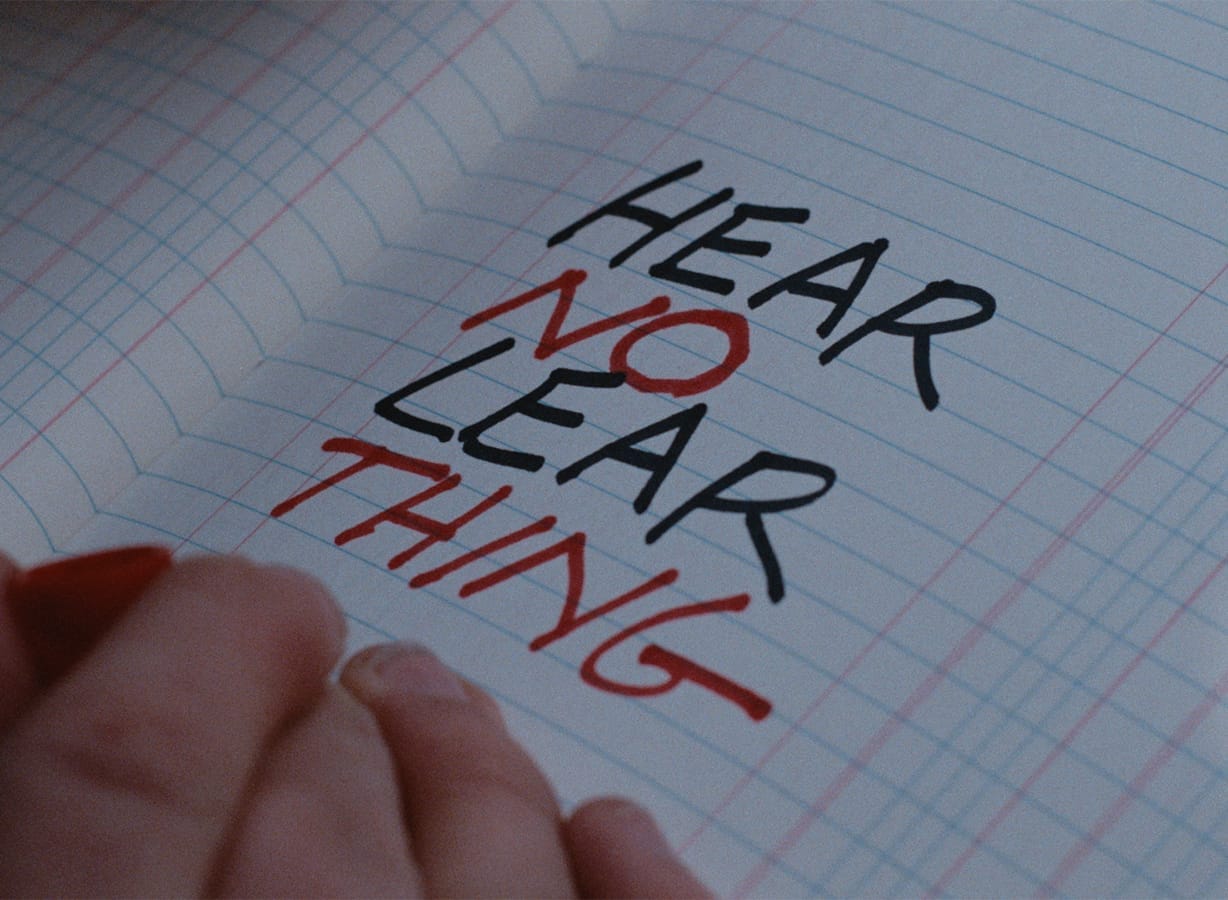
Golan’s fears were somewhat founded. Godard had started making King Lear with a script from noted author Norman Mailer. Well, that’s a bit of a stretch. Mailer did write a script, but it Godard’s method of filmmaking had moved far beyond the desire to work from a set template. Instead, Godard asked Mailer to star in the film as a sort of Lear surrogate who’s trying to write a contemporary take on Shakespeare’s play, incorporate elements from a mob movie that Godard himself was unsuccessful at getting off the ground, and star opposite his own daughter, Kate. Although Mailer appears at the start of King Lear, he didn’t last long on set, balking at being told to make vague references to a wholly fictional, incestuous relationship he was having with his real life daughter. For his part, Mailer was offered the chance to write and direct Tough Guys Don’t Dance, a movie that rivals King Lear in terms of making viewers wonder what the intent was, and Godard moved onto other projects, essentially ignoring Golan until that phone call.
The bulk of King Lear was pulled together at the last possible second and somewhat out of contractual obligation, the plot (what there is of it) unfolding in a post-Chernobyl meltdown world where all art has been lost and destroyed. A descendant of William Shakespeare (played by theatre legend Peter Sellars, who also became Godard’s de facto advisor on all things involving The Bard) has been tasked with recreating his ancestor’s lost works. Burgess Meredith – best known for his roles in the Rocky franchise and original live action Batman series, but who was trained as a Shakespearian actor – plays a decidedly Lear-like figure, and Molly Ringwald (near the height of her 80s fame) plays his daughter. There’s also a thread involving a detached, techno-minded film professor (played by Godard under a wig of cords and wires) and his addled devotees (Leos Carax and Julie Delpy, both early in their careers).
Godard’s King Lear is a film that reveals itself slowly to the viewer in layers, and a lot of its successes are the sort of happy accidents most filmmakers could only dream of achieving. Through the lens of Lear, Godard imagines the future of cinema, which would become one of his focal points throughout this period of his career leading up to his death. Like Lear, Godard wonders where and when all of this will end? What will be the point of it? How do we preserve intent and feeling and not just blindly follow what others have pontificated upon? You can follow in the footsteps of your teachers, or you can fail on your own merit. You can use language, culture, and cinema as a conduit, but where that all leads depends on how the observer chooses to interpret it. It could be a road to nowhere or to someplace profound. King Lear is one of the most complex, engaging, and narratively stringy reflections on the nature of failure.
It makes no sense, and yet, it makes perfect sense in hindsight and with the benefit of afterthought. The special features contained on Criterion’s recently released restoration include interviews with Sellars and Ringwald about their involvement in and thoughts on the production. But the best and finest commentary to be found here comes from Godard scholar and esteemed film critic Richard Brody, who provides both an interview and the liner notes essay. Until seeing Mr. Brody speak about King Lear, I hadn’t found too many other people who could get as enthusiastic about this film, let alone speaking so eloquently and thoughtfully about it. I would love to say that King Lear speaks for itself, but it’s more fun to approach it as an ongoing conversation with the viewer that never ends.
If there are any criticisms I could have with King Lear, they would just be personal preferences and differences of opinion. I certainly would’ve cut back on the relentless seagull sound effects by about two-hundred percent, but that’s just me. I would’ve made the film longer, but it already asks a lot of the viewer, and I understand that time was tight for completing this. Much like Lear’s daughter shows resistance to a lot of her father’s words and actions, so too does Godard towards the rules and edicts of cinema. The film is pushy and insistent, but that’s what makes it special. It’s a work of emotion, not of scholarship, and as we all know, shooting straight from the hip can be a little messy.
King Lear is now available on Blu-Ray via The Criterion Collection.
