

Ivona Juka’s black and white period drama Beautiful Evening, Beautiful Day doesn’t live up to its full potential as a post-war epic, but it does take an insightful look at international queer history that often goes unexamined. A story of four gay comrades who served their country dutifully, only to suffer in the aftermath of Nazi defeat, Beautiful Evening, Beautiful Day solemnly examines love, courage, and repression through the creative lens of working within the 1950s film industry. The film (which was Croatia’s selection for Oscar contention this past awards cycle) buckles under close scrutiny of Juka’s scripting and characterization, but the performances, sentiment, perspective, and thoughtfulness keep things nicely on track.
Yugoslavian filmmaker Lovro Horvat (Dado ?osi?) and writer Nenad Milicic (Ðorde Gali?) have been acquaintances and lovers since university, where they link up with like minded artist Stevan Petrovic (Slaven Došlo) and actor Ivan Bota (Elmir Krivali?). After watching occupying Nazi forces attempting to forcibly remove Jews and Serbs from their school, the quartet step up to join the war effort. During their military service, they become esteemed, highly decorated heroes, something that helps protect their homosexuality somewhat during the shift in power to the equally persecutory Communist regime. Lovro and Nenad have been collaborating together on carefully controlled, state produced pieces of entertainment that are nothing more than propaganda. When conflict arises over a particular scene where a Yugoslavian soldier abandons his post, a higher-up in the Agitprop bureau decides it’s time to go after Lovro and Nenad. When attempts to make the friends snitch on each other fail, the government ends up hiring Emir Servar (Emir Hadžihafizbegovi?) to infiltrate the group and sabotage their current production by any means necessary.
Beautiful Evening, Beautiful Day gets off to a rocky start before Juka finds her footing stylistically and narratively. The decision to shoot in black and white adds a period appropriate gloominess (especially in the film’s final stages), but it also presents as a decision made to cover up a budget deficit that make accurate historical staging and costuming a bit harder given the production’s modest scope. Similarly, writer-director Juka puts much more emphasis on what happens to these men after their military service has ended and remains vague on their heroism and the protection they received by some sympathetic members of the government in the aftermath. Juka focuses so rigidly on the hardship and despair that it forgets to make things truly tragic by showing how hard they fought for their country’s freedom in the first place, outside of the brief opening sequence where the actors are trying and failing to credibly portray younger versions of themselves.
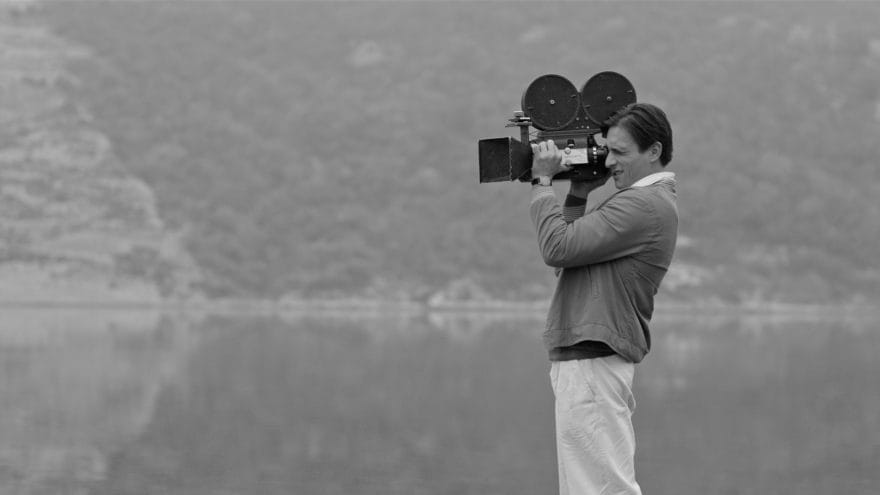
But once Emir infiltrates the filmmaking team, Beautiful Evening, Beautiful Day levels out and becomes an intriguing battle of wills. Veteran actor Hadžihafizbegovi? portrays Emir as a put-upon, burnt out company man who dutifully goes through the motions while not fully investing in the actual goal of his mission. His squabbles with ?osi? and Gali? build tension, but not towards their queerness. Emir remains more focused on sabotaging the production rather than outing the couple publicly, which builds to a nice moment of black comedy where the saboteur’s influence ends up producing a film that’s too good in the eyes of his superiors. The characters on Beautiful Evening, Beautiful Day are cogs in a machine that cares little about their wellbeing. They are told to follow orders, fall in line, or face dire consequences.
For much of the film’s running time, Juka focuses more on the situation rather than the inner lives of the characters. Any details learned about these people prior to the halfway point – when Emir starts bonding with those he has been sent to betray – are presented in passing. ?osi? and Gali? display a lot of loving and artistic chemistry, but their relationship as a couple is presented in as-is form, outside of noting how Lovro’s “bourgeois” parents are perfectly fine with their son’s sexuality. Outside of a few asides that show Stevan’s desire to connect with a like minded veteran and Ivan’s inherent kindness and generosity, Došlo and Krivali?’s contributions feel like tacked on footnotes that are divorced from the greater story. It also takes quite some time for Emir’s relationships with his housemates, Sanja (Ivana Boban) and traumatized war veteran Ankica (Asja Jovanovic), to have much payoff, despite having some considerable screen time paid towards them. Everyone in the film is putting in strong performances, but while Juka makes sure they all get a chance to shine, there’s often too much going on in Beautiful Evening, Beautiful Day for the narrative to have much balance.
During the earlier stages of her film, Juka shows moments of state sponsored violence in brief, but potent bursts, most notably via a well assembled juxtaposition of Lovro directing a sequence of nationalistic pride and pomp unfolding alongside the brutal beating of another character. And the film’s final act is a stark portrait of brutality that’s both harrowing and uniquely artful to behold, but once again, the impact is dampened by Juka’s inability to show more off the top to make the final sequences more impactful and tragic. Juka never shies away from brutal details, but the director also shortchanges their impact.
But as an overall story and thanks to its unique viewpoints on history, Beautiful Evening, Beautiful Day eloquently speaks to a country in turmoil, offering up both history and cautionary words for the future. The former Yugoslavia is depicted as a country that has traded old problems for a lot of the same issues served up to them in newer packaging. The struggle is always apparent and the game of politics is constantly stacked against each of these characters, and the frustration and paranoia are palpable. It’s an imperfect assembly of a lot of moving parts and characters of varying depths, but as an examination of historical oppression and cultural repression, Beautiful Evening, Beautiful Day manages many moments of dramatic power and grace.
Beautiful Evening, Beautiful Day opens in Toronto at Carlton Cinemas on Friday, May 30, 2025.
