
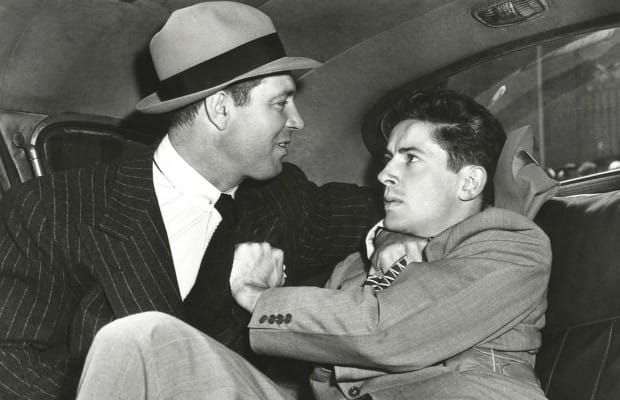
Director Anthony Mann’s 1949 thriller Side Street is an all time film noir classic, a sterling example of the genre that dominated cinemas around the midpoint of the twentieth century. It’s a cracking pressure cooker of a story that only takes about ten minutes to get started and another seventy to wrap things up without taking so much as a breath to relax. But what sets Side Street apart from a lot of its bleak brethren is a high budget and ambitious scope that heightens the overall air of suspense. Shooting in real life New York City locations and institutions (some of which are still around today), Side Street is an example of film noir that imbues a healthy dose of authenticity and grandeur into the story’s heightened atmosphere.
That story comes courtesy of journalist turned screenwriter Sydney Boehm (When Worlds Collide). Like many noirs, it’s the morally fluid tale of an everyday Joe Schmo who gets in over their head for the sake of a quick buck. The everyman in this case is Joe Norson, played by Farley Granger. Joe is a part time postman who lost everything he had on a failed business venture, forced to move back in with his parents and his newly-wedded wife, Ellen (Cathy O’Donnell). One day, while dropping off some mail at a law office, Joe catches a glimpse of of a few hundred dollars in loose cash. In an ill advised bit of thievery, Joe returns to the office to swipe the loot from its hiding place in a filing cabinet. But it turns out that there’s more than a few hundred dollars in the envelope. There’s $30,000, and that money was being held by a pair of blackmailers (Edmon Ryan and James Craig) as part of a scheme to extort a financial magnate (Paul Harvey). The pair of crooks has already killed one of their accomplices to tie up loose ends, and they wouldn’t hesitate to do the same to the sorry sap who was dumb enough to take their money. Worried, but seeing his take as life changing, Joe wraps the cash up in a nondescript package and leaves it with a barkeep friend (Edwin Max) until the heat dies down. But when Joe learns his wife is pregnant and tries to come clean to the people he stole from, they aren’t willing to accept an apology. They want the money back. And it turns out that Joe’s “friend” has seemingly skipped town with the “package.”
Side Street is a cautionary tale set in seedy offices, back alleys, and nightclubs, built around a character that’s pretty terrible at committing crimes. It’s narrated from the perspective of the police officer investigating the case (Paul Kelly) with an appropriate level of solemnity. The stress felt by Joe is palpable, with Granger delivering a solid effort while getting constantly knocked around like a punching bag in the film’s second half. The villains are pleasantly low key in their menace, and the romance between Granger and O’Donnell (who would have another film where they played a couple, the long shelved They Live by Night released around the same time) is well drawn and performed. Mann’s direction is spot on, and although he would abandon these kinds of genre efforts after Side Street, this one remains one of the jewels in his all time crown.
Side Street has all the elements of a low key classic, building towards what could be the best (non-comedic) car chase of the era. It’s no small feat to pull off such a dazzling action beat, let alone on the streets of New York City and not on an L.A. backlot. At the time, many films made the conscious decision to shoot New York set movies in Los Angeles to cut down on overhead (something expertly explained in Jason Bailey’s exceptional book, Fun City Cinema). As such, Side Street is one of the few New York films of the late 40s that has an authentic sense of attitude and grandeur, from stunning helicopter shots that highlight the skyline to tense encounters in world class restaurants that endure to this day.
Side Street is also uniquely philosophical and introspective for a movie that moves at a full on sprint. Boehm’s whip-smart screenplay lays bare the myth of the modern American consumerist; a world where wanting more for oneself is encouraged, but accomplishing those goals often involves a lot of dirty work. It’s noir as fable, one that likely resonated deeply with post World War II audiences caught in the mush middle between austerity and the relative prosperity that came with the baby boom. And like many classic films, Side Street and its subject matter have aged perfectly over time, finding newfound relevancy in our current uncertain world.
The remastering and repackaging of Side Street from Warner Archive is exceptional, boasting a gorgeous transfer, outstanding sound mix, and the inclusion of some classic shorts to make it feel like an old timey night out at the movies (one of my favourite elements of the Warner Bros. classic DVD era that I’m thrilled has been retained with the movement towards Blu-Ray). One of the short films – the bleak “crime doesn’t pay” drama The Luckiest Guy in the World, about a gambler who gets in over his head – is a perfect pairing with Side Street, and it might also be darker than the feature itself! All in all, a great return to form for the film, and another wonderful Blu-Ray package from Warner Archive.
Side Street is now available on Blu-Ray from Warner Archive.
