

A delicate dissection of trauma that balances sadness, frustration, and humour in equal measure, writer/director/star Eva Victor’s first feature Sorry, Baby is a profound, raw piece of work. It’s a film that takes awhile to fill in all of the gaps and necessary information towards understanding what its damaged protagonist is going through, but Victor’s overwhelming humanity and thoughtfulness makes it compelling and unnerving at every turn. This is a careful movie that deals with the aftermath of unwanted sexual contact in a frank and poignant manner, never going over the top or grandstanding for the sake of making a point. Sorry, Baby plays things as they lie, no matter how messy the situation at hand. This is a film that never flinches, but also never goes too far as to appear like a showy drama. It’s about the people, not necessarily the situation, which makes Sorry, Baby all the more amusing and heart-wrenching.
Agnes (Victor) lives in a coastal New England town where she’s a literature professor at her alma mater. Her best friend and former roommate, Lydie (Naomi Ackie), is now married, pregnant, and visiting from New York City, where she lives with her wife. Agnes misses Lydie a lot, as she was the only person to help her through a tumultuous period in grad school that forever reshaped their lives as friends. Agnes was the victim of unwanted sexual advances at the hand of her professor and advisor (Louis Cancelmi), an incident for which there hasn’t been any closure or repercussions. Today, Agnes works out of the same office as her abuser once did (although the assault didn’t take place in that room), and suffers from understandable amounts of PTSD that makes it difficult to open up to others, including the kindly neighbour (Lucas Hedges) she occasionally hooks up with.
Sorry, Baby doesn’t revolve around a plot, but rather series of events that occur within Agnes’ daily life. Victor adopts a non-linear approach to the story, starting with Agnes already in a dark place before explaining how things got to that point and why moving forward proves impossible. Sorry, Baby is a character examination in the purest sense, but not a study. Victor’s script and direction aren’t trying to be clinical. There’s no diagnosing Agnes beyond the obvious, and the film meets the character on their own terms, not those most suitable to easily categorized dramatic convention. Agnes is stuck in a situation that continues to trigger her trauma, and while that might not be a situation many people who haven’t suffered similarly can understand immediately, Victor through their flawless script and fully invested performance fosters a sense of reasoning that comes into sharp focus when taken in totality.
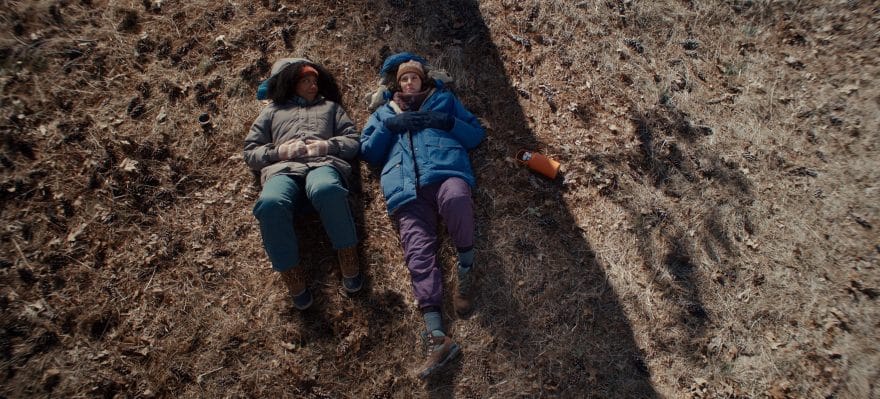
The level of rawness displayed by Victor – both behind and in front of the camera – is perfect. Sorry, Baby isn’t afraid to be an awkward movie packed with off-sounding, squirmy interactions, be it with Hedges’ likably awkward, but blissfully unaware love interest or whenever Victor is pitted opposite Kelly McCormack, as a terrible “friend” who can’t hide her professional and personal jealousy. Even the moments when Agnes is able to find comfort and solace – while venting to Ackie’s rock solid supporter or in a chance encounter with a gruff sandwich shop owner, played by John Carroll Lynch in one of the best single scene appearances this year – are fraught with second guessing and carefully chosen words on both sides of the conversation. A sequence where Agnes is called for jury duty is the kind of aside that most conventional films dealing with trauma would shy away from because it seems to have no greater purpose, but here it speaks volumes to the experiences of victims of violent crime and their hesitancy to speak openly to complete strangers about their troubles and struggles.
Every scene in Sorry, Baby is memorable and unique in terms of what it’s trying to convey, especially the chilling depiction of Agnes’ assault, which is dealt with in the most respectful, non-exploitative, and chilling way possible. Victor has great instincts when choosing what moments to play out slowly and which should be handled like the ripping off of a band-aid. The friendship depicted between Agnes and Lydie (expertly acted by both performers) comes with a lot of lived in shorthand and knowing glances. Through their interactions, both in person and over the phone from a distance, the viewer is given a key as to how to process Agnes’ reactions and what they mean. Sorry, Baby values the viewer’s ability to understand subtle, visual storytelling. When the film is at its least talkative, Victor’s work is at its most elegant and striking.
And what could’ve been a cold, bleak affair that matches the chilly, off-season New England coastline setting refrains from being didactic and staid. A great deal of Sorry, Baby comes with a dark sense of humour that cuts through the tension. A lot of that is of the “laugh to keep from cracking up” mentality, but it’s humour nonetheless. It allows the viewer to be more at ease with the discomfort, and to process the deluge of feelings Agnes experiences all the time. It’s a movie built on depression and trauma induced irritability, but also something that has moments of lightness to cut through all the doubt and uncertainty. It’s a film that comes from the heart, moves with gut instinct, and has a lot of brains.
Sorry, Baby opens at Cineplex Varsity and TIFF Lightbox in Toronto on Friday, July 4, 2025. It expands to Vancouver and Montreal on July 11, and to additional cities and theatres on July 18.
