

An examination of grief painted with artful, emotional, surreal brush strokes, Daniela Forever is bound to garner comparisons to the similarly minded Eternal Sunshine of the Spotless Mind. If anything, Spanish filmmaker Nacho Viaglondo’s vision of lost love is the inverse of Michel Gondry’s beloved cult classic. Instead of people struggling to forget the memory of a former love, Daniela Forever is about someone trying desperately to cling to that feeling, with similarly toxic results. That similarity could be intentional, as Vigalondo (Colossal, Timecrimes, Extraterrestrial) has always valued and centred his genre influences in the past, but Daniela Forever carves its own mournful, intelligent, and contemplative path.
Nick (Henry Golding) is an ex-pat DJ living in Madrid who’s perpetually grieving the death of his visual artist girlfriend, Daniela (Beatrice Grannò). Friends do their best to try and get Nick out of his funk (not to mention his messy apartment), but the loss has been too great to bear. A concerned friend (Nathalie Poza) who works for a pharmaceutical company tells Nick about a drug trial that helped her get over a painful divorce and suggests it might help him move forward in life. The experimental Belgian drug allows users to experience lucid dreams where they can interact consciously with the environments and memories they create. All that’s asked of Nick is that he follows a select set of prompts to dream about specific things and report back to them. Immediately, Nick starts dreaming of Daniela and creating a world where she never died and everything is always sunshine and roses.
Daniela Forever opens with the titular character recalling the first time she met Nick, but as Vigalondo moves forward from this point (and eventually back to it by the end) the viewer becomes keen to the subjective nature of memory and dreams. This opening perspective is from someone who has been lost, not someone who has experienced the same loss. If there’s a major downside to Vigalondo’s first feature effort since 2016, it’s that this is all the viewer gets to know about Daniela outside of the way others experienced her presence. Daniela isn’t much of a character, but rather an ideal. In Nick’s dreams, Daniela isn’t a real person, but rather a construct of what Nick remembers and his own feelings towards her as a human being, and as such she often seems stilted (on purpose); incapable of maintaining eye contact and speaking only in curt responses. The depiction of a loved one’s memory as part of a greater sense of self is a good one, but it would’ve been nice to get to know Daniela more before joining Nick’s bottomless grief already in progress.
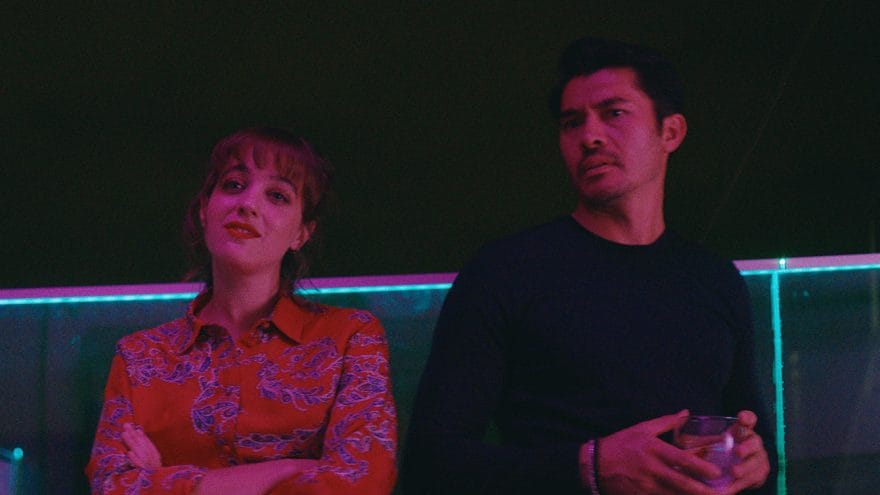
But beyond that quibble, Daniela Forever is a heartfelt and psychologically fascinating character study. Nick can have anything he wants in his dreams, and he chooses to revisit a time when he wasn’t miserable. It’s easy to see how someone in a poor mental state can grow addicted to that kind of controlled gratification. But Nick is so deep in his own feelings that he doesn’t realize that the Daniela he’s conjuring up isn’t the real thing. This Daniela is just another version of Nick himself, and he’s too stricken and tickled in equal measure to see that. He wants to experience feelings of romance and joy once again, but he’s faking it. All that’s left is an idea of love, hanging around him like the cheap ghostly decorations he remembers from a cut rate haunted house.
Golding get a chance to stretch a bit more than normal as Nick, and Aurra Garrido shines in a key supporting role as a “close acquaintance” of Daniela’s that he’s suspicious and jealous of, but the film is mostly an exercise for Vigalondo to wrestle with complex themes in a poetic, visually compelling way. Vigalondo isn’t afraid to get weird and subtextual, employing a creeping, grey miasma that takes over any elements of the dream world Nick hasn’t fleshed out and cleverly showcasing how light and shadows can be played with, both in art and memory. The dream world is captured in crisp, gorgeous widescreen, while Nick’s sadder waking hours are shot drably in lower quality digital video.
Eventually, and perhaps predictably, Nick’s waking hours and his dream world start colliding with one another to disastrous effect. But even if viewers can see where Daniela Forever is heading in advance, the weight and gravity of the situation is easy to identify and lands with confidence. By design, Daniela Forever is a movie that could only end with everything coming apart at the seams. The grief that Nick experiences branches outward and creates a sense of greater catharsis, even if things are left somewhat bittersweet. Loss is a neverending cycle. Things get worse before they get better and before they get worse again. But as a film, Daniela Forever stays great throughout.
Daniela Forever opens exclusively at TIFF Lightbox in Toronto on Friday, July 4, 2025. It expands to additional cities and theatres on July 11.
