

The sleazy, lurid 1982 law and order thriller Vice Squad is a film that’s both dated and ahead of its time. Depending on what lens you choose to view it through, Vice Squad is either a relic best left to the past or something that realized certain truths long before people talked about them. It’s tough to sit through and deeply uncomfortable, but that was the point back in 1982 as it is today, and thanks to a 4K UltraHD upgrade put out by Kino Lorber Studio Classics, the “neon slime” sung about in the film’s opening credits is as nasty as it ever was. The technical merits and demerits of Vice Squad have always been obvious and haven’t changed much in the past several decades, but the things that worked at the time still work today, and some elements of Gary A. Sherman’s film have a particular poignancy when viewed in a modern context.
Co-written by Sandy Howard (a veteran producer with credits going back to the 50s), Kenneth Peters (who would write Penelope Spheeris’ Hollywood Vice Squad several years later, also produced by Howard), and Robert Vincent O’Neil (the Angel franchise), Vice Squad opens with a stern memo to the audience: that while the film is a work of fiction, the story contained within is based on real cases investigated by the police. Considering Vice Squad contains moments of pure, unbridled melodrama that strain all forms of credibility and reality, that seems a bit rich, but if one were to look between the histrionics, they would find genuine worth.
Vice Squad revolves around three characters running in the same criminal underworld that are on a collision course. Princess (Season Hubley) is a loving, well put together mother by day, and independent sex worker at night that hustles on some of the street’s seediest corners. The film takes place at the start of a weekend when Princess has sent her daughter to San Diego for some time with grandma. Right before the kid leaves, Princess is called by fellow sex worker Ginger (MTV VJ Nina Blackwood), who’s frantic and worried. Ginger has just run away from her volatile pimp Ramrod (Wings Hauser), a cowboy hat wearing, custom Ford Bronco driving, Elvis adoring, money hungry sadist. When Ramrod catches up to Ginger, he brutally beats and kills her. When Princess is picked up by Sgt. Tom Walsh (Gary Swanson) for soliciting, he makes her a deal: help him put Ramrod away in a sting operation and he’ll drop all charges against her. Wanting to avenge her dead friend and retain custody of her child, it doesn’t take too much to convince Princess. The sting works, but Ramrod is able to slip police custody, and he’s hell bent on finding and killing Princess, who has gone back to work, unaware that he’s on the streets again. The film becomes a race against time as Sgt. Walsh and his team try to find Ramrod before the pimp finds Princess.
Vice Squad is a filthy neo-noir that takes place in a world of dive bars, hourly rate motels, outlandishly decorated apartments, and dance halls where cocaine is probably available on tap. The world and the perceived danger of it are more of a star than most of the film’s characters. Sherman (Dead & Buried, Wanted: Dead or Alive) effortlessly sets a scene that feels edgy and dangerous; the kind of thing that conservative critics of the day would widely reject on falsely moralistic grounds and liberal ones would brush off as an exaggeration of the truth. The story might come from real cases, but some natural sanitizing would be needed to make such a film palatable, and then that would have to be offset further by theatricality that adds some cheap thrills to get butts in the seats. Sherman’s sense of visual and dramatic balance helps to keep the off-kilter script under control.
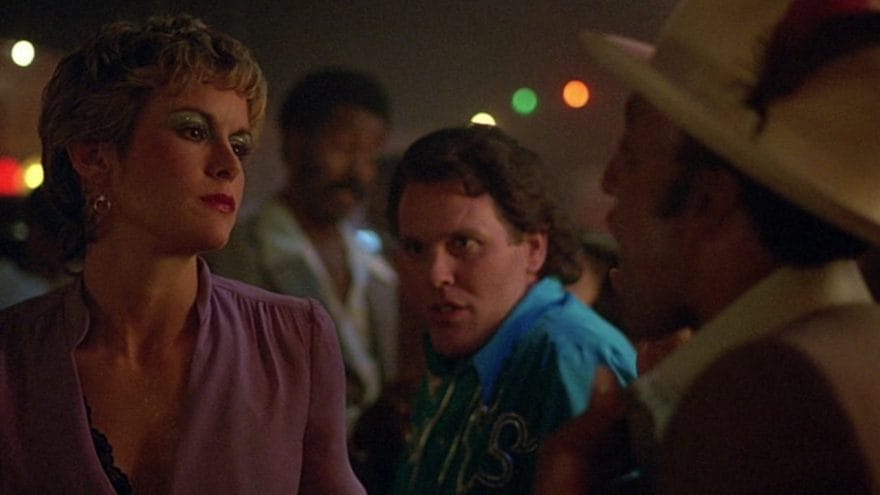
Vice Squad is most remembered for the tremendous work of Hauser as the deplorable, cold blooded, and flamboyant villain. A respected character actor with over a hundred credits to his name, Hauser found his first major break as the ludicrously named Ramrod. Hauser embodies the spirit and mannerisms of a full blown sociopath, often luring people into his orbit with soft, respectful talk and some well placed compliments before striking out with brutal, often torturous violence. Hauser (who sadly passed away in March of this year) portrays Ramrod like a rattlesnake shakings its tail and waiting for a moment to attack, effectively making his character the most dangerous figure in a dangerous world. He also sings the film’s bluesy, Van Morrison styled theme song, “Neon Slime,” over the opening credits.
But as time has gone on, I find myself thinking about the character of Princess more than I do about Ramrod and the film’s violent nature. While Hauser brings a sense of unease and dread, it’s the film’s depiction of sex work that has aged better in the grand scheme of things. The police (even Swanson’s “heroic” Sergeant Walsh) are depicted as ineffective city workers looking to hit their quotas without ever changing anything. An early scene set in the LAPD prison intake makes the department look horrible in ways that some modern audiences will more readily identify. There’s also an amusing takedown of a pair of racist, bigoted, tough talking cops at the hands of an elderly Asian man. At no point does Vice Squad take its view of policing too seriously or archly, with the film more often identifying with the marginalized peoples often targeted by police action.
After helping to get Ramrod arrested for the first time, Princess continues on her night shift, as if all of this trouble was just another part of the job. While Ramrod tries to track Princess down, Vice Squad settles into the most narratively interesting part of its story. Without the villain close by, and away from the prying eyes of the police, Sherman allows the film to simply follow along with Princess out on the job. While a lot of the kinks being discussed in the film were taboo to talk about in 1982, they seem almost quaint talking about them today. But what makes Vice Squad somewhat revolutionary is in how it depicts sex work in an empathetic light, like these people are involved in the service industry. There are moments of profound kindness and understanding that Princess takes part in throughout her night. It’s not all gloom and doom or moral finger wagging. Sure, there’s a scene towards the end that depicts a darkly comedic and unquestionably creepy situation that Princess gets herself into (thankfully not involving Ramrod) that is wildly unpredictable, and yet, oddly believable given the context of her profession. But even that feels like it comes from a reasoned, lived-in perspective. As sleazy and trashy as Vice Squad outwardly appears, there’s some refreshing positivity to be found.
The Kino Lorber packaging of Vice Squad includes a special bonus disc, filled with hours of interviews from numerous people involved with the production (most of which have been ported over from a previous, out-of-print Shout Factory Blu-Ray release), and they provide a further sense of context that many critics and detractors of the film missed upon its initial release. Overall, Vice Squad is a film that’s more interesting than it is exceptional, but there’s a lot to admire about a grindhouse-level film that turned out to be rather forward in its thinking.
Vice Squad is now available on 4K UltraHD and Blu-Ray from Kino Lorber Studio Classics.
