
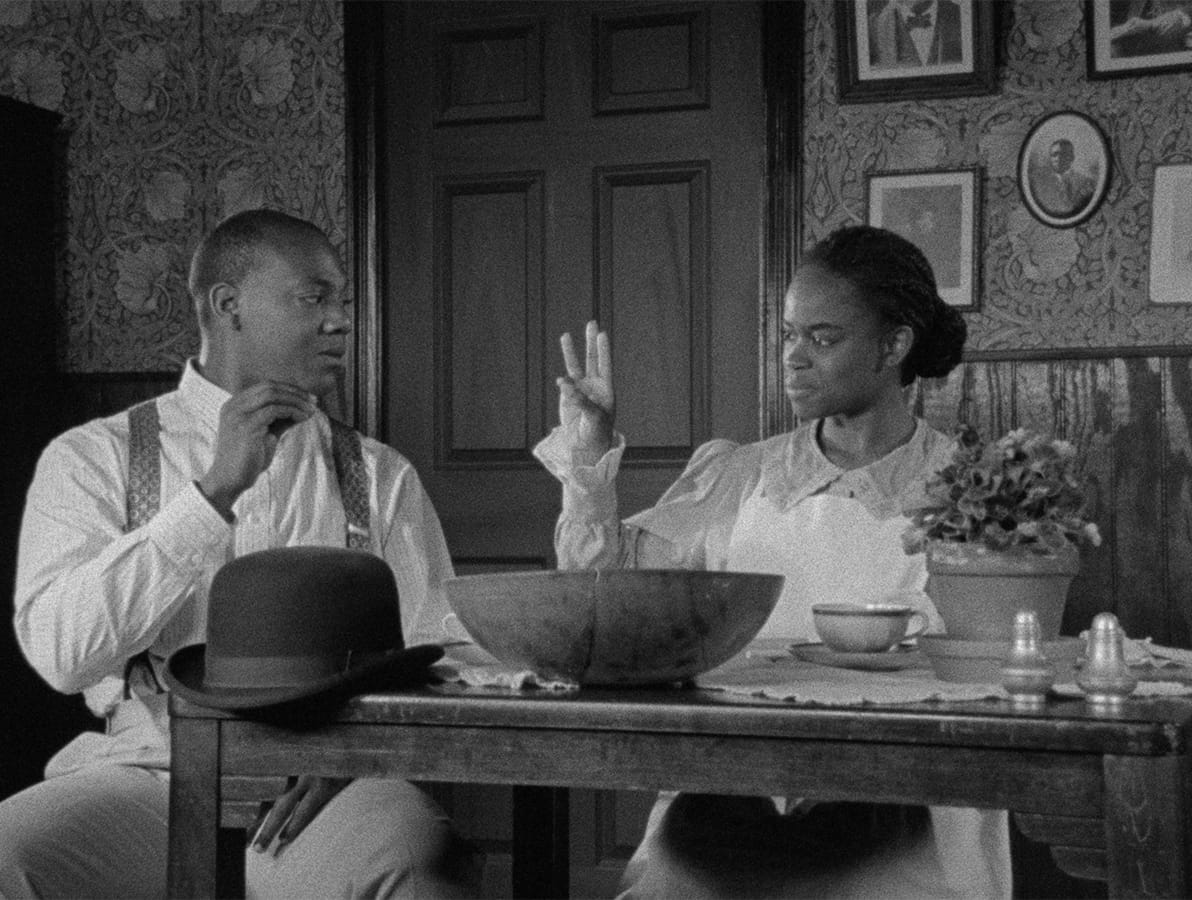
Compensation is a decades spanning drama that embodies the sentiment of doing something “with love and struggle.” That classic phrase is employed poignantly and literally within the text of director Zeinabu Irene Davis’ black and white masterwork, a story of romance and fellowship that has to overcome numerous social, physical, and ideological boundaries to take root. There’s great love, not always reciprocated in ways one might expect, and struggles upon struggles, but not to a point where life doesn’t seem like it’s worth living anymore. There’s a lot of hope in Compensation, but one has to look beyond a stigmatic lens to find it.
An inventive and culturally literate film, Compensation premiered to great acclaim at film festivals like Sundance and the Toronto International Film Festival upon its debut in 1999, although it was shot in 1993, as evidenced by some smile inducing shots of movie theatre marquees from the era. But after rave reviews and a successful festival run, Davis’ film slipped somewhat into obscurity, unavailable on any form of home media and theatrical screenings being a rarity. It wasn’t until 2021 when the film resurfaced on The Criterion Channel for streaming that Compensation saw a renaissance and a fresh generations of viewers that could be more appreciative than ever before. In 2024, Compensation became a part of the National Film Registry, preserving it forever as one of the essential works of American cinema. Now, with the help of the Sundance Institute and the UCLA Film and Television Archive, The Criterion Collection has completed the rejuvenation of Compensation, with an outstanding Blu-Ray release.
Compensation follows the trajectory of two Chicago area couples eight decades apart, both portrayed by hearing impaired actress Michelle A. Banks and John Earl Jelks. In the early 1910s, Malindy Brown (Banks) – a black woman of “much talent and ample learning,” despite being kicked out of a prestigious school for the deaf that turned to segregation – has established herself as a dressmaker of note. While on the beach one afternoon, Malindy has an encounter with Arthur Jones (Jelks), an illiterate migrant who recently arrived from the South. Arthur can’t understand American Sign Language, nor can he read whatever Malindy writes on her ever present tablet. Despite these obvious barriers, they form a fast friendship.
In 1993 Chicago, also on a beach, Malaika (Banks), a hearing impaired graphic artist, finds herself being hit upon by Nico (Jelks), an attractive, hearing librarian. At first, Malaika just wants to be left alone to do her Tai Chi in peace, but Nico makes an effort to learn ASL and slowly endears himself to her, eventually integrating himself into her life.
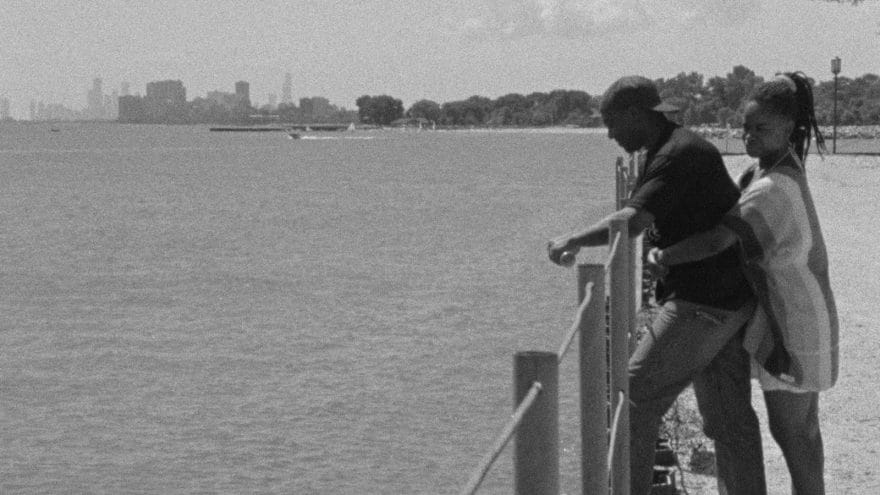
The problems faced by these tandem relationships allows Davis and her screenwriter partner Marc Arthur Chéry to examine prejudicial and stigmatizing barriers across American history. The characters in Compensation are proudly black, and three out of four of them (Arthur sadly excluded) are successful or noted in their fields. They’ve worked hard to get where they are in the face of obvious racial profiling and assumptions. Malaika and Malindy are hearing impaired, and especially in the case of the latter, they have to constantly deal with the false perception that they are also dumb. (This “deaf=dumb” assumption makes Malindy’s closeness to Arthur all the more heartening.) On the male side of the equation, both Arthur and Nico have to overcome widespread feelings that they aren’t right for a deaf woman, with both hearing and impaired persons making cases against the relationship.
Bookended by references to the Paul Laurence Dunbar poem that gives Davis’ film its title, Compensation adds further struggle into the lives of these characters in the form of harsh diseases that were most prevalent in the threads’ respective time periods: tuberculosis and HIV. For all that these lovers are able to be open about things regarding their identities, these universally relatable and frequently private battles with physical ailments are the things kept secret the longest; partially out of fear of judgment, and partially because they don’t want to make their partners sick. It’s quite telling that Davis and Chéry see illness as the biggest “deal breakers” in the constructions of these relationships, as they are often the hardest hills to climb, and battles that one often has to walk alone.
And that feeling of loneliness is quite striking throughout Compensation. Arthur and Malaika are people who’ve been forced into positions of solitude that they didn’t choose, but have had thrust upon them by society and prejudice. Malindy and Nico can make attempts to meet their partners on their own terms, but there are some things they still can’t break through or provide comfort for. The illiterate black migrant and the deaf black woman are both destined to be held down by a society that sees them as somehow enfeebled and unequal. They face a century’s worth of constantly shifting barriers, assumptions, and prejudices, but at its heart, Compensation carves out ample space for these people to learn, love, and enjoy life. Davis allows her characters to be seen, accepted, and embraced, even in the face of struggle and societal betrayal.
Visually and aurally, Davis sets a captivating scene that draws on the power and history of silent cinema during both of the film’s eras. Although most closely identified with the LA Rebellion movement in cinema, Davis’ choice to set Compensation in Chicago is psychologically and historically loaded; a hub for migrants hoping to leave the south at the turn of the twentieth century, only to run into further segregation in the north. Elegantly drawn title cards that use a variety of typefaces and handwriting styles to convey points of view help to drive the story, offering up innermost feelings that often can’t be conveyed with sounds or signs. Davis uses vèvè symbols from Haitian Vodou to call upon ancestry and allow the story to unfold at a proper pace and in due course. The placement of captions used to convey sound and dialogue throughout the frame allows the viewer to divert their attention in a number of directions, even when placed over still, archival images that Davis uses to set her scene. The score, featuring elegant piano work from Reginald R. Robinson and soulful African percussions from Atiba Y. Jali, is exceptionally integrated for the hearing crowd, while the performers on screen and Davis’ use of captions create an environment where one doesn’t need perfect hearing to enjoy it.
Compensation feels every bit like a film made by and for a community, and it’s a work of art that’s build upon radical inclusion for a number of marginalized peoples at once. These are fully formed human beings with hopes, dreams, and goals, none of whom need saving or pity. They need to be seen, understood, and held as equals. It’s a film unlike anything before or since; a true original in every sense of the word, and one worth preserving for generations to come.
Compensation is available on Blu-Ray and DVD from The Criterion Collection on Tuesday, August 26, 2025.
