

Deathstalker is a lot like professional wrestling. You know if you’re going to be into it or not just by looking at the package. If the idea of a jacked-up beefcake clad in leather and tattered linens swinging an enormous claymore at an assortment of monsters and human targets in a magical, medieval setting sounds like your idea of a good time, congratulations. You’ll be in for a major treat with this updated version of genre stalwart Deathstalker. If that sounds stupid to you, then maybe try something else. Or, if you haven’t seen such a movie and don’t know if it’s for you, this latest effort from writer, director, and special effects wizard Steven Kostanski isn’t a bad place to start. I had a blast, and can handily say that Kostanski’s take on things is vastly better than the 1983 original. Your journey may vary.
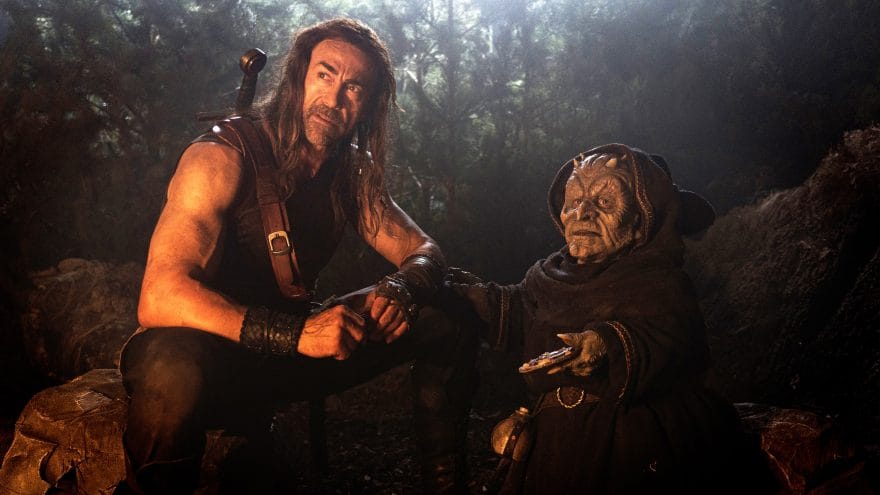
In the distant, war-torn kingdom of Abraxion, a once regaled member of the Queen’s army now roams the dystopian land as a scavenger warrior without a code. Known only as Deathstalker (Daniel Bernhardt), he makes a living by looting the dead bodies. But his latest pilfered trinket – a mystical amulet – leaves him not only cursed, but the target of every high profile assassin in the land. With the help of Doodad (played by Laurie Field, but voiced by Patton Oswalt), a diminutive descendant of a long line of magic folk, and a dubious new comrade in arms (Christina Orjalo), Deathstalker must return the amulet to its rightful place or otherwise find a way to reverse the curse and foil the plans of the nefarious team of evil warlock Nekromemnon (Nicholas Rice), a former friend turned unkillable bitter enemy (Paul Lazenby), and their accompanying army of Dreadites.
Or at least I think I got all of that right. I honestly don’t care if I did or I didn’t, because Deathstalker is the kind of silly sword and sorcery fantasy that sounds complicated but the details don’t really matter. This is pure fantasy movie nonsense that seems deep, but none of it needs to be parsed, analyzed, or even retained for a viewer to enjoy the spoils of its war campaign. It has lore, but this is easy to follow along with, because Kostanski (The Void, Manborg, Psycho Goreman) just wants to give the viewer a good time. It doesn’t have to be perfection. It just has to hold together and seem sorta epic for a low budget B-movie. While the over-plotted narrative does make Deathstalker a tad bit long for this sort of frivolity, Kostanski achieves his cinematic goals with this love letter to movies about big meaty men slapping, stabbing, and slicing meat.
Deathstalker is a remake of cheapo cinema legend Roger Corman’s Argentinian produced schlock-fest that was made to capitalize on the success of Conan the Barbarian. It has aged very poorly, but still has some B-movie cache. Kostanski vastly dials down the sleaze and sexism of the original – even including a couple of well written and realized roles for female performers – and adds some different horror and adventure points of reference to the mix. Shades of Willow, Clash of the Titans, Indiana Jones and the Temple of Doom, and Army of Darkness can be glimpsed by even the most casual of cinephiles, and all of Kostanski’s nods work well here. It makes one wonder if Kostanski and his team of craftspeople could take on other Corman reboots in the future and inject them with some respectability while retaining their goofy, low budget charms.
Deathstalker has that low budget charm in abundance, looking pretty great for an epic that was clearly shot in the woods of Northern Ontario. There’s plenty of sepia, smoke, fire, fogs, and bogs to be found in Deathstalker, and all of it is a solid backdrop to Kostanski’s more impressive love and devotion to practical effects and oopy-gloopy gore. The eye-catching creature designs, trick photography, and top notch costuming proves that Kostanski put the film’s budget and resources into the departments that matter most for the project’s success. The film’s heavy metal leaning score from Blitz//Berlin and catchy titular song (which includes the input of composer Bear McReary and Slash, one of the movie’s executive producers) sets the mood perfectly. And while there’s plenty of decapitations, amputations, impalements, and eviscerations on display, there’s a charming wholesomeness to Deathstalker that makes it an unlikley, but welcome comfort watch during the cozy sweater season. (Where else can you find a movie that features a potentially deadly encounter defused by the power of a good hug?)
Anchored by Berhardt’s impressive physicality and unforced roguish charm, Deathstalker coasts along on a lot of good will and desire to entertain. Konstanski isn’t trying to pull a fast one on the audience by suggesting Deathstalker is high grade, wholly original cinema, but he does come at the viewer from an honest, earnest, and respectful place without sacrificing a drop of the film’s B-movie roots. With his most epic and ambitious effort to date, Kostanski solidifies his status as someone who’s keeping a specific, long overlooked filmmaking tradition alive. Kostanski’s love for precisely this kind of movie and his abilities to both elevate and pay homage to these genre efforts is something to be commended and enjoyed.
Deathstalker is now playing in select cinemas.
