

With the film Meadowlarks (in Canadian cinemas this weekend), filmmaker Tasha Hubbard makes the leap from documentary to drama by tapping into something familiar.
Meadowlarks, co-written by Hubbard and novelist/playwright Emil Sher, is a fictionalized retelling of events depicted in her award winning 2017 documentary Birth of a Family. That film (which can be viewed via the NFB website) tells the true story of four indigenous siblings who were separated from their birth parents amid the “Sixties Scoop,” Although that name suggests events that took place during a certain decade, the “Sixties Scoop” remains a largely unremarked upon injustice the Canadian government further inflicted upon indigenous peoples.
Running from the early 1950s through to the early 90s, the “Scoop” evolved from the phasing out of Canada’s already wretched residential school system. Indigenous children were removed from their parents’ custody for any number of tenuous reasons and sent to live in foster care, where they would be then adopted out into predominantly white Canadian families. Birth of a Family documented a quartet of siblings that were split up during this time coming together for a family reunion.
Hubbard, who was herself adopted out via the Adopt Indian and Métis program in Saskatchewan (which is directly referenced in Meadowlarks), had her own personal connection to the material in the documentary, but Birth of a Family wasn’t the film she initially had in mind when considering adapting one of her works into a fictional format.
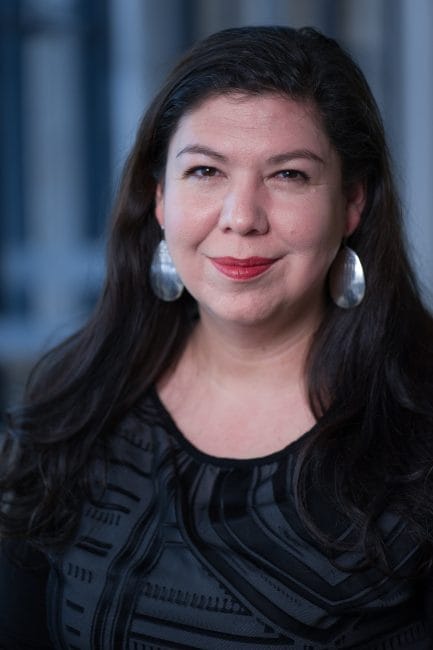
“I would say maybe fifteen years ago I had this idea for a different story that became a doc. At a certain point I remember telling my producer that this works so well as a drama, and she agreed,” Hubbard said during a Zoom call alongside Meadowlarks actor Michael Greyeyes, when asked about her inspiration to move from documentary to drama. “That notion has always been there, but it just seemed like too big of a leap at the time. And I hope to [go back] do that project someday, but when the opportunity was given and this was suggested, I could really see the way this would be a great transition to that sort of storytelling, and to go through the adaptation element. There were discussions about what we would keep from the doc, what would change; adding new characters, adding certain elements, debating if we kept this story in the mountains. The process was really important and informative. And now, looking ahead, I think it’s just about what the story wants, and that will decide if it wants to be a doc or a drama.”
The opportunity to dramatize Birth of a Family into Meadowlarks (which gets its title from the family in the film’s surname) started roughly around the same time the documentary made its premiere at Hot Docs, when producer Julia Rosenberg saw that film and approached Hubbard to see if she would ever consider making it into a drama. Alongside Rosenberg and acclaimed Métis-Canadian co-producer Tyler Hagan (Never Steady, Never Still, The Body Remembers When the World Broke Open), Hubbard set about not only to bring the documentary’s themes to a larger audience, but to also parse different aspects of sibling estrangement and the “Sixties Scoop” that she was previously unable to touch upon. (One of Birth of a Family’s subjects, eldest sibling Betty Ann Adam, also served as a consultant and Executive Producer on Meadowlarks.)
In Meadowlarks, Hubbard follows oldest brother Anthony (Greyeyes) and estranged sisters Connie (Carmen Moore), Marianne (Alex Rice), and Gwen (Michelle Thrush) as they see each other for the first time since childhood during a reunion in Banff, Alberta. Each of the siblings has their own distinct personality and feelings about how they fit into not on their family, but the indigenous community as a whole. Connie is eager to please, from a somewhat well-to-do background, and carries with her a lot of knowledge about their family history that she’s reluctant to share with her siblings. After being adopted, Marianne grew up in Belgium with her family, making her an outsider not only among indigenous peoples, but also Canadians. Gwen is a hard-nosed, no-nonsense advocate for indigenous rights and causes, but also the most reluctant when it comes to opening up about her own experiences.
For his part in Meadowlarks as Anthony, veteran and classically trained actor Greyeyes (Smoke Signals, The New World, Blood Quantum) is tasked with playing the big brother role (although not the eldest, as a fifth sibling, George, played by Lorne Duquette, declines to attend). From the moment he appears on screen, Greyeyes’ Anthony is aglow with youthful energy, despite being a middle aged man. Anthony has a sunny disposition, a love for the nostalgia of his youth, great listening skills, and an adoring family back home, but his smile belies a specific kind of sadness. From a young age, Anthony was told that he needed to “go along to get along” and to avoid anything remotely confrontational, blunting the traumas he endured and robbing him of a core set of skills necessary to be a functional, authoritative adult.
“To be quite honest, I think that’s the experience of most indigenous people in this country,” Greyeyes says about how Anthony’s positivity often belies deeper pain. “We have deep knowledge about the injustices and policies that have impacted our families and communities, and we’re in constant proximity to the children of the people who created these policies all the time. As you get to know us, you realize the complexity of those relationships that we have with others. There’s a lot behind smiles, and certainly in Anthony’s case. I definitely think that’s true for me, and I think that’s true for a lot of native people. We live in a settler state.”
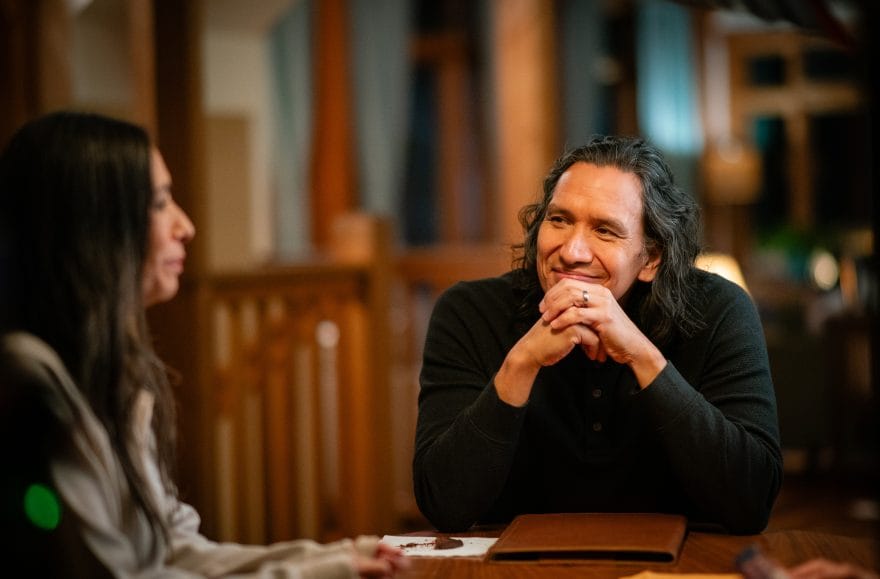
One of the interesting challenges for Greyeyes and his fellow cast members arose from having to portray people who didn’t know much about each other. In the indigenous filmmaking and theatre community, many performers tend to have worked together before, or at least have knowledge of each other. Greyeyes credits the strength of his fellow performers and the richness of Hubbard’s material for allowing all involved to create an all encompassing depiction of estrangement and reconnection.
“Of the actors who played my siblings, I’ve known two of them for decades,” Greyeyes explains. “Michelle Thrush and I were in [Tomson Highway’s play] The Rez Sisters together before I ever did any film or television. Alex Rice I knew from very early in my career, and then we didn’t work together for decades. Carmen Moore was an actor that I knew about and had heard of, but I never worked with her. So there was this interesting mix of trusted and great friends that I knew really well and a new person that I didn’t know as well.”
“The thing that I had to remember in the playing of the character, though, is that I don’t know these people. They’re all mostly strangers to me. I was able to hold that because of the work all of them were doing to convey that same feeling. They’re all such accomplished performers, and we all just kind of agreed to forget that we knew each other. And the script is so beautiful, and the characters are so well written and dimensional that the challenge within each scene and mini-arcs these characters all have within the greater story is that the material is decidedly complex. You really have to bring your A-game to what’s happening to these people. The demands of the script made it a lot easier to play the distance between these characters with authenticity.”
While the addition of a fifth sibling and changes to some of the characters and dynamics make Meadowlarks different from the documentary that inspired it, one of the things that Hubbard carried over between the two projects was the Banff setting. It’s a place that Hubbard herself has a long history with, but also a location that has one foot in indigenous history and tradition and another firmly rooted in a tourism based economy.
“I knew it had to be set in the Rockies. There’s something about that place that’s powerful and important,” Hubbard explains. “I got my degree in 1994 and didn’t know what to do. I moved to Banff, got a job working in a gallery. I worked overtime without getting paid for overtime. I lived in a shack that didn’t have a shower. I was just this 21 year old living a very Banff story, but I was already a critical thinker. It’s such a fascinating place, because there is a sense of community, and it is this beautiful place that’s so culturally significant for indigenous peoples. It’s many things to so many people. I’ve also spent time at the Banff Centre for Arts, which I am so grateful for, and that was a really important part of my career. About a decade ago, I came to realize and it was explained to me that Banff was a place of change, transformation, and ceremony. The family in Birth of a Family chose Banff, and I was happy to shoot there then with them, and that was a huge part of keeping that in this film.”
One of the things that makes Meadowlarks a special and cathartic dramatic experience comes not only from watching a family reuniting, but also in getting a chance to see themselves as part of a greater indigenous community and feeling seen by people who can share in similar experiences and traumas. At one point, Marianne befriends a local shopkeeper and artisan (played by Theda Newbreast) who invites the siblings to partake in a lowkey, but meaningful smudging ceremony with her husband (Russell Badger) and grandson (Quaide Cole Mountain Horse). It’s a powerful, heartfelt moment leading into the film’s climax, where some of the siblings are moved to share publicly amongst those gathered, while others still need more time to process and regulate their emotions.
“We knew we wanted something like that,” Hubbard says about the film’s largest and most moving sequence. “The elder characters are based on two couples that were instrumental in the formation of the film. One is a couple that has since passed, whose names were Simon and Alma, and they were so instrumental for me when I was in my early twenties and I was actively reconnecting. I’ve also been adopted by as a niece by a couple where one is Blackfoot and one is Cree, so I also wanted to reflect that, too.”
“But these characters need these moments where they can see it’s beyond just them, and be seen by other indigenous people AS indigenous people. These siblings have been quite isolated for such a long time. Maybe they’re received some of the prejudice indigenous people can experience in their communities, but they haven’t experienced that instant connection that indigenous people will have with each other. I wanted this to be an intergenerational moment for them. And they all have their own individual experiences and responses to it, and that was important. For some people it’s too much, but for others they have their own epiphanies. From there, the actors take it to where these characters need to go.”
Meadowlarks opens in Canadian cinemas on Friday, November 28, 2025. It screened as part of the 2025 Toronto International Film Festival.
