
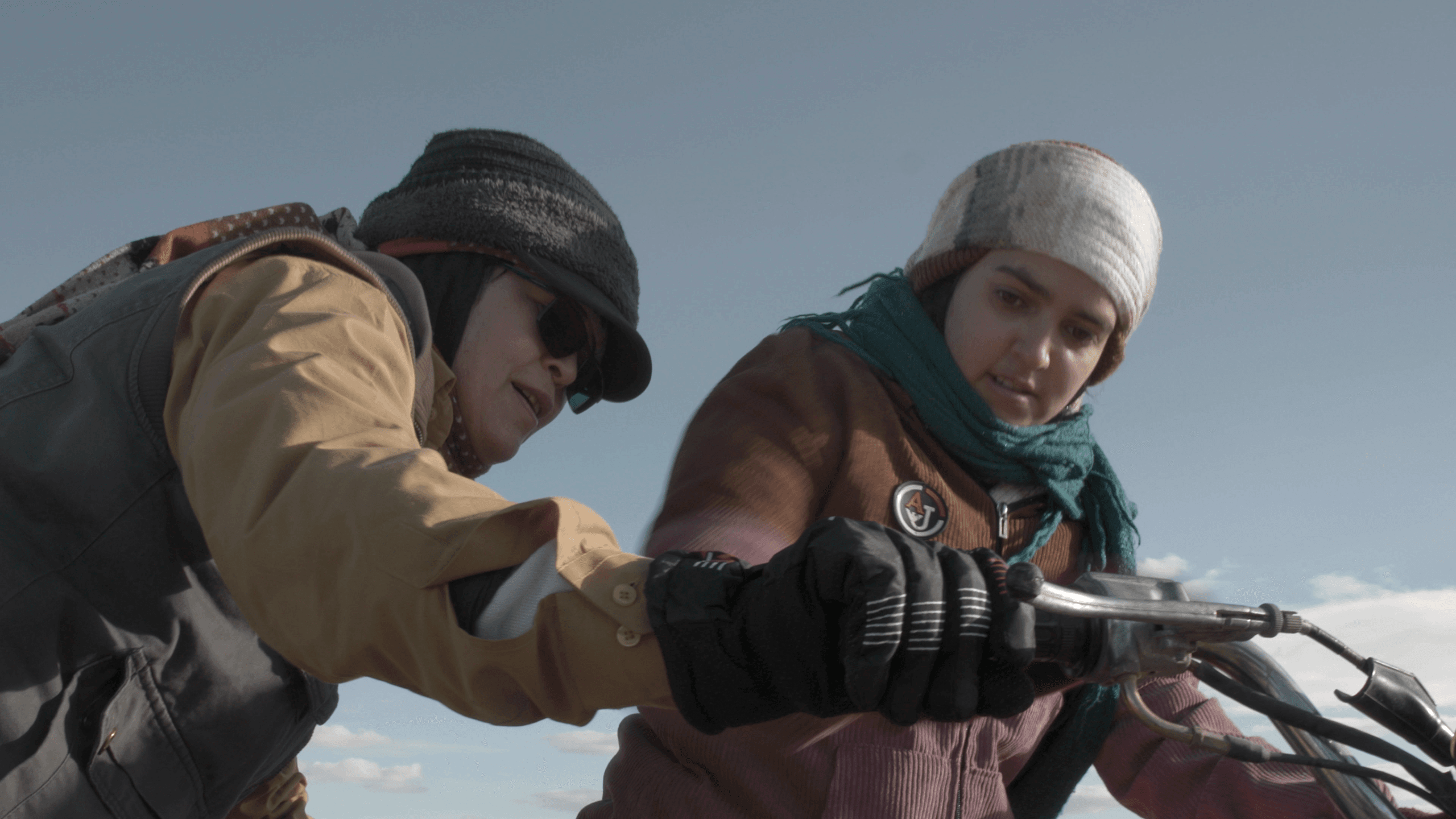
Sara Shahverdi, subject of Sara Khaki and Mohammadreza Eyni’s documentary Cutting Through Rocks, isn’t the stereotype of a rural Iranian woman. Often rocking a fashionable jacket and a ball-cap atop her hijab, Shahverdi is the kind of public facing figure who exudes confidence and tenacity out of every pore. She’s a teacher to some, politician to others, activist to many, and thorn in the side of the those who seek to oppose her. Across eight years spent with Shahverdi, Khaki and Eyni look at someone willing to fight back against the stagnancy of women’s rights in Iran, even if it means facing serious backlash and consequences.
The fourth born daughter of seven siblings (with all of her three brothers the youngest of the kids), Shahverdi was granted access to experiences only young men were privy to in her younger years. Her father taught her the art of construction and how to ride a motorcycle, two things women rarely learned how to do. After Shahverdi’s father died at the age of sixteen, her life took a more traditional trajectory, as she became the family’s sole breadwinner, with her older sisters married and her brothers too young to venture out on their own. She married and became a midwife, delivering over 400 children, driving between births on her trusty motorcycle. Shahverdi would later take the virtually verboten path of getting a divorce, leaving her trade, and becoming an outspoken activist and budding politician.
Cutting Through Rocks starts at this point, with Enyi and Khaki joining Shahverdi as she embarks on a campaign to become the first ever female elected official from her staunchly conservative village in Northwestern Iran. One of the candidates opposing her just happens to be one of her brothers, undoubtedly still miffed that she inserted herself into a family dispute where the family’s men attempted to cut their other sisters out of their inheritance by forcing them to sign an unfavourable agreement. As one might expect from a country steeped in religious customs and traditions, Shahverdi’s candidacy doesn’t appeal to many hardliners and women who don’t want to start trouble, and others question if a female representative can get the job done in such a male dominated field. When Shahverdi gets elected to one of the five open seats and garners the largest number of votes across all candidates, the real work begins.
And that’s also where the toll of the job and the enormity of Shahverdi’s tasks starts to take shape. Cutting Through Rocks starts in an inspirational place, but slowly becomes something more robust and emotionally complex. Shahverdi runs on a platform of several key issues, some pertaining to women directly (abolishing the act of older men taking child brides via arranged marriages, making education easier to access in a place where most girls drop out of school around the ninth grade) and others that better serve the community as a whole (the construction of a new park, ensuring homes are hooked up to a steady source of natural gas). Nothing goes quite the way Shahverdi hopes, but Khaki and Eyni show that amid all the hardship, any incremental gain is a positive one for the people in her community.

Cutting Through Rocks takes a direct cinema approach to its story, spending almost all of its time on the ground with Shahverdi as she goes about her campaigning, teaching, and community outreach. The film would benefit from more context and explanation when it comes to the ins, outs, and structure of Iranian politics, both municipal and federal, but that would break the choices made and stuck to by the filmmakers. There were moments where I felt like I was missing something as a viewer on a contextual and practical level, but I was always keenly attuned to the weight of any given situation because Shahverdi is such a compelling subject and guide to lead an audience through her community. Cutting Through Rocks casts a wide frame to look at what it means to be a woman with some degree of power in Iran, but Khaki and Eyni remain firmly rooted in individual moments and scenarios.
The need for the film to sometimes step away from solely looking at Shahverdi’s experiences and perspective becomes obvious in one of Khaki and Eyni’s most powerful scenes, where a teenager the councilwoman has been mentoring tries to get a divorce from the thirty-something man she’s been married to since the age of eleven. It’s one of the few scenes where Shahverdi isn’t present, but to watch the uncaring magistrate demean this unhappy child bride by saying her marriage is “part of [her] destiny” and glibly saying “it is what it is” speaks volumes to the experiences of women in this village. If Cutting Through Rocks included more moments with those Shahverdi is fighting for, the film would be stronger.
That’s not to say that Cutting Through Rocks doesn’t gain a lot of power as it goes along, especially when it comes to examining the personal struggles of its subject. The empowerment felt in the early going as Shahverdi successfully gains her seat in government gives way to a growing sense that her job will never be an easy one. She constantly has to act as a mediator in situations where male pride and ego grind progress to a halt. She continues her teachings of midwifery and motorcycle riding, much to the chagrin of some more traditional and less accommodating family members. She’s not above raising her voice when it comes to ensuring her vision is being achieved, even if some of her battles can appear like the nitpicking of odd details. The job begins to take a toll on her physical and mental health, and a complaint filed against her by a constituent leads to a major invasion of her privacy that will sicken most viewers.
But as much as Shahverdi is pushed around in her new position, she’s equally adept at pushing back, and even in the darkest moments and in the face of patriarchal consequences, she persists. Cutting Through Rocks is an apt title for a film about someone willing to go against centuries of old world traditions and prejudices, but Khaki and Enyi never sugarcoat the difficulty – and sometimes the danger – of Shahverdi’s mission. This could benefit from some additional external perspective, but as a series of well observed moments that resonate on a level that most viewers will be able to understand, Cutting Through Rocks is worth the struggle.
Cutting Through Rocks opens at TIFF Lightbox in Toronto and VIFF Centre in Vancouver on Friday, December 12, 2025.
