
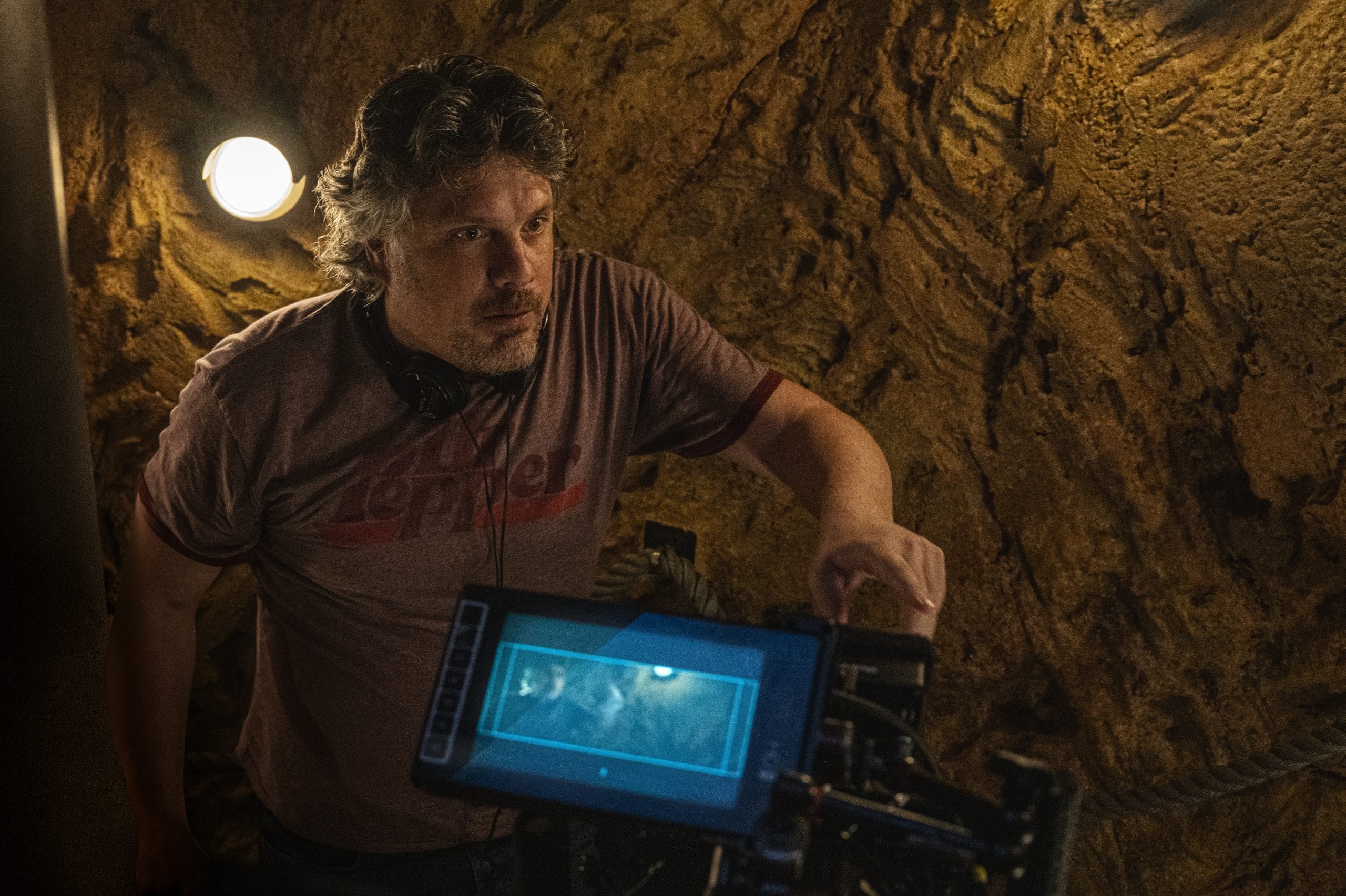
The phone of Primate writer-director Johannes Roberts starts blowing up part way through our interview, somewhat expectedly due to the timing of the conversation. At the exact moment when we were discussing his latest film this past October in a downtown Toronto office (the day after it made its Canadian premiere at the Toronto After Dark Film Festival, where it would pick up the returning annual event’s prize for Best Horror Movie), the first trailer for Primate was made available online. After having seen the entirety of Primate with a crowd and the impact it had on an unsuspecting audience, people texting and leaving messages of congratulations seem perfectly in order.
Primate (which opens in theatres everywhere this weekend after generating considerable buzz on the festival circuit throughout the tail end of 2025) is an intense, gory, slyly humorous creature feature throwback about a chimpanzee run amok. College student Lucy (Johnny Sequoyah) is heading home to Oahu to spend some time with her younger sister, Erin (Gia Hunter), invited friends, and her novelist father (Oscar winning actor Troy Kotsur). In addition to catching up with these loved ones, someone who’s excited to see Lucy is the family’s highly intelligent pet chimpanzee, Ben (played by Miguel Torres Umba in a practical effects suit), who was raised by her late linguistics expert mother. But Ben, who was bitten by a mongoose, isn’t feeling very well and needs to be sequestered to his cage while the young people have a pool party. An increasingly ill Ben turns rabid, escapes, and carries out a violent, bloody, and sustained attack on the hapless partygoers.
It’s the kind of film made for the theatrical experience, and at the start of our talk Roberts (the 47 Meters Down films, The Strangers: Prey at Night) and I have a good laugh about one audience member’s reactions during the Toronto After Dark screening the night before. At one point, when absolutely nothing or note or consequence is happening on screen, the woman sitting next to me (who was complaining to her friends before the film started that she hated horror movies and how she couldn’t believe they talked her into this) audibly gasped so loud that everyone could hear, almost as if she was about to explode into a full on panic. You know a movie is working well on an audience when people are scared even during the downtime between set pieces. It’s a perfect reaction to a horror movie.
These are the kinds of films Roberts excels at crafting and enjoys to make, pointing to director Lewis Teague’s terrifying Stephen King adaptation Cujo – a story about a loving family dog who becomes rabid, terrorizing a mother and child – as a major inspiration for Primate.
“I love single location thrillers,” Roberts says with an enthusiastic grin when talking about his influences. “I have always loved siege movies. I grew up on John Carpenter movies, and he’s one of the best to ever do it. And Cujo, is one of the best single location movies of its kind. I mean, if you break it down, 47 Meters Down is just Cujo with sharks. They’re trapped in a cage instead of a car. (laughs) It’s such a great space to set a horror movie in. I’m just a big kid at heart, and while I never go out of my way to actively nod to people like Carpenter, [Stephen] King, or [William] Friedkin, I do love trying to figure out how they do what they do. I don’t want to wink at the audience, but I do genuinely want to try some of the things they’ve done.”
“In these kinds of movies, you put people in a single, inescapable situation and see how they react,” he continues. “As a storyteller, I love being tested, and figuring out a location, what they have to fight against, and how they’re going to do it is both for for me and for an audience. A film like this makes the audience and me as a filmmaker always think about how these characters are going to do this.”
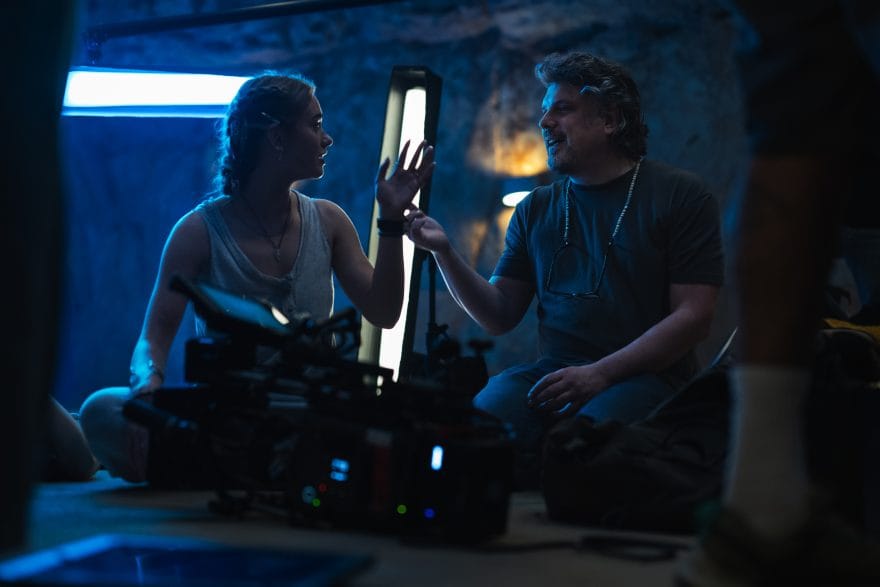
“And that extends to creating the style of the film, too,” Roberts explains when commenting on the challenges of keeping a thriller contained. “Our production designer, Simon Bowles, who did The Descent, which is one of the best examples of this kind of thriller, is a fucking genius. He built everything including Ben’s forest and the cliffs around the house. You need this wonderful sandpit to play in. When the actors are having fun bouncing off of each other, and I’m bouncing off their energy as a filmmaker, the sets and the setting add the extra element to pull everything together. If you have any weak links, then your whole day, whether you’re an actor, technician, or filmmaker, becomes all about having to compensate for what’s missing. With this, it all connects together, and on a film that isn’t a long shoot like this one – which was about five or six weeks – you don’t want to have to keep chasing those things. It’s just rock and roll. It was fun.”
Part of what sets Primate apart from other contemporary monster movies is Roberts’ decision to use practical effects and performers to depict Ben’s descent into madness, something that allows more empathy for the creature before things turn bloody and provides a much needed injection of genuine personality and humanity into the film.
“It’s a fun concept to play with. It’s so much fun to watch with an audience because we really went for it with the set pieces, but there is that moment of turning that I enjoyed working on. Miguel, who is so great at playing the chimpanzee, really make the viewer realize that, for the most part, Ben isn’t good or bad. If I’m making a 47 Meters Down movie, those are sharks, which are dangerous things, but they don’t necessarily need a personality or anything deeper than what they are. In something like this or something like Cujo, you need to know what this creature is ahead of time. I love the moment in the film when Ben hugs Lucy while they’re on the pool deck, and he’s already starting to turn towards this point of no return. He’s already committed some pretty heavy atrocities by this point (laughs), but he tries to bring himself back from the brink. Not to spoil anything that happens after that point, but from there there’s no going back, and it’s more impactful because the viewer has seen everything that has come before.”
“This movie lives or dies on practical effects,” Roberts notes with enthusiasm and glee. “You can’t make this movie and give it the same impact if you’re always leaning on digital effects. The gut reactions that this movie needs have to come from physicality. It’s a very tactile movie. That personality of the character imprints onto everything else around it. Everything bounces off of that, from the cinematography to the performances. Atoms are moving and shaping around each other.”
“The best way to break it down is to look at one of my favourite set pieces – the ‘red bedroom’ scene,” Roberts says talking about a moment where a less than honourable young man meets a painful end at the hands of Ben, a scene that won the award for Best Kill at Toronto After Dark. “If you transcribed it from my script, what you would see is that the scene is pretty much word for word what it is on the page. It’s all there. If you had done that with digital visual effects, you would have to take every aspect of the scene, break it down bit by bit, figure out where everything needs to be moved, changed, tweaked, or whatever, and bit by bit that changes the intent and the impact. There’s no substitute for real reactions. You have [actor] Charlie (Mann) interacting with the chimp, the lighting and the cameras moving with how they’re reacting. The words might be the same, but the space in-between them is where the real action lies, and when you have real actors in a real set with real effects, it becomes something magical. It’s energy.”
Roberts has a love for genre film that shines through at every turn when talking with him, but one of the biggest inspirations for that aforementioned scene of shocking violence isn’t something that one would traditionally classify as a horror movie: filmmaker Gaspar Noe’s controversial and emotionally brutalizing thriller Irreversible.
“I very rarely get shocked by movies. I’ve seen so many horror movies, and there are some that I find disgusting or whatever, but that’s different from being shocked. That’s all, whatever. I can see what they’ve done there, and they’ve done a great job of being unpleasant, but it hasn’t shocked me. But I remember watching Irreversible, which I had missed in the cinemas, and I didn’t know what it was about going in. And at first, I thought from where it started that it was just going to be a bunch of nonsense, and part of me almost turned it off. And then the fire extinguisher sequence happens, and at the time ,I had made the decision to watch it while eating a bowl of Corn Flakes, and I suddenly just had a ‘holy shit’ moment. And that feeling is something that I always had in my mind, particularly when doing the ‘red room’ sequence in this movie. I want to make someone audibly say ‘what the fuck has just happened?’ I mean, that’s not the kind of movie someone would traditionally say is a horror movie, but it’s certainly about horrifying things itself.”
Amid all the chaos, dark humour, and terror in Roberts’ latest is Kotsur, an acclaimed performer many wouldn’t expect to turn up in such a thrill ride movie. One of the most refreshing and original aspects of Primate is the inclusion of a deaf character who interacts with the film’s characters naturally and in American Sign Language without making it seem like a gimmick or plot point (outside of one very clever set piece late in the film). The film meets Kotsur’s character on his own terms as a novelist and distracted father being pulled in several directions at once. It’s another great performance from the actor, but in a film where one might not be expecting to find such work.
“Troy just looks like the kind of person who should be transporting dynamite across the jungle. I’m going to write that movie tonight.” Roberts chuckles, referencing Sorcerer after I noted that Kotsur looks like he would be right at home in a William Friedkin movie. “I like the fact that outside of having fun in a scene where we have it be a disadvantage for some of the other characters – which Troy had so much fun playing – the character being deaf isn’t used as a plot device or some kind of gimmick. This character is accepted and valued for who they are and they’re allowed to converse with everyone as they normally would. There’s no communication breakdowns or anything like that. Everything just keeps moving along. He’s just a dad and a writer, and it just so happens that he’s deaf.”
“I had never worked with a deaf person before meeting with Troy, which came with some nerves at first, but he just has this ability to put you at ease immediately. He’s so quick and thoughtful. He was able to bring twenty years of backstory that I needed to convey about these characters and their bonds simply through his presence alone, and that’s what he brings to the film. You can feel this relationship to his daughters, his late wife, and this chimp, and the means of how that’s communicated by him is something only Troy could provide. People go to these movies to scream and have a good time, but they also need to connect, and I’m so proud to have Troy in the film to provide that.”
Primate opens in theatres everywhere on Friday, January 9, 2026.
