

Although there are some good intentions to be found within the confused melodrama It Ends with Us, they’re lost in a sea of odd choices and mixed messaging. Based on a bestselling novel by Colleen Hoover that took “Book-Tok” by storm, It Ends with Us can’t decide if it wants to be a story about a woman’s slow realization that she’s in an abusive relationship or a tear-jerking romance about “the one that got away.” Settling for a mushy middle ground that reduces both of those interlocking, somewhat laughably convenient stories to their barest essences, It Ends with Us is able to convince the viewer that it’s saying a lot without actually doing much of anything at all.
Lily Bloom (Blake Lively) is a recent Boston transplant from small town Maine who has moved to the big city to pursue her on-the-nose dream of opening a flower shop. Her abusive dad (Kevin McKidd) has recently died, and while her mom (Amy Morton) is grieving, Lily seems to feel a sense of relief. Not long after the funeral, she has a chance encounter with Ryle Kincaid (Justin Baldoni, who also serves as the director), a hunky neurosurgeon. They start a relationship, things blossom, and eventually marry. But over the course of their marriage, the red flags start piling up, and Lily begins to suspect she’s in a relationship that mirrors the one shared by her parents. Further complicating things is the reappearance of Atlas Corrigan (Brandon Sklenar), Lily’s first childhood love – now working as a successful, trendy restaurateur – someone who knows all too well what it’s like to come from an abusive family.
It Ends with Us flashes back and forth between the present and the teenage years of Lily and Atlas, where the characters are played memorably and thoughtfully by Isabela Ferrer and Alex Neustaedter, respectively. The sections where younger Lily and Atlas get to know each other unwittingly steal the show here, providing a perfect bedrock for the story happening in the present timeline while crafting nuanced, likeable protagonists. It feels like a work of genuine and honest love rather than the manufactured drama that makes up the bulk of the story, which can’t figure out if it wants to be taken seriously as a message movie or if it wants to be a frothy beach read with some dark undertones.
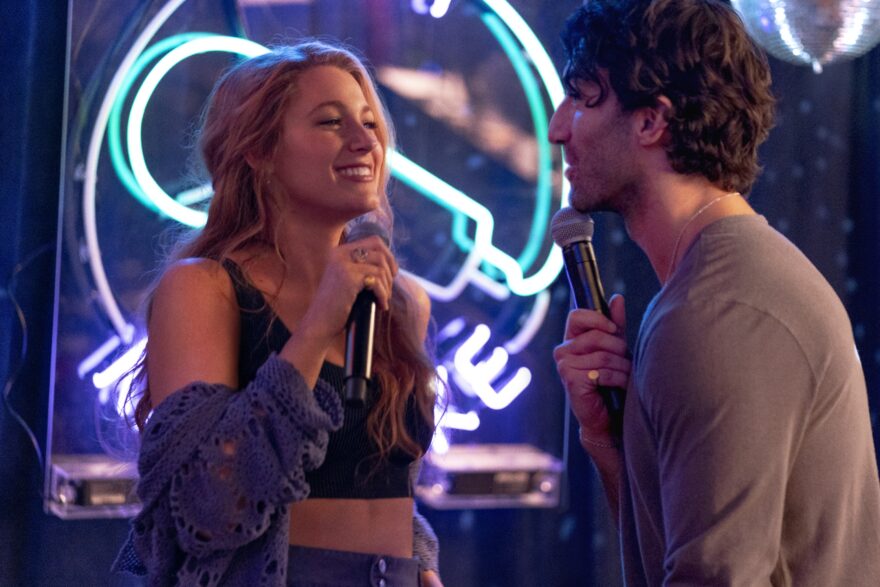
It Ends with Us is all very chaste and PG-13 in its approach to love and domestic violence, never pushing things too far to be shocking or realistic. Baldoni does a fine job at portraying a character who’s more complicated than their actions might suggest (with a groan worthy late film twist attempting to explain away his tempestuous nature), but he’s not bringing anything to the table as a director other than making sure things look credible, if unexceptional. It’s also clear to see that Baldoni and the cast are fighting against some of the book’s worse impulses and notions, with a lot of the cornier aspects (the ridiculous names, the old “noble poor kid makes good” trope, a false sense of being empowering) suppressing the chance to make something more realistic from this material. This is offset somewhat by the occasionally witty script from Christy Hall (Daddio), which has a degree of self-awareness and an ability to poke fun at some of Hoover’s sillier notions.
Things go well enough for awhile, with Lively putting in some great work as a capable woman slowly drowning in a situation that takes some time to understand. There’s good comedic relief from Jenny Slate as Lily’s BFF/Ryle’s brother and Hasan Minhaj as her husband. Layers to the characters emerge organically, and it’s almost admirable how It Ends with Us moves at a slower pace to coax things out of its characters. Not everything happens exactly as one might expect from something this basic and contrived, which does add a degree of pleasing dramatic novelty. It’s cheesy, but there are a lot of things going in the film’s overall favour.
But the difference between a movie sticking the landing and missing the mark can sometimes be a game of inches. While Baldoni, Hall, and Hoover’s attempts to tackle hard subject matter in an attractive package that’s slightly better than its made-for-TV movie counterparts (which do this sort of thing all the time), It Ends with Us glosses over the point where the biggest message should be made. The decision faced by Lily over whether she should leave her husband is botched in its execution, reducing the turmoil many people agonize over when trying to leave an abusive lover. The film is creating characters that have a richness to them, but also refusing to put them into situations that might feel all too real.
Ultimately, that makes It Ends with Us a real cop-out, one that delivers an unhealthy message that having an important talk with an abusive partner means saving that discussion for the most dramatically impactful moment. The film can’t navigate the territory it sets out for once it gets there, and that’s a shame. It could be useful to have a bit of mainstream baiting entertainment tackling a harsh subject head on, but no one involved here wants to do that to any meaningful degree. Unfortunately, the final act of It Ends with Us unravels everything else that was moderately good before it.
It Ends with Us is now playing in theatres everywhere.
