

Pablo Larraín’s Maria isn’t a biopic. It’s a garish fashion show disguised as a funeral. Despite a compelling leading performance from Angelina Jolie as opera legend Maria Callas, Larraín’s latest is a soulless, reductive, and almost insulting cautionary tale that does poorly by its subject and anyone who happens to be watching the film. Maria marks the full on abasement of the sort of biopic Larraín has been cranking out for years now with the likes of Jackie and Spencer, but taken to its ultimate, unfortunate extreme here. And just like with those films, a great performance does not make for an exceptional film.
Maria opens on the day of Callas’ death in September of 1977, flanked by her loyal housekeepers (Pierfrancesco Favino and Alba Rohrwacher), before rewinding a few days to look at the events leading to her tragic end and jumping into several flashbacks to fill in some gaps. For quite some time up to this point, Callas has been struggling. Her voice is failing. She hasn’t performed publicly in years. She’s lonely, missing the love of her life, Aristotle Onassis (Haluk Bilginer, creating another link between Maria and Larraín’s Jackie). She’s heavily self-medicating with the help of her enabler sister (Valeria Golino), and an important meeting with an interviewer (Kodi Smit-McPhee) could be a figment of her own imagination.
And that’s about it. Maria takes the form of a slow march towards death without ever giving the viewer a definitive look into what made Callas such a sensation. Larraín and screenwriter Steven Knight (Spencer, Locke, Peaky Blinders) throw context and nuance to the wind in favour of wallowing in the final days of a fallen star, all while giving Jolie precious little to work with. There are a few scenes where Callas is allowed to show some fire, but for the most part all Jolie is asked to play is decaying glamour. Knight’s tone deaf script allows Callas to speak her thoughts aloud to no one in particular, but whenever characters are forced to interact, all of the dialogue is stripped of its humanity; lugubriously telling the viewer what they need to know like reading items off a list and never imbuing the words with the slightest hint of emotion.
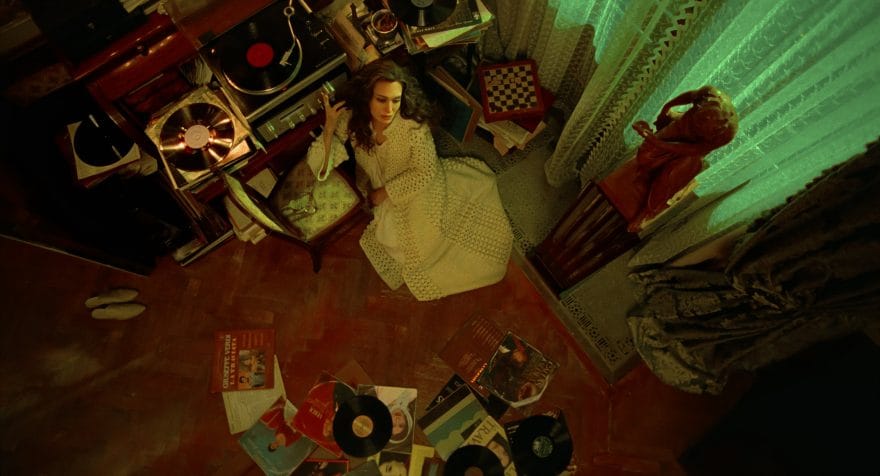
Jolie is trying her absolute best throughout, but she’s limited in what she can explain to the viewer thanks to Larraín and Knight’s narrow, simplistic view of Callas as a person and the events leading to her passing. There’s no subtext to be found, and even less explanation as to how Callas cultivated her talent and ego, two things Maria takes completely for granted outside of fleeting flashbacks to her childhood. The best scenes in Maria don’t even involve Callas, and instead belong to the perspective of Favino and Rohrwacher’s housekeepers, who have insightful conversations about the mental wellbeing of their employer and friend. Favino and Rohrwacher are so great in Maria, one wishes the entire film was from their perspective, and that Jolie was relegated to a supporting role around the periphery.
Maria finds Larraín opulently noodling on about how Callas was treated shabbily in her final days, which again feels like a lesser replication of what he did in Spencer and Jackie, but there’s a lot more gawking and ghoulishness here. Amid all of its unsubtle, heavily telegraphed coyness is a lot of rubbernecking that feels like a further demonization of the final days of a woman in crisis. There’s a memorable scene in here where Callas flips out on a reporter for only reporting on her downfall, but it’s memorable more as a moment of self-sabotage than of empowerment. All Maria does is report on the downfall of Callas, and so little breath and energy is ever devoted to the contrary.
So with the exception of a few flights of fancy where Callas envisions the world performing for her amusement instead of the other way around, Larraín’s film simply sits there, looking pretty and dutifully ticking down the minutes until the inevitable, looping back to the opening and telling the viewer what they already know: that this is a sad story surrounded by wealthy excess, little happiness, and gorgeous European settings. A sense of overwhelming emptiness presides over Maria, but outside of a few great performances, nothing fills that void. There’s no picture painted of Maria Callas as a person, either at the height or her powers or during her troubled final days. This is a film about dying that’s as insightful and deep as a tourism pamphlet.
Maria opens in select theatres, including TIFF Lightbox in Toronto, on Wednesday, November 27, 2024. It will be available to stream on MUBI starting December 11.
